Prevalence of Patellar Tendinopathy and Patellar Tendon Abnormality in Male Collegiate Basketball Players: A Cross-Sectional Study
- PMID: 31424974
- PMCID: PMC6795094
- DOI: 10.4085/1062-6050-70-18
Prevalence of Patellar Tendinopathy and Patellar Tendon Abnormality in Male Collegiate Basketball Players: A Cross-Sectional Study
Abstract
Context: Patellar tendinopathy (PT) is a degenerative condition known to affect athletes who participate in sports such as basketball and volleyball. Patellar tendinopathy is a challenging condition to treat and may cause an athlete to prematurely retire from sport. The prevalence of PT in male collegiate basketball players is unknown.
Objective: To determine the prevalence of PT and patellar tendon abnormality (PTA) in a population of male collegiate basketball players.
Design: Cross-sectional study.
Setting: National Collegiate Athletic Association Divisions II and III, National Association of Intercollegiate Athletics, and Northwest Athletic Conference male collegiate basketball teams were assessed in a university laboratory setting.
Patients or other participants: Ninety-five male collegiate basketball players (age = 20.0 ± 1.7 years).
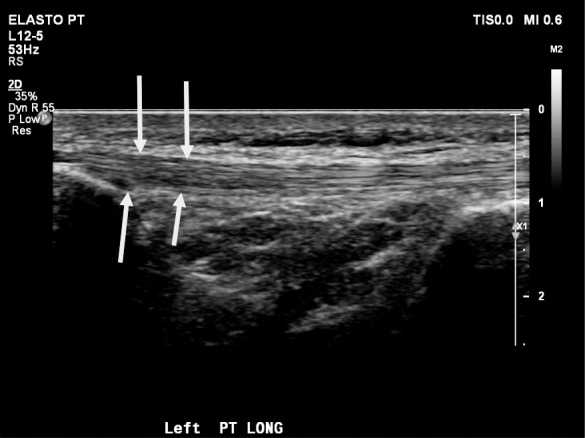
Main outcome measure(s): A diagnostic ultrasound image of an athlete's patellar tendon was obtained from each knee. Patellar tendinopathy was identified based on a player's symptoms (pain with palpation) and the presence of a hypoechoic region on an ultrasonographic image.
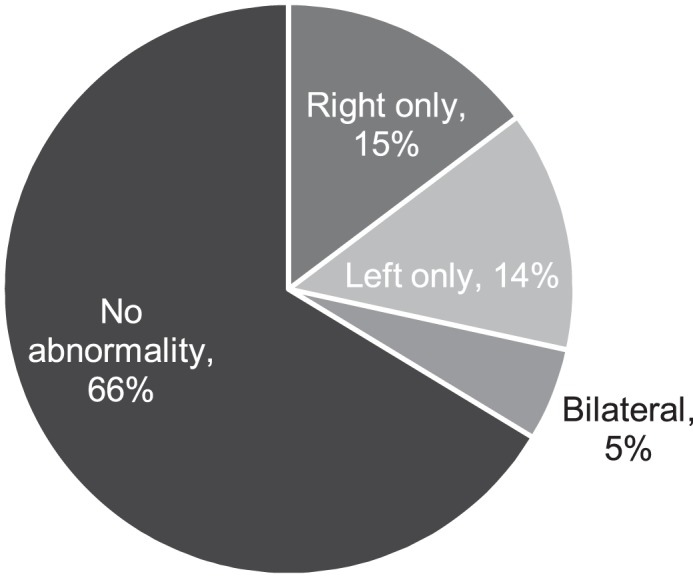
Results: A majority of participants, 53 of 95 (55.8%), did not present with pain during palpation or ultrasonographic evidence of PTA. Thirty-two basketball players (33.7%) displayed ultrasonographic evidence of PTA in at least 1 knee; 20 of those athletes (21.1%) had PT (pain and tendon abnormality). Nonstarters were 3.5 times more likely to present with PTA (odds ratio = 3.5, 95% confidence interval = 1.3, 9.6; P = .017) and 4 times more likely to present with PT (odds ratio = 4.0, 95% confidence interval = 1.1, 14.8; P = .038) at the start of the season.
Conclusions: One in 3 male collegiate basketball players presented with either PT or PTA. Sports medicine professionals should evaluate basketball athletes for PT and PTA as part of a preseason screening protocol.
Keywords: diagnostic ultrasound; jumper's knee; knee.
Figures
References
-
- Malliaras P, Cook J, Purdam C, Rio E. Patellar tendinopathy: clinical diagnosis, load management, and advice for challenging case presentations. J Orthop Sports Phys Ther. 2015;45(11):887–898. - PubMed
-
- Peers KHE, Lysens RJJ. Patellar tendinopathy in athletes: current diagnostic and therapeutic recommendations. Sports Med. 2005;35(1):71–87. - PubMed
-
- Mendonça Lde M, Ocarino JM, Bittencourt NF, Fernandes LM, Verhagen E, Fonseca ST. The accuracy of the VISA-P questionnaire, single-leg decline squat, and tendon pain history to identify patellar tendon abnormalities in adult athletes. J Orthop Sports Phys Ther. 2016;46(8):673–680. - PubMed
MeSH terms
LinkOut - more resources
Full Text Sources
Medical