Review
. 2019 Sep;129(3):762-773.
doi: 10.1213/ANE.0000000000004234.

Fibrinolysis Shutdown in Trauma: Historical Review and Clinical Implications

Affiliations
Review

Fibrinolysis Shutdown in Trauma: Historical Review and Clinical Implications

Hunter B Moore et al. Anesth Analg. 2019 Sep.

Abstract

Despite over a half-century of recognizing fibrinolytic abnormalities after trauma, we remain in our infancy in understanding the underlying mechanisms causing these changes, resulting in ineffective treatment strategies. With the increased utilization of viscoelastic hemostatic assays (VHAs) to measure fibrinolysis in trauma, more questions than answers are emerging. Although it seems certain that low fibrinolytic activity measured by VHA is common after injury and associated with increased mortality, we now recognize subphenotypes within this population and that specific cohorts arise depending on the specific time from injury when samples are collected. Future studies should focus on these subtleties and distinctions, as hypofibrinolysis, acute shutdown, and persistent shutdown appear to represent distinct, unique clinical phenotypes, with different pathophysiology, and warranting different treatment strategies.


Conflict of interest statement

The authors declare no conflicts of interest.

Figures
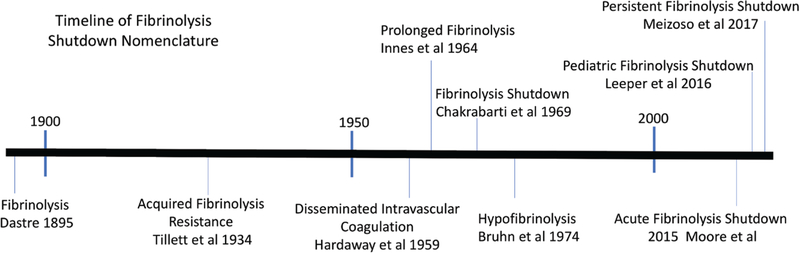
Figure 1.
Figure 1.
Timeline of fibrinolysis nomenclature.
Figure 2.
Figure 2.
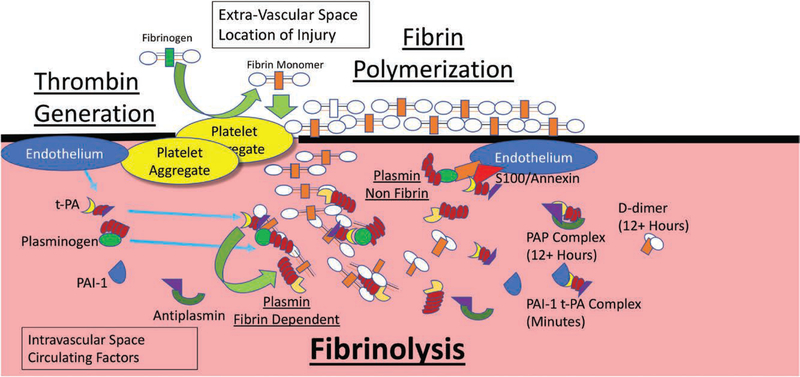
Local regulation of fibrinolysis. The different levels of regulation of fibrinolysis and clot generation at a local level. The vascular wall at the site of injury promotes platelet aggregation and thrombin generation. This results in fibrin polymerization. At the same time, the endothelium is activated to release tissue plasminogen activator (t-PA) via a yet to be defined mechanism. This results in local plasmin activation via t-PA binding to the growing fibrin chain and colocalization of plasminogen. The resulting plasmin cleaves the fibrin chain, exposing more sites for plasminogen and t-PA to bind increasing fibrinolytic activity promoting clot degradation. Plasmin can also be generated in a non–fibrin-mediated fashion away from the site of injury with endothelial surface receptors such as annexin and s100, which colocalize t-PA and plasminogen promoting plasmin generation. This plasmin generation and fibrinolysis is kept in check with circulating proteins that bind and complex t-PA and plasmin (plasminogen activator inhibitor 1 [PAI-1] and α2 antiplasmin). Platelets can also locally release these fibrinolytic inhibitors. Fibrin clot degradation is also regulated by intrinsic clot properties such as fibrin cross-linking and cleavage of lysine residues which were not incorporated due to size. The laboratory assessment of fibrinolysis measures the efferent blood from the site of injury that has mixed with the systemic circulation. D-dimer and plasmin–antiplasmin (PAP) complexes will remain in the circulation for hours after injury while t-PA PAI-1 complexes are cleared in minutes from the liver (although in states of shock duration remains unknown). Measurement of total antigen of these proteins does reflect the activity, as the complex, which cannot generate plasmin, is included in the total antigen measurement. Viscoelastic hemostatic assays (VHA) assessment of blood contains components of the proteases and inhibitors from the site of injury and other remote ischemic organ beds, but not the local injury milieu which has been diluted and altered after it has been through circulation. Neither laboratory technique depicts the local endothelial contribution to clot strength and fibrinolysis.
Figure 3.
Figure 3.
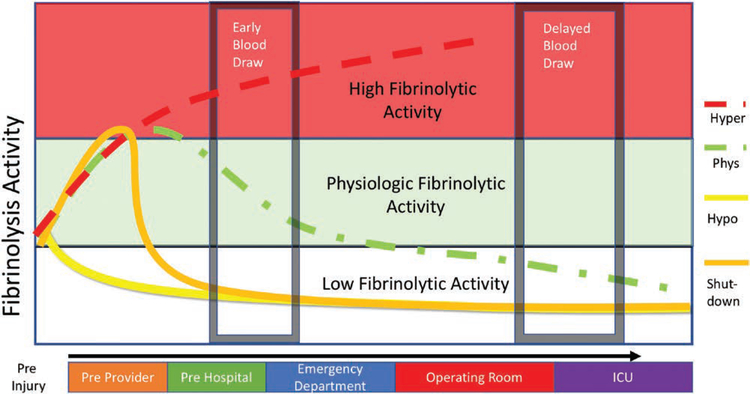
Timing of blood draw and fibrinolysis phenotypes. The theoretical time course of fibrinolysis changes of the various phenotypes of fibrinolysis after severe injury. With severe injury and shock, the expected response is activation of the fibrinolytic system to counterbalance early hypercoagulability. This occurs early after injury and often before prehospital providers arrive on the scene. After initial prehospital resuscitation, the phenotypes of postinjury fibrinolysis emerge. Patients who develop acute fibrinolysis shutdown will have a rapid transition to a low fibrinolytic state, while patients with physiologic fibrinolysis will have a more gradual decline in fibrinolytic activity. The hypofibrinolytic phenotype will have a blunted response to trauma and retain low fibrinolysis activity early after injury. Early blood draws (within hour of injury) can stratify patients into respective phenotypes except for hypofibrinolysis and fibrinolysis shutdown. After resuscitation, all phenotypes converge into a low fibrinolytic state due to a postresuscitation acquired fibrinolysis resistance from plasminogen activator inhibitor 1 (PAI-1) elevation. Patients who have sustained hyperfibrinolytic after initial in-hospital resuscitation efforts are unlikely to be alive several hours after injury. Obtaining blood samples several hours after provides a feedback on successful resuscitation efforts, but differentiating a patient’s initial fibrinolytic phenotype based on viscoelastic hemostatic assays (VHA) is not possible as all prior phenotypes have converged to a fibrinolytic resistant state. This postresuscitation fibrinolytic resistant state is not associated with increased mortality, but the duration that these patients remain in fibrinolysis shutdown predicts adverse outcomes. ICU indicates intensive care unit.

Comment in

References

    1. Kutcher ME, Ferguson AR, Cohen MJ. A principal component analysis of coagulation after trauma. J Trauma Acute Care Surg 2013;74:1223–1229. - PMC - PubMed
    1. Chin TL, Moore EE, Moore HB, et al. A principal component analysis of postinjury viscoelastic assays: clotting factor depletion versus fibrinolysis. Surgery. 2014;156:570–577. - PMC - PubMed
    1. White NJ, Contaifer D Jr, Martin EJ, et al. Early hemostatic responses to trauma identified with hierarchical clustering analysis. J Thromb Haemost. 2015;13:978–988. - PMC - PubMed
    1. Shakur H, Roberts I, Bautista R, et al. ; CRASH-2 trial collaborators. Effects of tranexamic acid on death, vascular occlusive events, and blood transfusion in trauma patients with significant haemorrhage (CRASH-2): a randomised, placebo-controlled trial. Lancet. 2010;376:23–32. - PubMed
    1. Myles PS, Smith JA, Forbes A, et al. ; ATACAS Investigators of the ANZCA Clinical Trials Network. Tranexamic acid in patients undergoing coronary-artery surgery. N Engl J Med. 2017;376:136–148. - PubMed

Publication types

MeSH terms