


Distribution of geographical scale, data aggregation unit and period in the correlation analysis between temperature and incidence of HFRS in mainland China: A systematic review of 27 ecological studies
- PMID: 31425512
- PMCID: PMC6715292
- DOI: 10.1371/journal.pntd.0007688
Distribution of geographical scale, data aggregation unit and period in the correlation analysis between temperature and incidence of HFRS in mainland China: A systematic review of 27 ecological studies
Abstract
Background: Changes in climate and environmental conditions could be the driving factors for the transmission of hantavirus. Thus, a thorough collection and analysis of data related to the epidemic status of hemorrhagic fever with renal syndrome (HFRS) and the association between HFRS incidence and meteorological factors, such as air temperature, is necessary for the disease control and prevention.
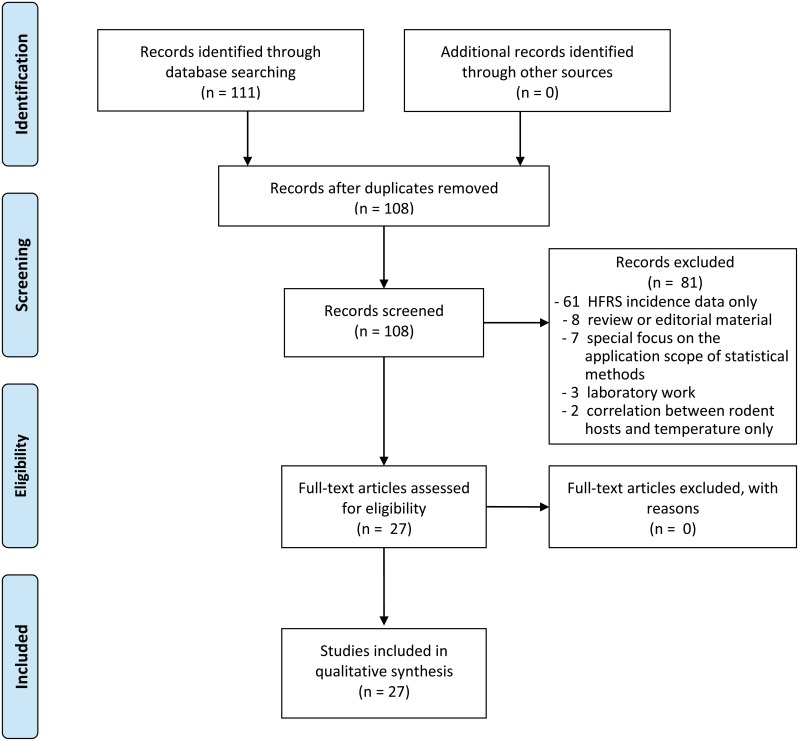
Methods: Journal articles and theses in both English and Chinese from Jan 2014 to Feb 2019 were identified from PubMed, Web of Science, Chinese National Knowledge Infrastructure, Wanfang Data and VIP Info. All identified studies were subject to the six criteria established to ensure the consistency with research objectives, (i) they provided the data of the incidence of HFRS in mainland China; (ii) they provided the type of air temperature indexes; (iii) they indicated the underlying geographical scale information, temporal data aggregation unit, and the data sources; (iv) they provided the statistical analysis method that had been used; (v) from peer-reviewed journals or dissertation; (vi) the time range for the inclusion of data exceeded two consecutive calendar years.
Results: A total of 27 publications were included in the systematic review, among them, the correlation between HFRS activity and air temperature was explored in 12 provinces and autonomous regions and also at national level. The study period ranged from 3 years to 54 years with a median of 10 years, 70.4% of the studies were based on the monthly HFRS incidence data, 21 studies considered the lagged effect of air temperature factors on the HFRS activity and the longest lag period considered in the included studies was 34 weeks. The correlation between HFRS activity and air temperature varied widely, and the effect of temperature on the HFRS epidemic was seasonal.
Conclusions: The present systematic review described the heterogeneity of geographical scale, data aggregation unit and study period chosen in the ecological studies that seeking the correlation between air temperature indexes and the incidence of HFRS in mainland China during the period from January 2014 to February 2019. The appropriate adoption of geographical scale, data aggregation unit, the length of lag period and the length of incidence collection period should be considered when exploring the relationship between HFRS incidence and meteorological factors such as air temperature. Further investigation is warranted to detect the thresholds of meteorological factors for the HFRS early warning purposes, to measure the duration of lagged effects and determine the timing of maximum effects for reducing the effects of meteorological factors on HFRS via continuous interventions and to identify the vulnerable populations for target protection.
Conflict of interest statement
The authors have declared that no competing interests exist.
Figures
References
-
- Chen HX, Qiu FX. Epidemiologic surveillance on the hemorrhagic fever with renal syndrome in China. Chin Med J (Engl). 1993; 106(11):857–63. - PubMed
-
- Song G. Major achievements in the prevention and treatment of epidemic hemorrhagic fever in China. Chinese Journal of Epidemiology. 2000; 21(5):378–82. (Article in Chinese)
-
- He J, Christakos G, Wu J, Cazelles B, Qian Q, Mu D, et al. Spatiotemporal variation of the association between climate dynamics and HFRS outbreaks in Eastern China during 2005–2016 and its geographic determinants. PLoS Negl Trop Dis. 2018; 12(6):e0006554 10.1371/journal.pntd.0006554 - DOI - PMC - PubMed
Publication types
MeSH terms
LinkOut - more resources
Full Text Sources
