


Transcriptome Landscape Variation in the Genus Thymus
- PMID: 31426352
- PMCID: PMC6723042
- DOI: 10.3390/genes10080620
Transcriptome Landscape Variation in the Genus Thymus
Abstract
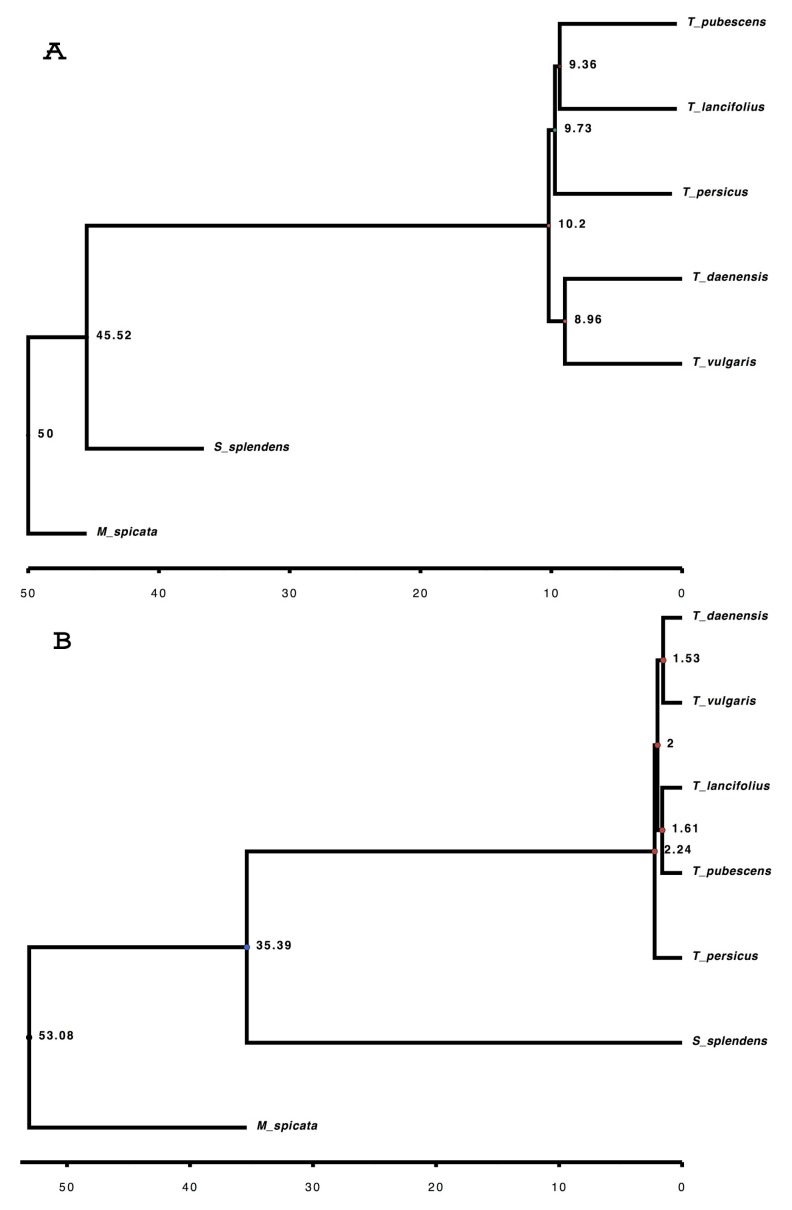
Among the Lamiaceae family, the genus Thymus is an economically important genera due to its medicinal and aromatic properties. Most Thymus molecular research has focused on the determining the phylogenetic relationships between different species, but no published work has focused on the evolution of the transcriptome across the genus to elucidate genes involved in terpenoid biosynthesis. Hence, in this study, the transcriptomes of five different Thymus species were generated and analyzed to mine putative genes involved in thymol and carvacrol biosynthesis. High-throughput sequencing produced ~43 million high-quality reads per sample, which were assembled de novo using several tools, then further subjected to a quality evaluation. The best assembly for each species was used as queries to search within the UniProt, KEGG (Kyoto Encyclopedia of Genes and Genomes), COG (Clusters of Orthologous Groups) and TF (Transcription Factors) databases. Mining the transcriptomes resulted in the identification of 592 single-copy orthogroups used for phylogenetic analysis. The data showed strongly support a close genetic relationship between Thymus vulgaris and Thymus daenensis. Additionally, this study dates the speciation events between 1.5-2.1 and 9-10.2 MYA according to different methodologies. Our study provides a global overview of genes related to the terpenoid pathway in Thymus, and can help establish an understanding of the relationship that exists among Thymus species.
Keywords: Thymus; phylotranscriptome; terpenoid biosynthesis; transcriptome.
Conflict of interest statement
The authors declare no conflict of interest.
Figures
References
-
- World Checklist of Selected Plant Families. [(accessed on 5 August 2018)]; Available online: http://apps.kew.org/wcsp/incfamilies.do.
-
- Harley M.R., Atkins S., Budantsev L.A., Cantino P.D., Conn B.J., Grayer R., Harley M.M., de Kok R., Krestovskaja T., Morales R., et al. In: The Families and Genera of Vascular Plants. Kubitzki K., Kadereit J.W., editors. Volume 6. Springer; Berlin, Germany: 2004. pp. 167–275.
-
- Morales R. The history, botany and taxonomy of the genus Thymus. In: Saez F., editor. Stahl-Biskup. Taylor & Francis; London, UK: 2002. pp. 1–43.
-
- Lajayer H.M., Zakizadeh H., Hamidoghli Y., Bigluei M.H., Chamani E. Ornamental potential and freezing tolerance of six Thymus spp. species as ground-covering plants in the landscape. Zemdirb. Agric. 2018;105:79–88. doi: 10.13080/z-a.2018.105.011. - DOI
-
- Leal F., Taghouti M., Nunes F., Silva A., Coelho A.C., Matos M. Active Ingredients from Aromatic and Medicinal Plants. IntechOpen; Rijeka, Croatia: 2017. Thymus Plants: A Review—Micropropagation, Molecular and Antifungal Activity.
Publication types
MeSH terms
Substances
LinkOut - more resources
Full Text Sources
Miscellaneous
