


Stereotactic ablative radiotherapy for the comprehensive treatment of 4-10 oligometastatic tumors (SABR-COMET-10): study protocol for a randomized phase III trial
- PMID: 31426760
- PMCID: PMC6699121
- DOI: 10.1186/s12885-019-5977-6
Stereotactic ablative radiotherapy for the comprehensive treatment of 4-10 oligometastatic tumors (SABR-COMET-10): study protocol for a randomized phase III trial
Abstract
Background: Stereotactic ablative radiotherapy (SABR) has emerged as a new treatment option for patients with oligometastatic disease. SABR delivers precise, high-dose, hypofractionated radiotherapy, and achieves excellent rates of local control for primary tumors or metastases. A recent randomized phase II trial evaluated SABR in a group of patients with a small burden of oligometastatic disease (mostly with 1-3 metastatic lesions), and found that SABR was associated with benefits in progression-free survival and overall survival. The goal of this phase III trial is to assess the impact of SABR in patients with 4-10 metastatic cancer lesions.
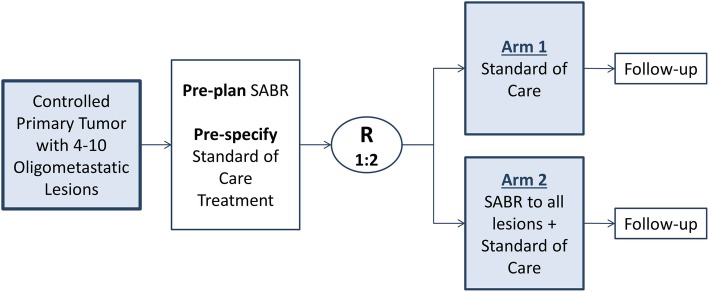
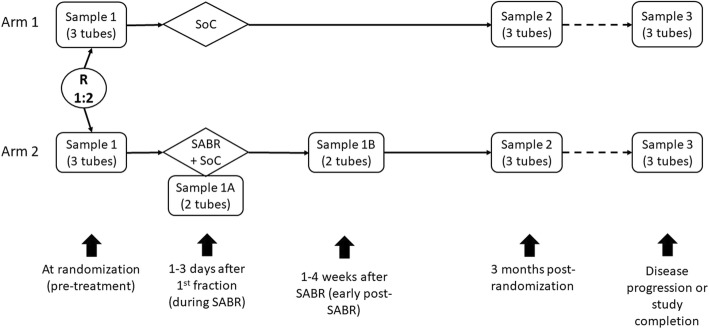
Methods: One hundred and fifty-nine patients will be randomized in a 1:2 ratio between the control arm (consisting of standard of care palliative-intent treatments), and the SABR arm (consisting of standard of care treatment + SABR to all sites of known disease). Randomization will be stratified by two factors: histology (Group 1: prostate, breast, or renal; Group 2: all others), and type of pre-specified systemic therapy (Group 1: immunotherapy/targeted; Group 2: cytotoxic; Group 3: observation). SABR is to be completed within 2 weeks, allowing for rapid initiation of systemic therapy. Recommended SABR doses are 20 Gy in 1 fraction, 30 Gy in 3 fractions, or 35 Gy in 5 fractions, chosen to minimize risks of toxicity. The primary endpoint is overall survival, and secondary endpoints include progression-free survival, time to development of new metastatic lesions, quality of life, and toxicity. Translational endpoints include assessment of circulating tumor cells, cell-free DNA, and tumor tissue as prognostic and predictive markers, including assessment of immunological predictors of response and long-term survival.
Discussion: This study will provide an assessment of the impact of SABR on clinical outcomes and quality of life, to determine if long-term survival can be achieved for selected patients with 4-10 oligometastatic lesions.
Trial registration: Clinicaltrials.gov identifier: NCT03721341 . Date of registration: October 26, 2018.
Keywords: Cancer; Oligometastases; Quality of life; Stereotactic radiotherapy; Survival.
Conflict of interest statement
RO has received grant funding from Varian Medical Systems, unrelated to this research project. DS has received grant funding from Varian Medical Systems Inc, and honoraria from AstraZeneca, Bayer, and Merck, unrelated to this research project. AVL has received honoraria from Varian Medical Systems and AstraZeneca, unrelated to this research project. SSenan has received grant funding from ViewRay and Varian Medical Systems, and honoraria from AstraZeneca, Celgene, and MSD, unrelated to this research project. The other authors declare that they have no competing interests.
Figures
References
-
- Pastorino U, Buyse M, Friedel G, Ginsberg RJ, Girard P, Goldstraw P, Johnston M, McCormack P, Pass H, Putnam JB Jr on behalf of the International Registry of Lung Metastases. Long-term results of lung metastasectomy: prognostic analyses based on 5206 cases. The International Registry of Lung Metastases. J Thorac Cardiovasc Surg. 1997;113(1):37–49. - PubMed
-
- Hong JC, Ayala-Peacock DN, Lee J, Blackstock AW, Okunieff P, Sung MW, Weichselbaum RR, Kao J, Urbanic JJ, Milano MT, et al. Classification for long-term survival in oligometastatic patients treated with ablative radiotherapy: a multi-institutional pooled analysis. PLoS One. 2018;13(4):e0195149. doi: 10.1371/journal.pone.0195149. - DOI - PMC - PubMed
-
- Palma D, Salama S, Lo S, Senan S, Treasure T, Govinden R, Weichselbaum R. The oligometastatic state – separating truth from wishful thinking. Nat Rev Clin Oncol. 2014; Accepted in press. - PubMed
Publication types
MeSH terms
Substances
Associated data
Grants and funding
LinkOut - more resources
Full Text Sources
Medical
