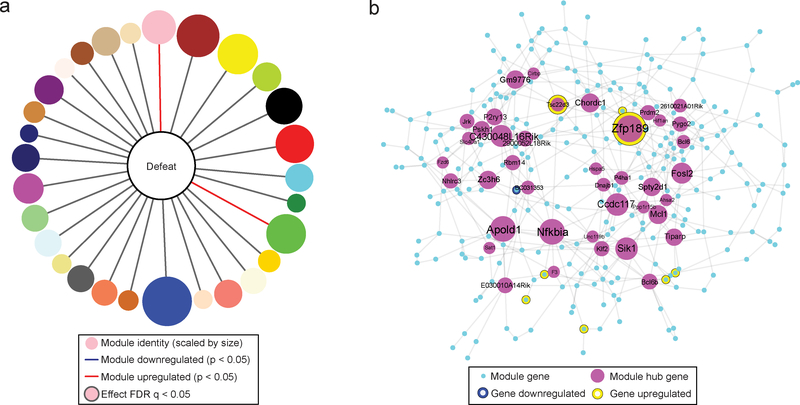
. 2019 Sep;22(9):1413-1423.
doi: 10.1038/s41593-019-0462-8. Epub 2019 Aug 19.

Stress resilience is promoted by a Zfp189-driven transcriptional network in prefrontal cortex

Affiliations

Stress resilience is promoted by a Zfp189-driven transcriptional network in prefrontal cortex

Zachary S Lorsch et al. Nat Neurosci. 2019 Sep.

Abstract

Understanding the transcriptional changes that are engaged in stress resilience may reveal novel antidepressant targets. Here we use gene co-expression analysis of RNA-sequencing data from brains of resilient mice to identify a gene network that is unique to resilience. Zfp189, which encodes a previously unstudied zinc finger protein, is the highest-ranked key driver gene in the network, and overexpression of Zfp189 in prefrontal cortical neurons preferentially activates this network and promotes behavioral resilience. The transcription factor CREB is a predicted upstream regulator of this network and binds to the Zfp189 promoter. To probe CREB-Zfp189 interactions, we employ CRISPR-mediated locus-specific transcriptional reprogramming to direct CREB or G9a (a repressive histone methyltransferase) to the Zfp189 promoter in prefrontal cortex neurons. Induction of Zfp189 with site-specific CREB is pro-resilient, whereas suppressing Zfp189 expression with G9a increases susceptibility. These findings reveal an essential role for Zfp189 and CREB-Zfp189 interactions in mediating a central transcriptional network of resilience.


Conflict of interest statement

Competing Interests Statement

All authors declare no competing interests.

Figures
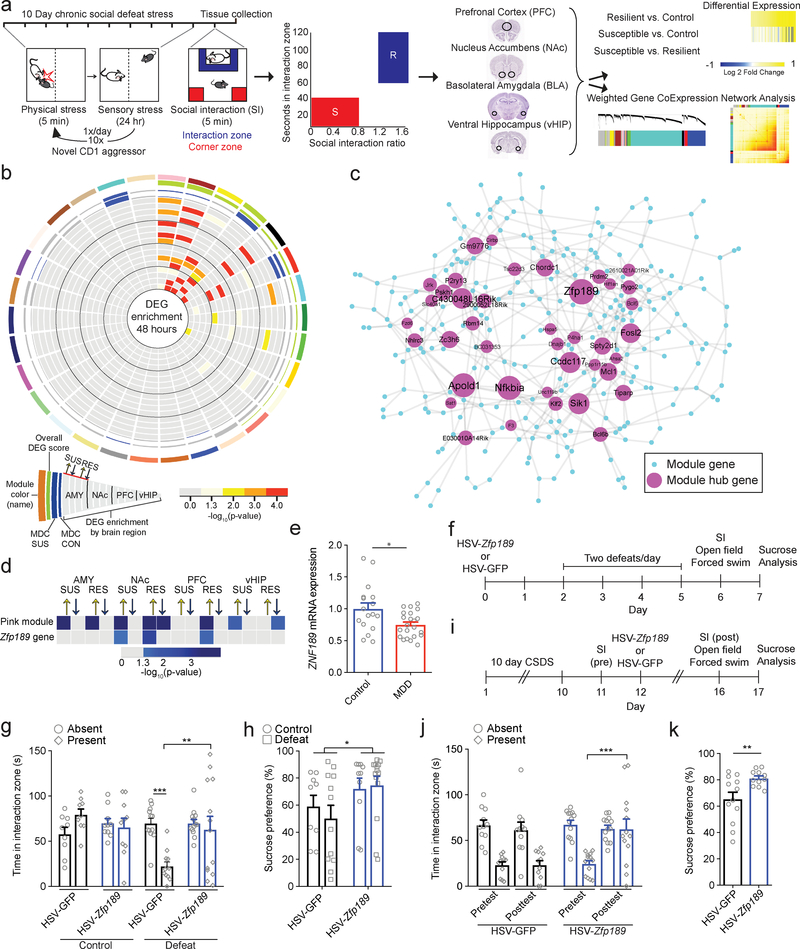
Fig 1.
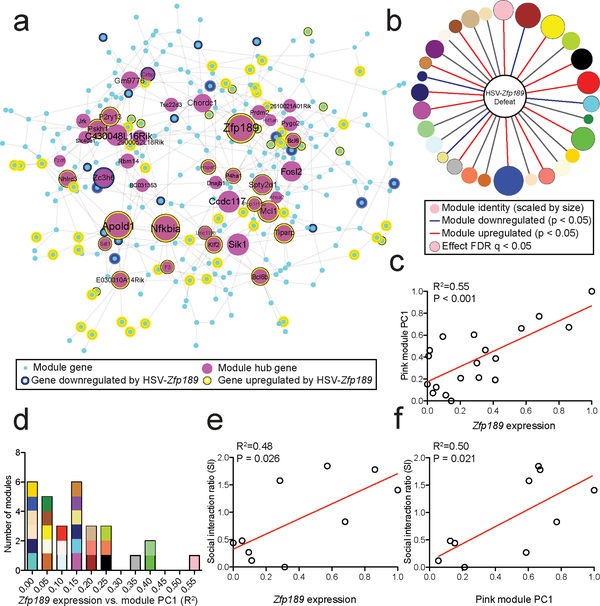
Fig 1.. Identification of the resilient-specific pink module and its pro-resilient top key driver Zfp189
a) Overview of chronic social defeat stress (CSDS) protocol, social interaction test (SI) phenotyping, brain dissections, and RNA-sequencing analysis of four brain regions, prefrontal cortex (PFC), nucleus accumbens (Nac), basolateral amygdala (BLA) and ventral hippocampus (vHIP), used to identify resilient-specific transcriptional networks. b) Resilient modules (colored bars) identified by weighted gene co-expression network analysis (WGCNA). Modules, named with an arbitrary color (outer most ring) are ranked clockwise by overall differentially expressed gene (DEG) enrichment (p < 0.05, FC > 1.3). Phenotype specificity as determined by resilient module differential connectivity (MDC) in susceptible and control networks and DEG enrichment is displayed internally. Presence of MDC color denotes statistical significance (FDR q < 0.05). DEG enrichments are scaled by -log10(p-value) with only significant (p < 0.05) enrichments featured in color. The pink module (top) is the only module that shows DEGs across brain regions and MDC when compared to both susceptible and control mice. Modules were generated from n=44 RNA-seq libraries consisting of pooled brain samples with DEG enrichment assessed via a Fisher’s exact test with Benjamini-Hochberg FDR correction for multiple comparisons as indicated. c) Network structure of the pink module. Key drivers are featured and scaled in size according to number of connections in the network. Zfp189 is the top key driver gene. d) Correspondence between differential expression for the individual Zfp189 transcript and DEG enrichment for the pink module as a whole across phenotypes and brain areas. DEG enrichments are scaled by -log10(p-value) with only significant (p < 0.05) enrichments featured in color. In PFC, both Zfp189 and the pink module are only affected in animals resilient to CSDS (both upregulated). e) mRNA of ZNF189, the human ortholog of Zfp189, is reduced in post-mortem PFC from major depressive disorder (MDD) patients (two-tailed Mann Whitney, U = 110.0, p = 0.0291, n=17,22). f) Experimental timeline to characterize behavioral effects of virally overexpressing Zfp189 in PFC prior to CSDS. g) Pro-resilient behavioral effects of Zfp189 in SI. Mice injected intra-PFC with HSV-Zfp189 and exposed to CSDS spend more time in the interaction zone when a target mouse present than defeated HSV-GFP mice (mixed model ANOVA, interaction F1,40 = 8.501, p = 0.006, n=9,10,12,13 mice, Bonferroni post-test p < 0.01). h) Mice overexpressing Zfp189 in PFC have an elevated preference for sucrose relative to HSV-GFP mice (two-way ANOVA, F1,41 = 5.102, p = 0.029, n=9,12,10,14 mice). i) Experimental timeline to determine behavioral effects of overexpressing Zfp189 in PFC in CSDS-susceptible mice. j) Zfp189 reverses depression-like social withdrawal in susceptible mice. Susceptible mice injected intra-PFC with HSV-Zfp189 spend more time in the interaction zone when the target mouse is present in the post-injection post-test than the pre-injection pretest, but HSV-GFP injection does not change behavior (mixed model ANOVA, interaction F1,23 = 5.634, p = 0.026, n=11 HSV-GFP and 13 HSV-Zfp189 mice, Bonferroni post-test p < 0.001). k) Previously susceptible mice injected with HSV-Zfp189 have a higher sucrose preference than previously susceptible mice injected with HSV-GFP (two-tailed Mann Whitney, U = 29.0, p = 0.025, n=11,12 mice). *p < 0.05, **p < 0.01, ***p < 0.001. Bar graphs show mean ± SEM.
Fig. 2.
Fig. 2.. Antidepressant-like effects of Zfp189 associate with pink module expression changes
a) Pink module genes are differentially expressed (p < 0.05, log2FC > |0.2|) in PFC following reversal of susceptibility with HSV-Zfp189. n=10 RNA-seq libraries consisting of unpooled PFC from 5 stressed HSV-GFP and 5 stressed susceptible to resilient HSV-Zfp189 mice. b) Module-wide enrichment for HSV-Zfp189 overexpression in PFC in previously susceptible mice. Enrichment is determined via multinomial logistic regression with Benjamini-Hochberg FDR correction for multiple comparisons as indicated. c) Variations in Zfp189 predict the first principal component of pink module expression. Linear regression, n = 19 RNA-seq libraries consisting of unpooled PFC from 5 stressed HSV-GFP, 4 unstressed HSV-GFP, 5 stressed susceptible to resilient HSV-Zfp189 and 5 unstressed HSV-Zfp189 mice. d) Histogram of the coefficient of determination (R2) from linear regression analysis examining the relationship between Zfp189 expression and the first principal component of each resilient module (modules are plotted accordingly and represented by color). Of all resilient modules, Zfp189 shows the strongest regulation of the pink module. e-f) Linear regression showing a positive relationship between resilient behavior and (e) Zfp189 levels in PFC of each mouse and (f) pink module expression (n=10 RNA-seq libraries consisting of 5 stressed HSV-GFP and 5 stressed susceptible to resilient HSV-Zfp189 mice).
Fig 3.
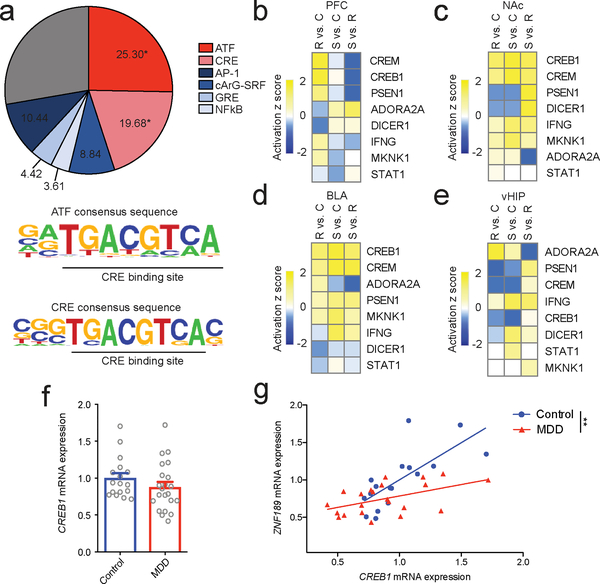
Fig 3.. CREB is an upstream regulator of the pink module
a) Binding motifs overrepresented (FDR q < 0.05) in the pink module (colored pink) with common non-overrepresented motifs (colored blue) included for comparison (top). Both significantly overrepresented binding motifs contain a CRE site (bottom). b-e) Upstream regulator analysis of transcriptional changes in pink module genes. CREB is an upstream regulator across brain regions and is predicted to be upregulated in resilience in PFC. f) mRNA levels of CREB1 in PFC from MDD patients and matched controls (two-tailed t test, t= 1.216, p = 0.232, n=17,22 mice). g) CREB1 and ZNF189 are correlated in the PFC of controls to a greater extent than in MDD subjects (ANCOVA, F1,35 = 7.702, p = 0.009, n = 17 control and 22 MDD). **p < 0.01. Bar graphs show mean ± SEM.
Fig. 4.
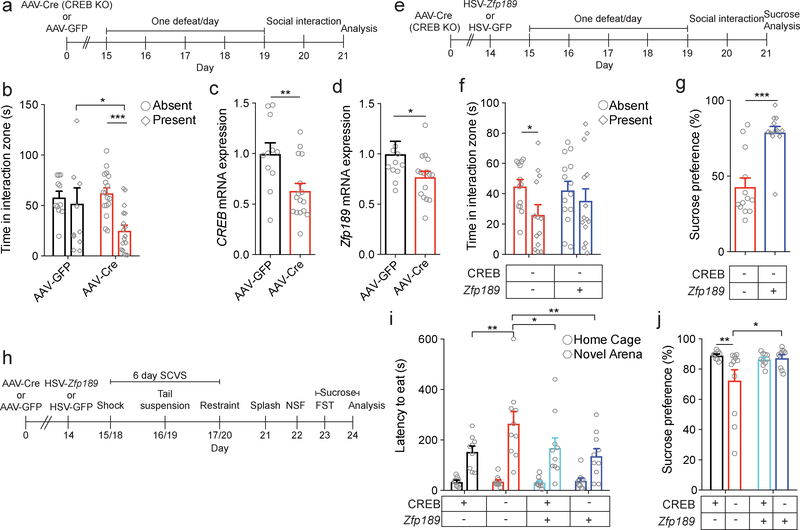
Fig. 4.. CREB knockout (KO) in PFC increases susceptibility but is rescued by Zfp189 overexpression
a) Experimental timeline to evaluate behavioral effects of CREB KO in PFC. b) Local KO of CREB in PFC produces social avoidance in SI in a subthreshold social defeat procedure (mixed model ANOVA, interaction F1,26 = 4.656, p = 0.040, n=11,17 mice, Bonferroni post-test p < 0.001). c-d) CREB KO reduces mRNA levels of (c) Creb1 (two-tailed t test, t = 2.974, p = 0.006) and (d) Zfp189 (two-tailed Mann-Whitney, U = 45.0, p = 0.036), n=11,16 mice. e) Experimental timeline to determine whether Zfp189 overexpression in PFC reverses the deleterious effects of CREB KO. f) CREB KO in PFC produces social avoidance in the SI test but concurrent overexpression of Zfp189 reverses this deficit (mixed model ANOVA, target F1,25 = 5.690, p = 0.025, n=13,14 mice, Bonferroni post-test p < 0.05). g) Overexpression of Zfp189 in PFC increases sucrose preference in CREB KO mice (two-tailed t test, t = 5.176, p < 0.001, n=13 mice). h) Experimental schematic for female sub-chronic variable stress (SCVS) to investigate behavioral effects of CREB KO and Zfp189 overexpression in PFC. i) CREB KO in PFC increases latency to eat in the novel arena, but not when CREB KO is paired with Zfp189 overexpression (mixed model ANOVA, interaction F1,35 = 5.301, p = 0.027, n=9,11,10,10 mice, Bonferroni post-test compared to CREBZfp189- in novel arena, p < 0.01 for CREB+Zfp189-, p < 0.01 for CREBZfp189+, and p < 0.05 for CREB+Zfp18+). j) Mice with local KO of CREB in PFC have a lower sucrose preference than control mice, an effect blocked by concurrent Zfp189 overexpression (Kruskall-Wallis test, χ2(3) = 8.475, p = 0.037, n=9,11,10,10 mice, two-tailed Mann-Whitney post-test p = 0.009 for local KO of CREB and p = 0.029 for overexpression of Zfp189 with concurrent CREB KO). *p < 0.05, **p < 0.01, ***p < 0.001. Bar graphs show mean ± SEM.
Fig 5.
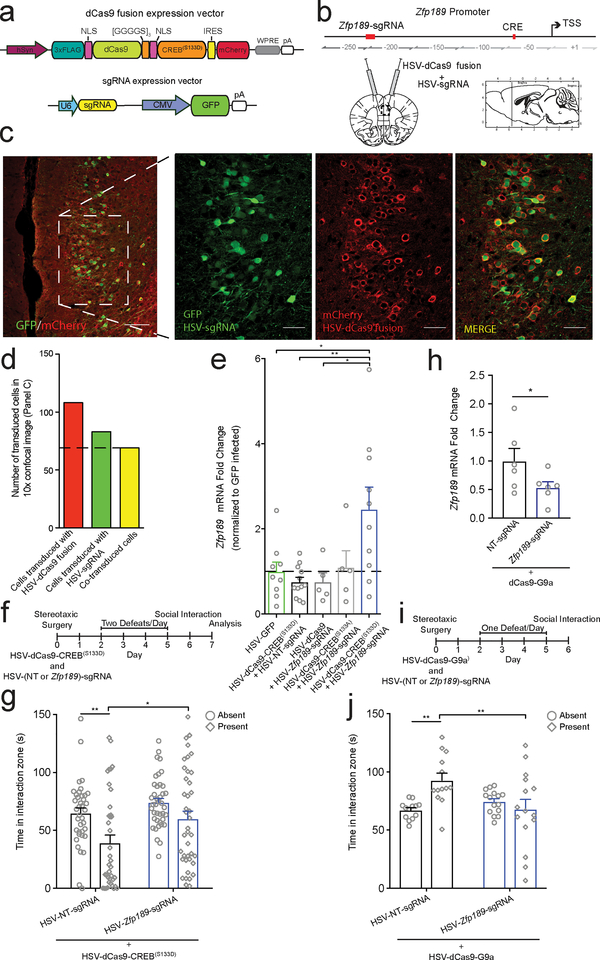
Fig 5.. CRISPR-mediated, locus-specific modulation of Zfp189 with CREB or G9a bidirectionally controls resilient behavior
a) Schematic of the CRISPR vectors. Variable dCas9 functional moiety in orange. Variable gene-targeting single guide RNA (sgRNA) in yellow. b) Location of Zfp189-targeting sgRNA binding site relative to other features in the Zfp189 promoter (in red). CRISPR vectors were packaged in HSV and delivered as a viral cocktail bilaterally to PFC. Hashed box denotes field of confocal imaging for Panel C, left. c) Immunohistological staining shows high degree of colocalization of HSV-sgRNA expression vector (GFP) and HSV-dCas9 fusion expression vector (mCherry) in PFC neurons. Left: 10x objective, scale bar = 100 μm. Right: 20x objective, scale bar = 50 μm. Repeated with similar results in three animals. d) Quantification of virus colocalization. e) CRISPR-mediated targeting of active, pseudo-phosphorylated CREB(S133D) to Zfp189 is sufficient to increase mRNA expression in PFC relative to HSV-GFP, un-targeted dCas9-CREBS133D, and dCas9 with no functional domain targeted to Zfp189 (Kruskall-Wallis test, χ2(5) = 10.27, p = 0.036, n=9,12,5,5,19 mice, two-tailed Mann-Whitney post-test p = 0.035, p = 0.004, and p = 0.040 respectively). Targeting dominant negative CREB(S133A) to Zfp189 has no effect. f) Experimental timeline to determine effect of CRISPR-mediated placement of CREB at the Zfp189 promoter in PFC neurons. g) Pro-resilient effects of CRISPR-dependent CREB-Zfp189 interactions. dCas9-CREBS133D delivered with Zfp189-targeting sgRNA increases time in the interaction zone when a target mouse is present relative to dCas9-CREBS133D with non-targeted (NT) sgRNA (Mixed model ANOVA, virus F1,76 = 6.235, p = 0.015, n=38,40 mice, Bonferroni post-test p < 0.05). h) Targeting dCas9 with G9a to the Zfp189 promoter reduces Zfp189 expression (two-tailed t test, t = 2.835, p = 0.037, n=6 mice). i) Experimental timeline to determine effect of CRISPR-mediated localization of G9a to the Zfp189 promoter in PFC neurons. j) Pro-susceptible effects Zfp189-targeted repression with G9a. dCas9-G9a delivered with Zfp189-targeting sgRNA decreases time in the interaction zone when a target mouse is present relative to dCas9-G9a with non-targeted (NT) sgRNA (Mixed model ANOVA, interaction F1,26 = 9.844, p = 0.0042, n=13,15 mice, Bonferroni post-test p < 0.01). *p < 0.05, **p < 0.01. Bar graphs show mean ± SEM.
Fig 6.
Fig 6.. CRISPR-mediated induction of CREB-Zfp189 interactions activates the pink module
a) Module overlap for PFC DEGs (p < 0.05, log2FC > |0.2|) resulting from Zfp189-targeted dCas9-CREB(S133D) compared to NT-dCas9-CREB(S133D) in mice exposed to social defeat. Enrichment is determined via multinomial logistic regression with Benjamini-Hochberg FDR correction for multiple comparisons as indicated. b) Pink module genes differentially expressed in defeated mice (p < 0.05, log2FC > |0.2|). n=20 RNA-seq libraries consisting of unpooled samples from 8 Zfp189-targeted dCas9-CREB(S133D) and 12 NT-dCas9-CREB(S133D) mice.

Comment in

  • Resilient networking.
    Wrighton KH. Wrighton KH. Nat Rev Neurosci. 2019 Nov;20(11):646-647. doi: 10.1038/s41583-019-0219-0. Nat Rev Neurosci. 2019. PMID: 31511656 No abstract available.

References

    1. Berton O et al. Essential role of BDNF in the mesolimbic dopamine pathway in social defeat stress. Science 311, 864–868 (2006). - PubMed
    1. Krishnan V et al. Molecular Adaptations Underlying Susceptibility and Resistance to Social Defeat in Brain Reward Regions. Cell 131, 391–404 (2007). - PubMed
    1. Bagot RC et al. Circuit-wide Transcriptional Profiling Reveals Brain Region-Specific Gene Networks Regulating Depression Susceptibility. Neuron 90, 969–983 (2016). - PMC - PubMed
    1. Maschietto M et al. Co-expression network of neural-differentiation genes shows specific pattern in schizophrenia. BMC Med. Genomics 8, 23 (2015). - PMC - PubMed
    1. Yue Z et al. Repositioning drugs by targeting network modules: a Parkinson’s disease case study. BMC Bioinformatics 18, 532 (2017). - PMC - PubMed

Methods-only references

    1. Neve RL, Neve KA, Nestler EJ & Carlezon WAJ Use of herpes virus amplicon vectors to study brain disorders. Biotechniques 39, 381–391 (2005). - PubMed
    1. Hsu PD et al. DNA targeting specificity of RNA-guided Cas9 nucleases. Nat. Biotechnol 31, 827–832 (2013). - PMC - PubMed
    1. Hamilton PJ, Lim CJ, Nestler EJ & Heller EA Viral Expression of Epigenome Editing Tools in Rodent Brain Using Stereotaxic Surgery Techniques. Methods Mol. Biol 1767, 205–214 (2018). - PMC - PubMed
    1. Wang F et al. RNAscope: a novel in situ RNA analysis platform for formalin-fixed, paraffin-embedded tissues. J. Mol. Diagn 14, 22–29 (2012). - PMC - PubMed
    1. Kim D, Langmead B & Salzberg SL HISAT: a fast spliced aligner with low memory requirements. Nat. Methods 12, 357–360 (2015). - PMC - PubMed

Publication types