Review
. 2019 Aug 2:10:972.
doi: 10.3389/fphys.2019.00972. eCollection 2019.

Insect Odorscapes: From Plant Volatiles to Natural Olfactory Scenes

Affiliations
Review

Insect Odorscapes: From Plant Volatiles to Natural Olfactory Scenes

Lucie Conchou et al. Front Physiol. .

Abstract

Olfaction is an essential sensory modality for insects and their olfactory environment is mostly made up of plant-emitted volatiles. The terrestrial vegetation produces an amazing diversity of volatile compounds, which are then transported, mixed, and degraded in the atmosphere. Each insect species expresses a set of olfactory receptors that bind part of the volatile compounds present in its habitat. Insect odorscapes are thus defined as species-specific olfactory spaces, dependent on the local habitat, and dynamic in time. Manipulations of pest-insect odorscapes are a promising approach to answer the strong demand for pesticide-free plant-protection strategies. Moreover, understanding their olfactory environment becomes a major concern in the context of global change and environmental stresses to insect populations. A considerable amount of information is available on the identity of volatiles mediating biotic interactions that involve insects. However, in the large body of research devoted to understanding how insects use olfaction to locate resources, an integrative vision of the olfactory environment has rarely been reached. This article aims to better apprehend the nature of the insect odorscape and its importance to insect behavioral ecology by reviewing the literature specific to different disciplines from plant ecophysiology to insect neuroethology. First, we discuss the determinants of odorscape composition, from the production of volatiles by plants (section "Plant Metabolism and Volatile Emissions") to their filtering during detection by the olfactory system of insects (section "Insect Olfaction: How Volatile Plant Compounds Are Encoded and Integrated by the Olfactory System"). We then summarize the physical and chemical processes by which volatile chemicals distribute in space (section "Transportation of Volatile Plant Compounds and Spatial Aspects of the Odorscape") and time (section "Temporal Aspects: The Dynamics of the Odorscape") in the atmosphere. The following sections consider the ecological importance of background odors in odorscapes and how insects adapt to their olfactory environment. Habitat provides an odor background and a sensory context that modulate the responses of insects to pheromones and other olfactory signals (section "Ecological Importance of Odorscapes"). In addition, insects do not respond inflexibly to single elements in their odorscape but integrate several components of their environment (section "Plasticity and Adaptation to Complex and Variable Odorscapes"). We finally discuss existing methods of odorscape manipulation for sustainable pest insect control and potential future developments in the context of agroecology (section "Odorscapes in Plant Protection and Agroecology").

Keywords: insect olfaction; landscape; odorscape; olfactome; plant volatiles; plant-insect interaction; sensory ecology; volatilome.


Figures
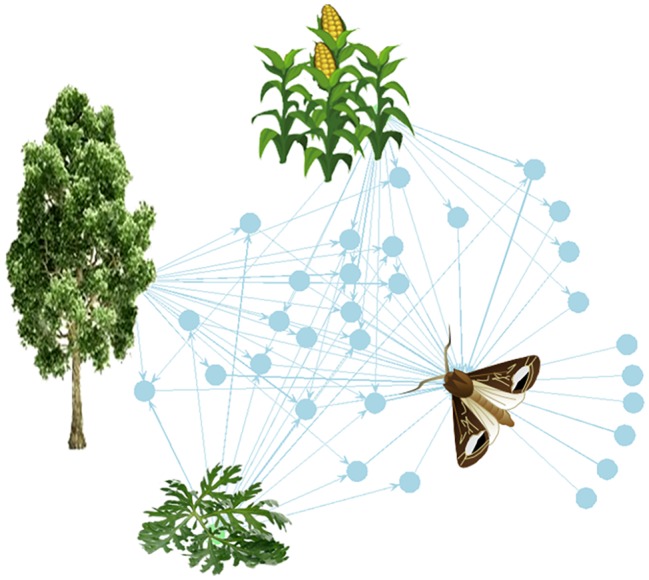
Figure 1
Figure 1
The plant-VPC-insect network. The complex odorscape of a moth (Agrotis ipsilon) shown as a communication network between plants, VPCs, and insect spaces. The network graph is based on the chemical analyses of plant VPCs and recordings of EAG responses from the literature (Greiner et al., 2002; Jerkovic et al., 2003; Degen et al., 2004; McCormick et al., 2014). It has been drawn using the R package “network” (R Core Team, 2013). The plant species release VPCs (blue spots) that are detected by the olfactory system of the moth. The information contained in VPCs circulates from the plants to the insect (blue arrows). Each plant emits a variety of VPCs and one VPC can be produced by different plant species. For simplification, the VPCs not detected by the moth have been omitted. The olfactory system of the moth detects VPCs released by its host plant, maize, as well as by companion plants, such as a weed (Artemisia vulgaris) and trees surrounding the fields (Populus nigra). Most of the VPCs are shared between two or three plants. This simplified network does not take into account the intensity of the emissions, which can largely differ among VPCs released by a same plant, and moreover varies according to the biomass of individual plants and of the whole plant communities.
Figure 2
Figure 2
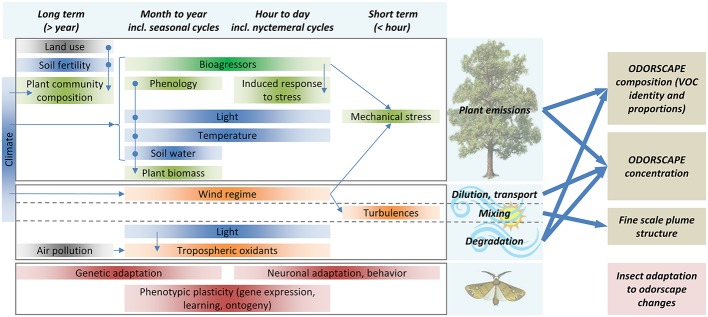
Odorscapes are highly variable at a diversity of time scales. The left part of this chart depicts the factors that determine volatile emissions by plants (top), atmospheric processes (middle), and the processes by which insects can adapt to changes in their olfactory environment (bottom), classified horizontally by the time scale at which they act or vary. Thin arrows depict indirect impacts, through influence on another factor. Box color: dark blue = climate and soil factors, green = plant physiology and ecology, orange = atmospheric physico-chemistry, brown = insect adaptation processes, gray = anthropic factors. Although this is not represented for readability issues, extremes of most climate and soil factors do cause stress responses in plants. VOC sources other than plants (especially anthropogenic VOC) are ignored. On the right side, thick arrows depict how plant emissions and atmospheric processes determine the characteristics of the odorscape.
Figure 3
Figure 3
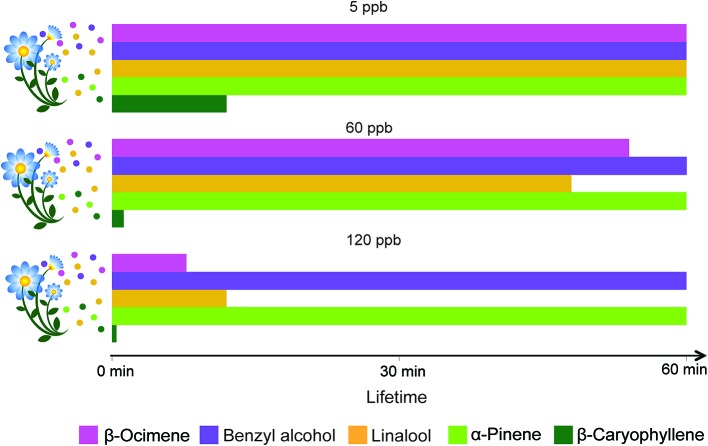
Effect of ozone concentration on odor plume composition over time. Lifetimes in the atmosphere, measured up to 60 min, of volatiles emitted commonly by flowers (β-ocimene, benzyl alcohol, and linalool) and by leaves (linalool, α-pinene and β-caryophyllene) are presented under the influences of the O3 levels indicated above the histograms. The degree of O3 reactivity is based on the structural properties of the VPCs (Atkinson and Arey, 2003).
Figure 4
Figure 4
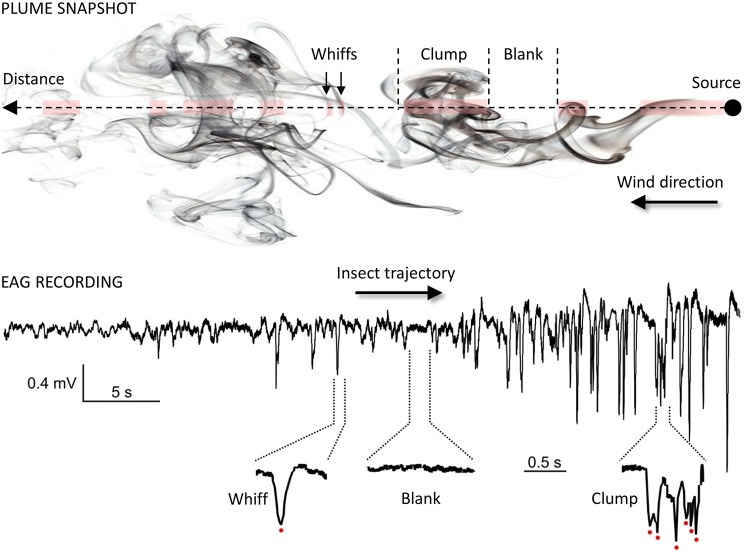
Temporal structure of the odor plume. Plume snapshot (upper part): the wind transports odorants away from the source along its main direction. The mean odorant concentration in the odor plume decreases with the square of the distance but local vertices mix together odorized and clean air, making the local odor concentration vary considerably around the average. As a result, odor plumes are highly intermittent signals, consisting of series of whiffs, clumps and blanks (odor/no-odor events). Foraging insects cannot rely on a chemical gradient but use the fast temporal dynamic of the plume to locate distant mates and host plants (Budick and Dickinson, 2006; Cardé and Willis, 2008). EAG recording (lower part): the complex structure of odor plumes can be visualized with the EAG technique (Vickers et al., 2001; Riffell et al., 2008; Nagel and Wilson, 2011) since the insect antenna responds gradually and dynamically to odor stimuli. Here, the EAG was recorded from an Agrotis ipsilon antenna attached to a walking red palm weevil (Rhynchophorus ferrugineus). The weevil was attracted to an odor source containing 10 µg of its aggregation pheromone (4-methyl-5-nonanol, ferrugineol) mixed with 10 µg of the main component of the A. ipsilon pheromone, (Z)7-dodecenyl acetate (Z7-12:Ac). Z7-12:Ac is thus used as a tracer of ferrugineol. The distance between the starting point of the insect and the odor source it reached was 1.75 m. Portions of the EAG recording corresponding to a whiff, a blank, and a clump of whiffs are enlarged and show single detection events (red dots).

References

    1. Ache B. W., Gleeson R. A., Thompson H. A. (1988). Mechanisms for mixture suppression in olfactory receptors of the spiny lobster. Chem. Senses 13, 425–434. 10.1093/chemse/13.3.425 - DOI
    1. Ainsworth E. A. (2017). Understanding and improving global crop response to ozone pollution. Plant J. 90, 886–897. 10.1111/tpj.13298, PMID: - DOI - PubMed
    1. Anderson P., Anton S. (2014). Experience-based modulation of behavioural responses to plant volatiles and other sensory cues in insect herbivores. Plant Cell Environ. 37, 1826–1835. 10.1111/pce.12342, PMID: - DOI - PubMed
    1. Andersson M. N. (2012). Mechanisms of odor coding in coniferous bark beetles: from neuron to behavior and application. Psyche. 2012:149572. 10.1155/2012/149572 - DOI
    1. Andersson M. N., Larsson M. C., Blaženec M., Jakuš R., Zhang Q. H., Schlyter F. (2010). Peripheral modulation of pheromone response by inhibitory host compound in a beetle. J. Exp. Biol. 213, 3332–3339. 10.1242/jeb.044396, PMID: - DOI - PubMed

LinkOut - more resources