. 2019 Aug 19;7(1):50.
doi: 10.1186/s40635-019-0263-0.

Effect of landiolol on sex-related transcriptomic changes in the myocardium during sepsis

Affiliations

Effect of landiolol on sex-related transcriptomic changes in the myocardium during sepsis

Thi Thom Tran et al. Intensive Care Med Exp. .

Abstract

Objectives: The aims of this study are to better understand phenotypic differences between male and female rats during sepsis, to characterise the contribution of the beta1-adrenergic blocker landiolol to septic cardiomyopathy and to determine why landiolol induces divergent effects in males and females.

Methods: The myocardial transcriptional profiles in male and female Wistar rats were assessed after the induction of sepsis by cecal ligation and puncture and addition of landiolol.

Results: Our results showed major differences in the biological processes activated during sepsis in male and female rats. In particular, a significant decrease in processes related to cell organisation, contractile function, ionic transport and phosphoinositide-3-kinase/AKT (PI3K/AKT) signalling was observed only in males. The transcript of ATPase sarcoplasmic/endoplasmic reticulum Ca2+ transporting 3 (SERCA3) was sex-differently regulated. In males, landiolol reversed several signalling pathways dysregulated during sepsis. The expression level of genes encoding tubulin alpha 8 (TUBA8) and myosin heavy chain 7B (MYH7) contractile proteins, phosphatase 2 catalytic subunit alpha (PPP2CA), G protein-coupled receptor kinase 5 (GRK5) and A-kinase anchoring protein 6 (AKAP6) returned to their basal levels. In contrast, in females, landiolol had limited effects.

Conclusion: In males, landiolol reversed the expression of many genes that were deregulated in sepsis. Conversely, sepsis-induced deregulation of gene expression was less pronounced in females than in males, and was maintained in the landiolol-treated females. These findings highlight important sex-related differences and confirm previous observations on the important benefit of landiolol intake on cardiac function in male rats.

Keywords: Beta-blocker; Dimorphism; Genes; Sepsis; Sex; Transcriptome.


Conflict of interest statement

LM discloses conflict of interest with Amomed (Consulting, Lectures), Aguettant (Consulting), Aspen (Lecture), MSD (Lecture), Pfizer (Lecture), Orion (Lecture) and Octapharma (Lecture). The other authors declare that they have no competing interests.

Figures
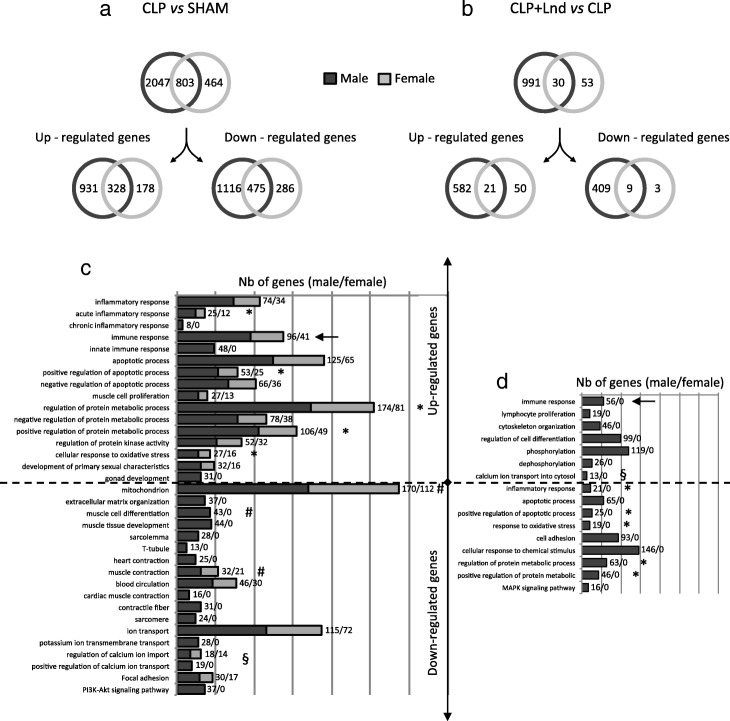
Fig. 1
Fig. 1
Differentially expressed genes (DEG) in male and female hearts after cecal ligation and puncture and landiolol. DEG were obtained after 2-class significance analysis of microarrays (SAM) 2 classes in TMeV, 10,000 permutations with an FDR < 0.01 for CLP vs sham (a) and with an FDR < 0.05 for CLP plus landiolol vs CLP groups (b). a, b Venn diagrams show the total number of DEG and the number of genes significantly up- and down-regulated in CLP (a) and CLP plus landiolol groups (b). The number of specific genes in females is very low compared to males. c, d A gene ontology analysis realised with the DAVID Database is reported on graphs in which the most significant biological process (BP)-GO terms for up- and down-regulated genes are indicated for CLP vs sham groups (c) and for CLP plus landiolol vs CLP groups (b). For all the processes, the number of genes deregulated in males is much greater than in females. Note the total absence of significant biological processes for females after landiolol infusion in (d). (*) indicates over-expressed biological processes during CLP that were reversed by landiolol. (§) indicates under-expressed biological processes during CLP that were reversed by landiolol. (#) indicates under-expressed biological processes related to cardiac activity and cardiomyocyte function that were affected during CLP and were not restored by landiolol. (←) shows that the immune response is over-expressed during sepsis and potentiated by landiolol. (N = 5–6 per group). CLP cecal ligation and puncture, CLP + Lnd CLP plus landiolol, Nb of genes number of genes
Fig. 2
Fig. 2
Biological processes associated with up-regulated genes after cecal ligation and puncture and back-regulated by landiolol infusion. a Venn diagram associated with the 1259 up-regulated genes in CLP group and the 418 down-regulated genes in CLP plus landiolol group in males. The 226 common genes represent regulated genes with a characteristic V form, up-regulated in sepsis and back-regulated by landiolol infusion. From these 226 common genes, a gene ontology analysis with the DAVID Database revealed significant biological processes (P-Benjamini < 0.05). A gene network diagram was performed using Cytoscape integrating the 226 genes (light grey circles) with their associated biological processes (dark grey rectangles). Genes associated with the JAK/STAT pathway, IL6R and STAT, with the PI3K/AKT and focal adhesion pathways, FGF2 and NFκB1, and with the mitogen-activated protein kinase and tumour necrosis factor-α pathways, cyclic adenosine monophosphate responsive element modulator and MAPK14 and GRK5, are surrounded by a black circle. b Venn diagram associated with the 506 up-regulated genes in CLP group and the 12 down-regulated genes in CLP plus landiolol group in females. Note that only 12 genes were down-regulated in CLP plus landiolol condition and that only seven of them were back-regulated. No significant biological processes were found associated to these seven genes presented in the table; two genes are members of the adrenergic signalling in the cardiomyocyte KEGG-pathway and the others are isolated genes. CLP cecal ligation and puncture, CLP + Lnd CLP plus landiolol
Fig. 3
Fig. 3
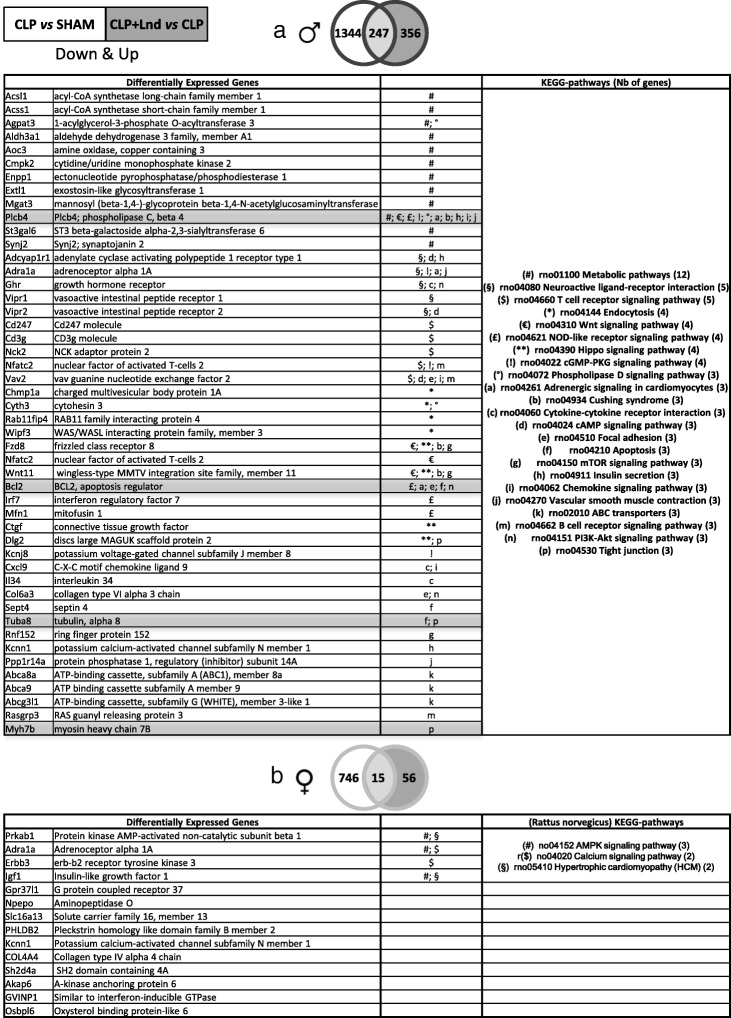
KEGG-pathways associated with down-regulated genes after cecal ligation and puncture and back-regulated by landiolol infusion. a Venn diagram associated with the 1591 down-regulated genes in CLP group and the 603 up-regulated genes in CLP plus landiolol group in males. The 247 common genes represent regulated genes with a characteristic V form, down-regulated in sepsis and back-regulated by landiolol infusion. No significant biological processes were found associated to these 247 common genes. The table presents KEGG-pathways in which at least three of these 247 common genes are involved. Genes associated with the JAK/STAT pathway, BCL2 and AOX, and with the adrenergic pathway, PLCB4, TUBA8 and MYH7B, are highlighted in grey. b Venn diagram associated with the 761 down-regulated genes in CLP group and the 71 up-regulated genes in CLP plus landiolol group in females. Note that only 71 genes were up-regulated in the CLP plus landiolol group and that only 15 of them were back-regulated. No biological processes were found associated to these 15 common genes presented in the table; four genes are members of specific KEGG-pathways and the others are isolated genes. CLP cecal ligation and puncture, CLP + Lnd CLP plus landiolol

References

    1. Martin Lukas, Derwall Matthias, Al Zoubi Sura, Zechendorf Elisabeth, Reuter Daniel A., Thiemermann Chris, Schuerholz Tobias. The Septic Heart. Chest. 2019;155(2):427–437. doi: 10.1016/j.chest.2018.08.1037. - DOI - PubMed
    1. Kumar A, Brar R, Wang P, Dee L, Skorupa G, Khadour F, Schulz R, Parrillo JE. Role of nitric oxide and cGMP in human septic serum-induced depression of cardiac myocyte contractility. Am J Phys. 1999;276:R265–R276. - PubMed
    1. Parrillo JE, Burch C, Shelhamer JH, Parker MM, Natanson C, Schuette W. A circulating myocardial depressant substance in humans with septic shock. Septic shock patients with a reduced ejection fraction have a circulating factor that depresses in vitro myocardial cell performance. J Clin Invest. 1985;76:1539–1553. doi: 10.1172/JCI112135. - DOI - PMC - PubMed
    1. Cimolai MC, Alvarez S, Bode C, Bugger H. Mitochondrial mechanisms in septic cardiomyopathy. Int J Mol Sci. 2015;16:17763–17778. doi: 10.3390/ijms160817763. - DOI - PMC - PubMed
    1. Kumar A, Wood K, Parrillo JE. Circulating substances and energy metabolism in septic shock. Crit Care Med. 2003;31:632–633. doi: 10.1097/01.CCM.0000050073.36518.A2. - DOI - PubMed