Case Reports
. 2019 Dec;198(3):416-429.
doi: 10.1111/cei.13365. Epub 2019 Sep 4.

Functional analysis of a novel G87V TNFRSF1A mutation in patients with TNF receptor-associated periodic syndrome

Affiliations
Case Reports

Functional analysis of a novel G87V TNFRSF1A mutation in patients with TNF receptor-associated periodic syndrome

S Tsuji et al. Clin Exp Immunol. 2019 Dec.

Abstract

Tumor necrosis factor (TNF) receptor-associated periodic syndrome (TRAPS) is an autoinflammatory disease that is caused by heterozygous mutations in the TNFRSF1A gene. Although more than 150 TNFRSF1A mutations have been reported to be associated with TRAPS phenotypes only a few, such as p.Thr79Met (T79M) and cysteine mutations, have been functionally analyzed. We identified two TRAPS patients in one family harboring a novel p.Gly87Val (G87V) mutation in addition to a p.Thr90Ile (T90I) mutation in TNFRSF1A. In this study, we examined the functional features of this novel G87V mutation. In-vitro analyses using mutant TNF receptor 1 (TNF-R1)-over-expressing cells demonstrated that this mutation alters the expression and function of TNF-R1 similar to that with the previously identified pathogenic T79M mutation. Specifically, cell surface expression of the mutant TNF-R1 in transfected cells was inhibited with both G87V and T79M mutations, whereas the T90I mutation did not affect this. Moreover, peripheral blood mononuclear cells (PBMCs) from TRAPS patients harboring the G87V and T90I mutations showed increased mitochondrial reactive oxygen species (ROS). Furthermore, the effect of various Toll-like receptor (TLR) ligands on inflammatory responses was explored, revealing that PBMCs from TRAPS patients are hyper-responsive to TLR-2 and TLR-4 ligands and that interleukin (IL)-8 and granulocyte-macrophage colony-stimulating factor (GM-CSF) are likely to be involved in the pathogenesis of TRAPS. These findings suggest that the newly identified G87V mutation is one of the causative mutations of TRAPS. Our findings based on unique TRAPS-associated mutations provide novel insight for clearer understanding of inflammatory responses, which would be basic findings of developing a new therapeutic and prophylactic approach to TRAPS.

Keywords: TNFRSF1A; TNF receptor-associated periodic syndrome; TNF-R1; autoinflammatory disease.


Conflict of interest statement

S. T., A. N., H. H., Y. M. and T. M. have received scholarship donations from Chugai Pharmaceutical. R. N. has received scholarship donations from Novartis. The funders had no role in the design of the study, in the collection, analyses or interpretation of data, in the writing of the manuscript or in the decision to publish the results.

Figures
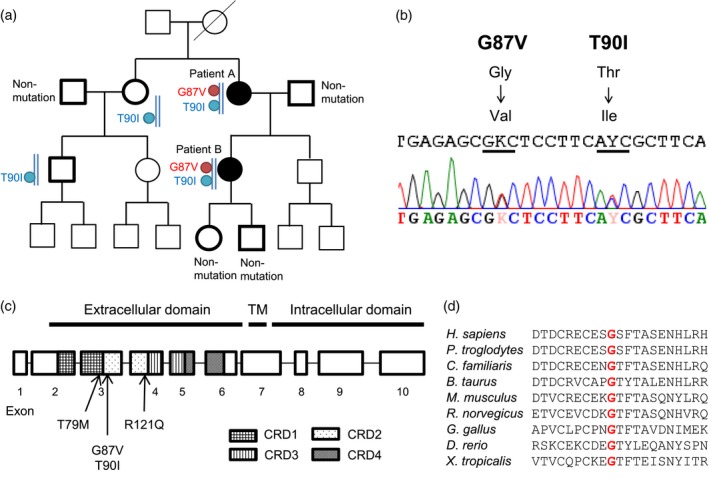
Figure 1
Figure 1
Gene mutations in TNFRSF1A. (a) Pedigree of the family of patients with tumor necrosis factor (TNF) receptor‐associated periodic syndrome (TRAPS). Patients (patients A and B) had both G87V and T90I mutations in the same allele of the TNFRSF1A gene. Patients with periodic inflammatory episodes are indicated as black symbols. Subcloning examination revealed that both G87V and T90I mutations are located on the same allele. The family members subjected to genetic tests are marked in bold. Types of mutations are indicated next to each symbol. (b) DNA sequence electropherograms of TNFRSF1A. Two locations of a heterozygous single‐base mutation, specifically c.260 G>T (G87V: p.Gly87Val) and c.269 C>T (T90I: p.Thr90Ile), in exon 3 were detected. Subcloning examination revealed that both the G87V and T90I mutations are located on the same allele of the TNFRSF1A gene. (c) Gene structure of TNFRSF1A and position of TRAPS mutations. TM = transmembrane domain; CRD = cysteine‐rich domain. T79M, G87V and T90I mutations are located in exon 3. The R121Q mutation is located in exon 4. (d) Comparison of peptide sequences among species. Red color indicates residue 87.
Figure 2
Figure 2
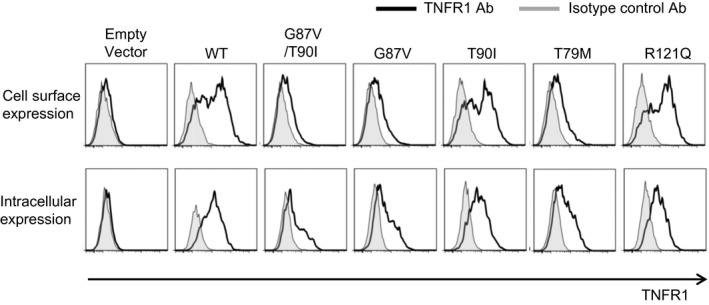
The cell surface expression of tumor necrosis factor (TNF) receptor type I (TNF‐R1) is impaired with the G87V TNFRSF1A mutation. HEK293 cells were transiently transfected with the indicated wild‐type (WT) or mutant TNF‐R1‐green fluorescent protein (GFP) fusion constructs. The cells were stained with the fluorochrome‐labeled anti‐TNF‐R1 antibody. Cell surface or intracellular expression of TNF‐R1 was determined by flow cytometry. The cells were gated based on the GFP‐positive cells, and then histograms representing TNF‐R1 expression were generated. T79M (c.236 C>T, p.Thr79Met) and R121Q (c.362 G>A, p.Arg121Gln) were used as controls. T79M and R121Q mutations are known to be related to severe and mild phenotypes of TRAPS, respectively. Data are representative of three independent experiments.
Figure 3
Figure 3
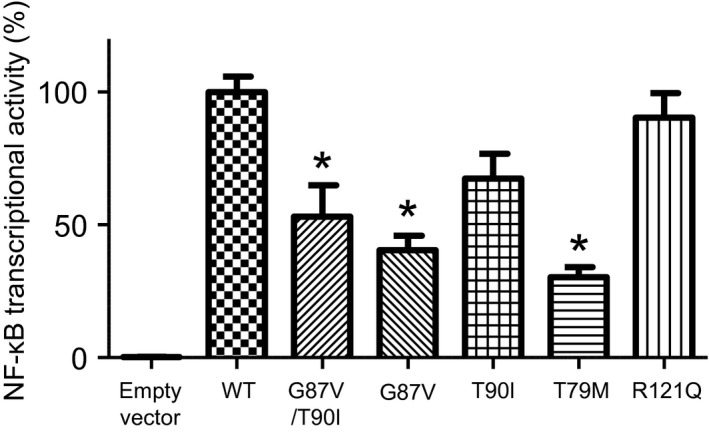
Nuclear factor‐kappa B (NF‐κB) promotor activity in HEK293 cells transfected with TNFRSF1A variants. HEK293 cells were transfected with wild‐type (WT) or mutant tumor necrosis factor receptor 1 (TNF‐R1)‐expression constructs together with an NF‐κB luciferase reporter vector and a secreted alkaline phosphatase (SEAP) expression vector, as a transfection efficiency control. After incubation for 24 h, the activity of each reporter enzyme was measured to calculate the relative NF‐κB transcriptional activity in each sample. The value in cells expressing WT TNF‐R1 is shown as 100%. Data represent the average of three independent experiments. Values are presented as means ± standard deviation (s.d.). *P < 0·05 between WT and indicated mutant TNF‐R1 constructs.
Figure 4
Figure 4
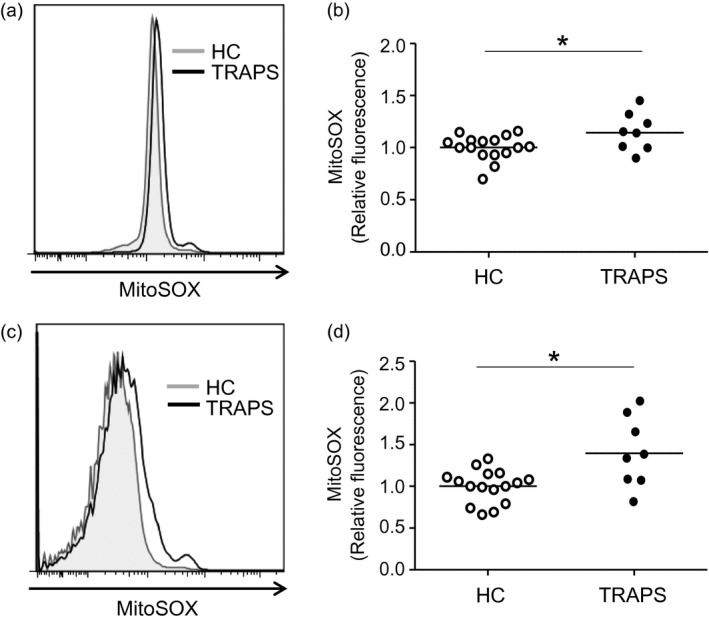
Mitochondrial reactive oxygen species (ROS) production in peripheral blood mononuclear cells (PBMCs) of tumor necrosis factor (TNF) receptor‐associated periodic syndrome (TRAPS) patients. PBMCs were isolated from healthy controls (HC; 16 PMBC samples from 12 individuals) and TRAPS patients (eight PBMC samples from two individuals) by density gradient separation. PBMCs were incubated with MitoSOX Red indicator for 10 min, and then ROS levels were determined by flow cytometry. Cells were gated based on monocytes (a,b) and lymphocytes (c,d) according to forward‐ and side‐scatter characteristics. Representative results of mitochondrial ROS production are shown in histograms (a,c). Data were normalized to the average values of healthy controls in each experiment. *P < 0·05.
Figure 5
Figure 5
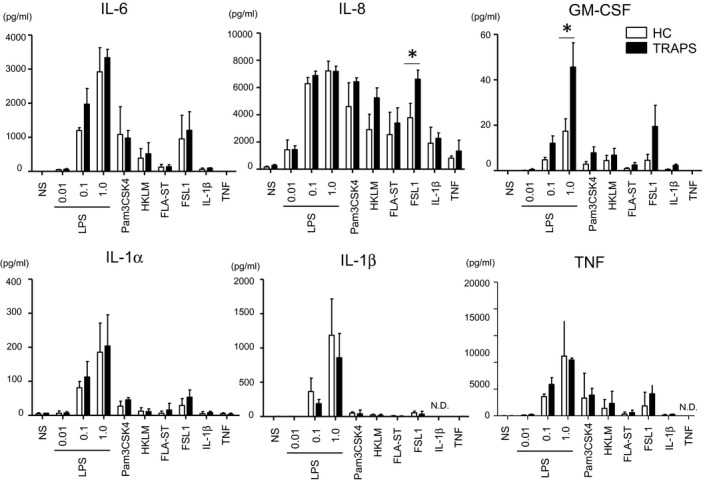
Expression of multiple cytokines in the culture supernatant of peripheral blood mononuclear cells (PBMCs) from healthy controls and the patients with tumor necrosis factor (TNF) receptor‐associated periodic syndrome (TRAPS). PBMCs from healthy controls (HC; n = 4, collected samples = 4) and the TRAPS patients (n = 2, collected samples = 4) were incubated for 10 h with lipopolysaccharide (LPS) (0·01, 0·1, 1·0 ng/ml), Pam3CSK (10 μg/ml), HKLM (3 × 10⁸ cells/ml), FLA‐ST (10 ng/ml), FSL1 (1 ng/ml), interleukin (IL)‐1β (1 ng/ml) and TNF (100 ng/ml). The expression levels of indicated cytokines and chemokines were determined using a multiplex assay system. Values are presented at the means ± standard deviation (s.d.). *P < 0·05; n.d.  = not determined; n.s.  = no stimulation; LPS = lipopolysaccharide; HKLM, heat‐killed Listeria monocytogenes; FLA‐ST, flagellin from Salmonella typhimurium; IL, interleukin; GM‐CSF, granulocyte–macrophage colony‐stimulating factor.

References

    1. Jarosz‐Griffiths HH, Holbrook J, Lara‐Reyna S, McDermott MF. TNF receptor signalling in autoinflammatory diseases. Int Immunol 2019. 10.1093/intimm/dxz024. - DOI - PubMed
    1. Ozen S, Bilginer Y. A clinical guide to autoinflammatory diseases: familial Mediterranean fever and next‐of‐kin. Nat Rev Rheumatol 2014; 10:135–47. - PubMed
    1. Ueda N, Ida H, Washio M et al . Clinical and genetic features of patients with TNFRSF1A variants in Japan: findings of a nationwide survey. Arthritis Rheumatol 2016; 68:2760–71. - PubMed
    1. Lachmann HJ, Papa R, Gerhold K et al . The phenotype of TNF receptor‐associated autoinflammatory syndrome (TRAPS) at presentation: a series of 158 cases from the Eurofever/EUROTRAPS international registry. Ann Rheum Dis 2014; 73:2160–7. - PMC - PubMed
    1. McDermott MF, Aksentijevich I, Galon J et al . Germline mutations in the extracellular domains of the 55 kDa TNF receptor, TNFR1, define a family of dominantly inherited autoinflammatory syndromes. Cell 1999; 97:133–44. - PubMed

Publication types

Substances

Supplementary concepts