


Advancing the Science of Deprescribing: A Novel Comprehensive Conceptual Framework
- PMID: 31430394
- PMCID: PMC6800794
- DOI: 10.1111/jgs.16136
Advancing the Science of Deprescribing: A Novel Comprehensive Conceptual Framework
Abstract
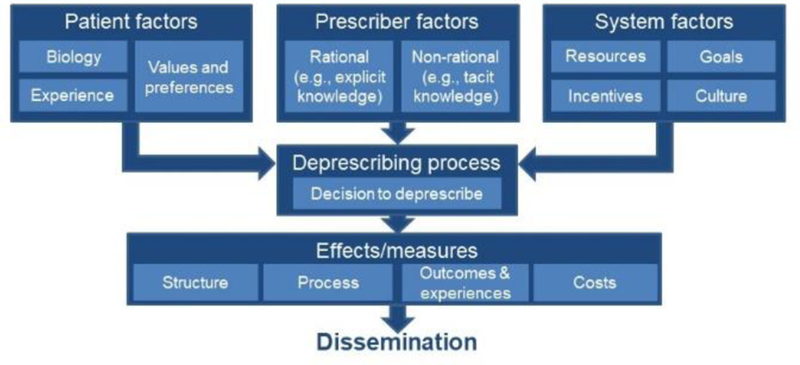
Polypharmacy is common in older adults and associated with inappropriate medication use, adverse drug events, medication nonadherence, higher costs, and increased mortality compared with those without polypharmacy. Deprescribing, the clinically supervised process of stopping or reducing the dose of medications when they cause harm or no longer provide benefit, may improve outcomes. Although potentially beneficial, clinicians struggle to overcome structural, organizational, technological, and cognitive barriers to deprescribing, limiting its use in clinical practice. Deprescribing science would benefit from a unifying conceptual framework to prioritize research. Current deprescribing conceptual frameworks have made important contributions to the field but often with a focus on specific medication classes or aspects of deprescribing. To further this relatively nascent field, we developed a broader deprescribing conceptual framework that builds on prior frameworks and includes patient, prescriber, and system influences; the process of deprescribing; outcomes; and dissemination. Patient factors include patients' biology, experience, values, and preferences. Prescriber factors include rational (eg, based on explicit knowledge) and nonrational (eg, behavioral tendencies, biases, and heuristics) decision making. System factors include resources, incentives, goals, and culture that contribute to deprescribing. The framework separates the deprescribing decision from the deprescribing process. The framework captures the results of deprescribing by examining changes in clinical structures, performance processes, patient experience, health outcomes, and cost. Through testing and refinement, this novel, more comprehensive conceptual framework has the potential to advance deprescribing research by organizing the existing evidence, identifying evidence gaps, and categorizing deprescribing interventions and the settings in which they are applied. J Am Geriatr Soc 67:2018-2022, 2019.
Keywords: behavioral economics; clinical decision making; health services for older adults; implementation science; polypharmacy.
© 2019 The American Geriatrics Society.
Conflict of interest statement
References
-
- National Center for Health Statistics (US). Health, United States, 2016: with chartbook on long-term trends in health 2017. Report No.: 2017–1232. - PubMed
-
- Akazawa M, Imai H, Igarashi A, Tsutani K. Potentially inappropriate medication use in elderly Japanese patients. Am J Geriatr Pharmacother 2010;8: 146–160. - PubMed
Publication types
MeSH terms
Grants and funding
LinkOut - more resources
Full Text Sources
Medical
