. 2019 Oct;33(10):836-847.
doi: 10.1177/1545968319868716. Epub 2019 Aug 20.

Upper Limb Performance in Daily Life Improves Over the First 12 Weeks Poststroke

Affiliations

Upper Limb Performance in Daily Life Improves Over the First 12 Weeks Poststroke

Kimberly J Waddell et al. Neurorehabil Neural Repair. 2019 Oct.

Abstract

Background. Upper limb (UL) performance, or use, in daily life is complex and likely influenced by many factors. While the recovery trajectory of UL impairment poststroke is well documented, little is known about the recovery trajectory of sensor-measured UL performance in daily life early after stroke and the potential moderating role of psychosocial factors. Objective. To examine the recovery trajectory of UL performance within the first 12 weeks poststroke and characterize the potential moderating role of belief, confidence, and motivation on UL performance. Methods. This was a longitudinal, prospective cohort study quantifying UL performance and related psychosocial factors early after stroke. UL performance was quantified via bilateral, wrist-worn accelerometers over 5 assessment sessions for 24 hours. Belief, confidence, and motivation to use the paretic UL, and self-perceived barriers to UL recovery were quantified via survey. Change in 4 accelerometer variables and the moderating role of psychosocial factors was tested using hierarchical linear modeling. The relationship between self-perceived barriers and UL performance was tested via Spearman rank-order correlation analysis. Results. UL performance improved over the first 12 weeks after stroke. Belief, confidence, and motivation did not moderate UL performance over time. There was a negative relationship between UL performance and self-perceived barriers to UL recovery at week 2, which declined over time. Conclusions. Sensor-measured UL performance can improve early after stroke. Early after stroke, rehabilitation interventions may not need to directly target belief, confidence, and motivation but may instead focus on reducing self-perceived barriers to UL recovery.

Keywords: accelerometry; confidence; psychosocial; sensors; stroke; upper limb.


Figures

Figure 1.
Figure 1.
Change profiles for every participant (spaghetti plots) Each line represents a study participant with the thick black line representing the mean ± SE shading. The dashed lines represent referent values from a healthy, community dwelling adult population. For hours of use, the dashed red line represents referent hours for the dominant UL and the blue line represents referent values for the nondominant UL.
Figure 2.
Figure 2.
Predicted slopes for confidence x time interaction The black line represents the reference group (participants who slightly agreed, slightly disagreed, or strongly disagreed) and the red line represents participants who strongly agreed. Participants who strongly agreed did not differ from the reference group in rate of change over time.
Figure 3.
Figure 3.
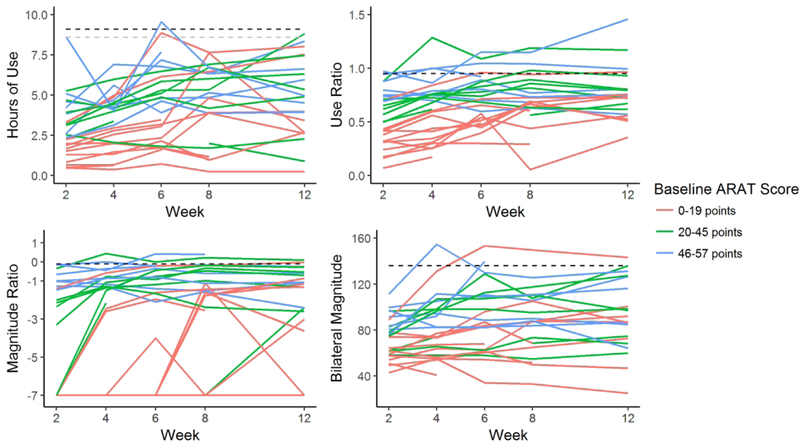
Individual change profiles by week 2 ARAT score. The dashed lines represent referent values. For hours of use, the black line represents the dominant UL and the gray line represents the nondominant UL. Participants with limited UL capacity at week 2 (low ARAT score) demonstrated greater change compared to participants with mild UL paresis.
Figure 4.
Figure 4.
Examples of individual density plots Density plots show UL activity for both upper limbs, for every second of data. The magnitude ratio, which quantifies the contribution of each limb to an activity, is on the x-axis. The y-axis represents the intensity of UL activity (bilateral magnitude). At week 2, participant 1 (Fig. 4A) had severe UL paresis, participant 2 (Fig. 4B) had moderate UL paresis, and participant 3 (Fig. 4C) had mild UL paresis. Across all three participants, there was an increase in UL performance from week 2 to week 12, as observed in the improved symmetry, appearance or increase of the center peak (bilateral magnitude), and improved overall frequency of UL activity (color change). For all three participants, the majority of UL activity occurred bilaterally (magnitude ratio value of 0) and of low intensity, consistent with healthy, neurologically intact adults.

References

    1. Langhorne P, Coupar F, Pollock A. Motor recovery after stroke: a systematic review. The Lancet Neurology 2009;8(8):741–754. - PubMed
    1. Dobkin BH. Clinical practice. Rehabilitation after stroke. The New England journal of medicine 2005;352(16):1677–1684. - PMC - PubMed
    1. Langhorne P, Bernhardt J, Kwakkel G. Stroke rehabilitation. The Lancet 2011;377(9778):1693–1702. - PubMed
    1. Wade DT, Langton-Hewer R, Wood VA, Skilbeck CE, Ismail HM. The hemiplegic arm after stroke: measurement and recovery. Journal of neurology, neurosurgery, and psychiatry 1983;46(6):521–524. - PMC - PubMed
    1. Dobkin BH. Strategies for stroke rehabilitation. The Lancet Neurology 2004;3(9):528–536. - PMC - PubMed

Publication types