Review
. 2019 Aug 19;374(1779):20180215.
doi: 10.1098/rstb.2018.0215. Epub 2019 Jul 1.

Tissue mechanics, an important regulator of development and disease

Affiliations
Review

Tissue mechanics, an important regulator of development and disease

Nadia M E Ayad et al. Philos Trans R Soc Lond B Biol Sci. .

Abstract

A growing body of work describes how physical forces in and around cells affect their growth, proliferation, migration, function and differentiation into specialized types. How cells receive and respond biochemically to mechanical signals is a process termed mechanotransduction. Disease may arise if a disruption occurs within this mechanism of sensing and interpreting mechanics. Cancer, cardiovascular diseases and developmental defects, such as during the process of neural tube formation, are linked to changes in cell and tissue mechanics. A breakdown in normal tissue and cellular forces activates mechanosignalling pathways that affect their function and can promote disease progression. The recent advent of high-resolution techniques enables quantitative measurements of mechanical properties of the cell and its extracellular matrix, providing insight into how mechanotransduction is regulated. In this review, we will address the standard methods and new technologies available to properly measure mechanical properties, highlighting the challenges and limitations of probing different length-scales. We will focus on the unique environment present throughout the development and maintenance of the central nervous system and discuss cases where disease, such as brain cancer, arises in response to changes in the mechanical properties of the microenvironment that disrupt homeostasis. This article is part of a discussion meeting issue 'Forces in cancer: interdisciplinary approaches in tumour mechanobiology'.

Keywords: cancer; extracellular matrix; mechanobiology; microenvironment; tissue mechanics.


Conflict of interest statement

We declare we have no competing interests.

Figures
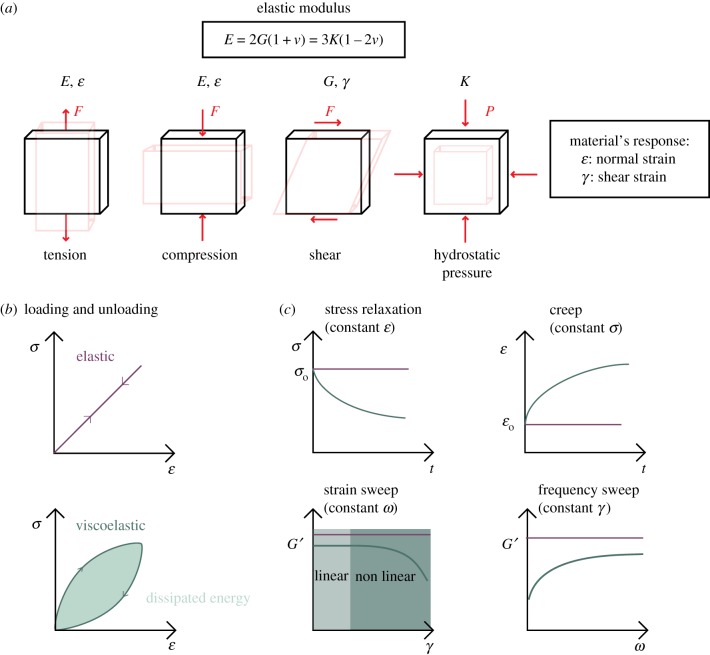
Figure 1.
Figure 1.
A summary of mechanical properties deforming under stress. (a) A material resistance to elastic deformation to force (F) or stress (σ) is the elastic modulus. E is Young's modulus, a response to tensile or compressive stress, G is the shear modulus, a response to shear stress, and K is the bulk modulus, a response to hydrostatic pressure. (b) A viscoelastic material dissipates energy upon loading and unloading, whereas an elastic material does not. (c) Different modes of testing the response of viscoelastic materials, which is strain- and frequency-dependent. Viscoelastic materials have an initial linear response to the storage modulus (G′) at low strains followed by a nonlinear response with increasing strain.
Figure 2.
Figure 2.
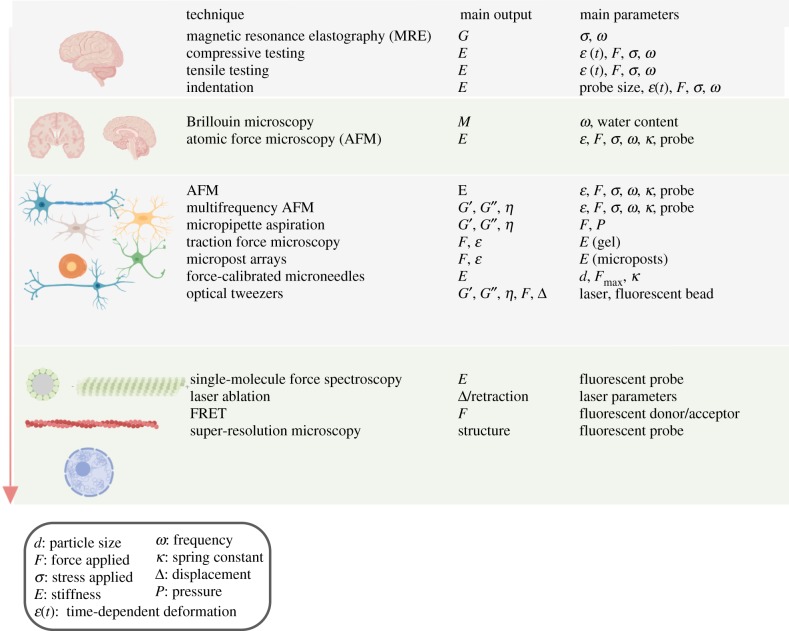
Different techniques used for measuring mechanical properties in the brain and the nervous system divided by length-scale. The far-right column describes some important parameters to consider when choosing to use the technique and compare with different studies.
Figure 3.
Figure 3.
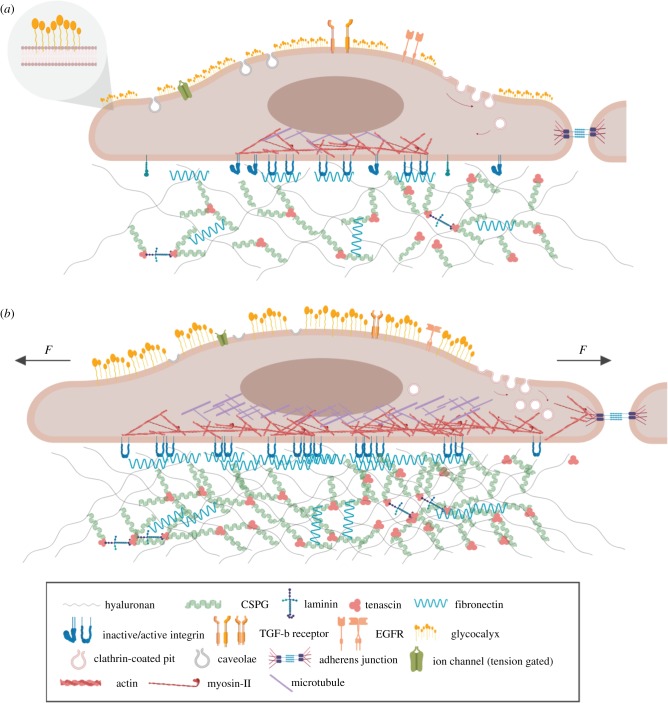
Structures present at the cell surface identified as participating in mechanotransduction. Changes in their behaviour are shown in a rest state (a) and when mechanically activated by force (b).

References

    1. Sinha B, et al. . 2011. Cells respond to mechanical stress by rapid disassembly of caveolae. Cell 144, 402–413. (10.1016/j.cell.2010.12.031) - DOI - PMC - PubMed
    1. Paszek MJ, et al. . 2005. Tensional homeostasis and the malignant phenotype. Cancer Cell 8, 241–254. (10.1016/j.ccr.2005.08.010) - DOI - PubMed
    1. Miroshnikova YA, et al. . 2016. Tissue mechanics promote IDH1-dependent HIF1α-tenascin C feedback to regulate glioblastoma aggression. Nat. Cell Biol. 18, 1336–1345. (10.1038/ncb3429) - DOI - PMC - PubMed
    1. Vijayraghavan DS, Davidson LA. 2017. Mechanics of neurulation: from classical to current perspectives on the physical mechanics that shape, fold, and form the neural tube: mechanics of neurulation. Birth Defects Res. 109, 153–168. (10.1002/bdra.23557) - DOI - PMC - PubMed
    1. Galford E, McElhaney H. 1970. A viscoelastic study of scalp, brain and dura. J. Biomech. 3, 211–221. (10.1016/0021-9290(70)90007-2) - DOI - PubMed

Publication types