


Admission Laboratory Values Accurately Predict In-hospital Mortality: a Retrospective Cohort Study
- PMID: 31432440
- PMCID: PMC7080898
- DOI: 10.1007/s11606-019-05282-2
Admission Laboratory Values Accurately Predict In-hospital Mortality: a Retrospective Cohort Study
Abstract
Background: The greater the severity of illness of a patient, the more likely the patient will have a poor hospital outcome. However, hospital-wide severity of illness scores that are simple, widely available, and not diagnosis-specific are still needed. Laboratory tests could potentially be used as an alternative to estimate severity of illness.
Objective: To evaluate the ability of hospital laboratory tests, as measures of severity of illness, to predict in-hospital mortality among hospitalized patients, and therefore, their potential as an alternative method to severity of illness risk adjustment.
Designs and patients: A retrospective cohort study among 38,367 adult non-trauma patients admitted to the University of Maryland Medical Center between November 2015 and November 2017 was performed. Laboratory tests (hemoglobin, platelet count, white blood cell count, urea nitrogen, creatinine, glucose, sodium, potassium, and total bicarbonate (HCO3)) were included when ordered within 24 h from the time of hospital admission. A multivariable logistic regression model to predict in-hospital mortality was constructed using a section of our cohort (n = 21,003).
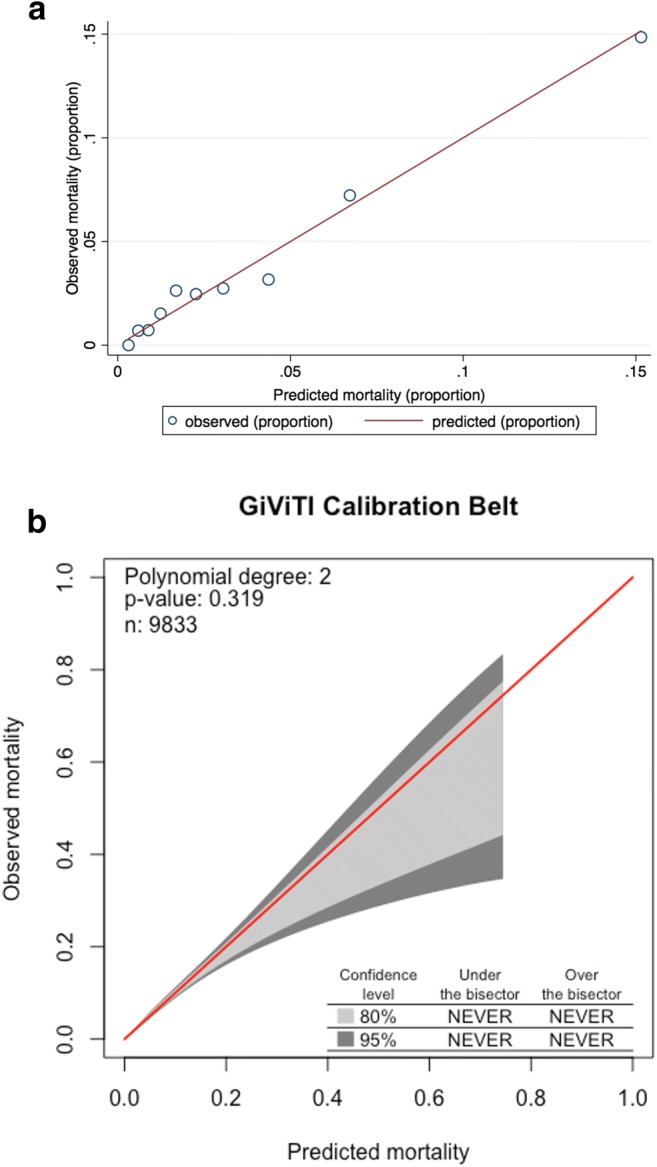
Main measures: Model performance was evaluated using the c-statistic and the Hosmer-Lemeshow (HL) test. In addition, a calibration belt was constructed to determine a confidence interval around the calibration curve with the purpose of identifying ranges of miscalibration.
Key results: Patient age and all laboratory tests predicted mortality with good discrimination (c = 0.79). Patients with abnormal HCO3 levels or leukocyte counts at admission were twice as likely to die during their hospital stay as patients with normal results. A good model calibration and fit were observed (HL = 13.9, p = 0.18).
Conclusions: Admission laboratory tests are able to predict in-hospital mortality with good accuracy, providing an objective and widely accessible approach to severity of illness risk adjustment.
Keywords: laboratory tests; mortality; prediction model; severity of illness.
Conflict of interest statement
The authors declare that they do not have a conflict of interest.
Figures
References
-
- Vincent JL, Bruzzi de Carvahlo F. Severity of illness. Semin Respir Crit Care Med. 2010;31:31–38. - PubMed
-
- Risk adjustment. Fact Sheet [Internet]. [Accessed: June 6, 2019 ]. Available from: https://www.cms.gov/Medicare/Medicare-Fee-for-Service-Payment/PhysicianF...
-
- Defining the Medicare Severity Diagnosis Related Groups (MS-DRGs), Version 34.0 [Internet]. [Accessed: June 6, 2019 ]. Available from: https://www.cms.gov/ICD10Manual/version34-fullcode-cms/fullcode_cms/Defi...
-
- Office of the Inspector General. Medicare Hospital Prospective Payment System. How DRG rates are calculated and updated. 2011.
Publication types
MeSH terms
Grants and funding
LinkOut - more resources
Full Text Sources
