Association of China's universal two child policy with changes in births and birth related health factors: national, descriptive comparative study
- PMID: 31434652
- PMCID: PMC6699592
- DOI: 10.1136/bmj.l4680
Association of China's universal two child policy with changes in births and birth related health factors: national, descriptive comparative study
Abstract
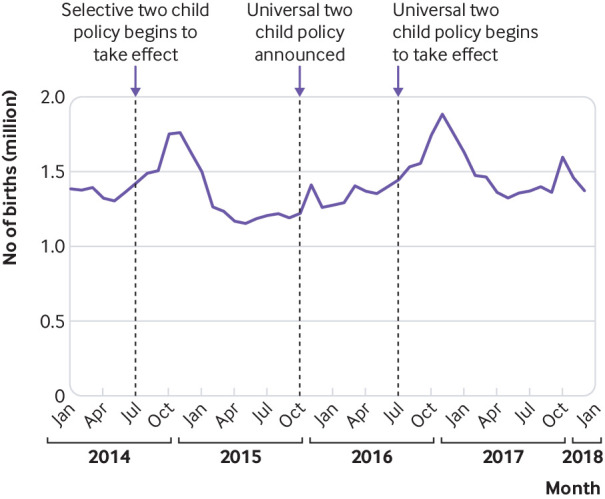
Objective: To measure the association of China's universal two child policy, announced in October 2015, with changes in births and health related birth characteristics.
Design: National, descriptive before-and-after comparative study.
Setting: Every county in 28 of 31 provinces of mainland China.
Participants: Births included in two national databases: 67 786 749 births from county level monthly aggregated data between January 2014 and December 2017; and 31 786 279 deliveries from individual level delivery information records between January 2015 and December 2017.
Main outcome measures: Monthly mean number of births and mean proportion of multiparous mothers and mothers aged 35 and over, preterm deliveries, and caesarean deliveries.
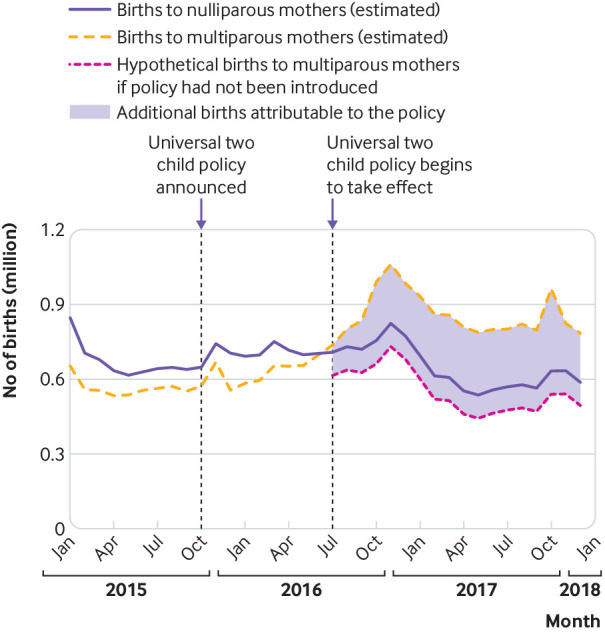
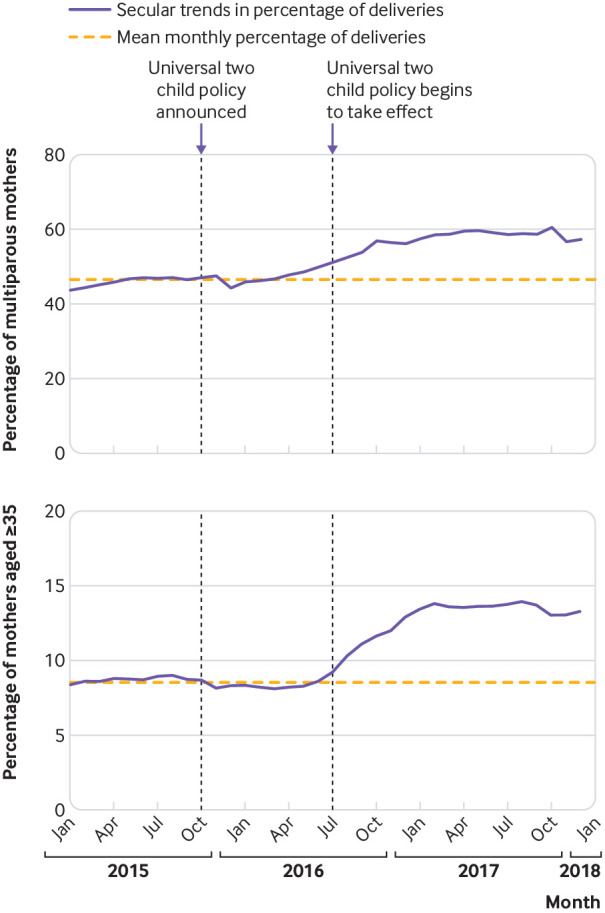
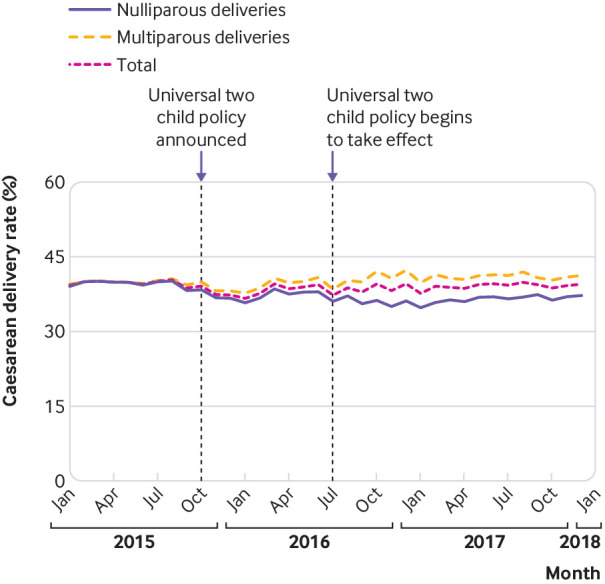
Results: The study had two phases: the baseline period (up to and including June 2016, nine months after the policy announcement) and the effective period (from July 2016 to December 2017). The estimated number of additional births attributable to the new policy between July 2016 and December 2017 was 5.40 million (95% confidence interval 4.34 to 6.46). The monthly mean percentage of multiparous mothers and mothers aged 35 and over increased by 9.1 percentage points (95% confidence interval 6.4 to 11.7) and 5.8 percentage points (5.2 to 6.4), respectively. This increase in older mothers, however, was not associated with a concurrent increase in the overall rate of preterm birth. The monthly mean caesarean delivery rate among multiparous mothers increased by 1.2 percentage points (0.8 to 1.6) from 39.7% to 40.9%, and decreased by 3.0 percentage points (-3.5 to -2.5) among nulliparous mothers from 39.6% to 36.6%.
Conclusions: Since its announcement in October 2015, the universal two child policy has been associated with a rise in births in China and with changes in health related birth characteristics: women giving birth have been more likely to be multiparous, and more likely to be aged 35 and over. No evidence of concurrent worsening outcomes (that is, premature births) was seen.
Published by the BMJ Publishing Group Limited. For permission to use (where not already granted under a licence) please go to http://group.bmj.com/group/rights-licensing/permissions.
Conflict of interest statement
Competing interests: All authors have completed the ICMJE uniform disclosure form at www.icmje.org/coi_disclosure.pdf and declare: support from the National Key Research and Development Program of China, National Health Commission of China, and National Natural Science Foundation of China for the submitted work; no financial relationships with any organisations that might have an interest in the submitted work in the previous three years; no other relationships or activities that could appear to have influenced the submitted work.
Figures
References
-
- Zhai Z, Li L, Chen J. Accumulated couples and extra births under the universal two-child policy [in Chinese] Renkou Yanjiu 2016;40:35-51.
-
- Gu B, Wang F, Guo Z, Zhang E. China’s local and national fertility policies at the end of the twentieth century. Popul Dev Rev 2007;33:129-48. 10.1111/j.1728-4457.2007.00161.x . - DOI
Publication types
MeSH terms
LinkOut - more resources
Full Text Sources
Medical