


JOB INSECURITY AND WELL-BEING IN RICH DEMOCRACIES
- PMID: 31435077
- PMCID: PMC6703155
JOB INSECURITY AND WELL-BEING IN RICH DEMOCRACIES
Abstract
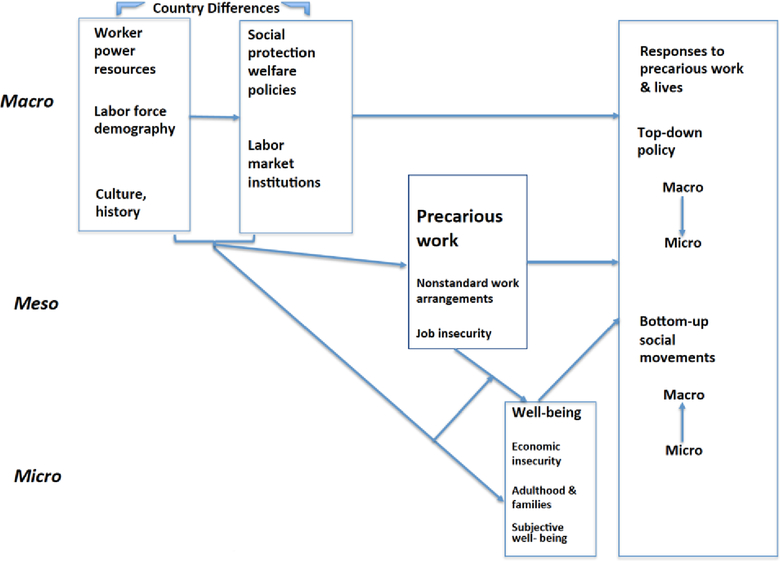
Precarious work (i.e., work that is insecure and uncertain, often low-paying, and in which the risks of work are shifted from employers and the government to workers) has emerged as a serious concern for individuals and families and underlies many of the insecurities that have fueled recent populist political movements. The impacts of precarious work differ among countries depending on their labor market and welfare system institutions, laws and policies, and cultural factors. This article examines how people in six advanced industrial countries representing different welfare and employment regimes-Denmark, Germany, Japan, Spain, the United Kingdom and the United States-differ both in their experience of precarious work and in outcomes of precarious work such as job and economic insecurity, entry into the labor force, and subjective well-being. It also suggests a new social and political contract needed to address precarious work and its consequences.
References
-
- Adams Zoe and Deakin Simon. 2014. “Institutional Solutions to Precariousness and Inequality in Labour Markets.” British Journal of Industrial Relations 52: 779–809.
-
- Beck Ulrich. 2000. The Brave New World of Work (translated by Patrick Camiller). Cambridge, UK: Polity Press.
-
- Breman Jan and van der Linden Marcel. 2014. “Informalizing the Economy: The Return of the Social Question at a Global Level.” Development and Change 45: 920–940.
-
- Devine Ethan. 2013. “The Slacker Trap.” The Atlantic, May (https://www.theatlantic.com/magazine/archive/2013/05/the-slacker-trap/30...; accesssed October 11, 2017.
-
- Esping-Andersen Gøsta. 1990. The Three Worlds of Welfare Capitalism. Princeton, NJ: Princeton University Press.
Grants and funding
LinkOut - more resources
Full Text Sources