


Age-dependent brain volume and neuropsychological changes after chemotherapy in breast cancer patients
- PMID: 31436005
- PMCID: PMC6865635
- DOI: 10.1002/hbm.24753
Age-dependent brain volume and neuropsychological changes after chemotherapy in breast cancer patients
Abstract
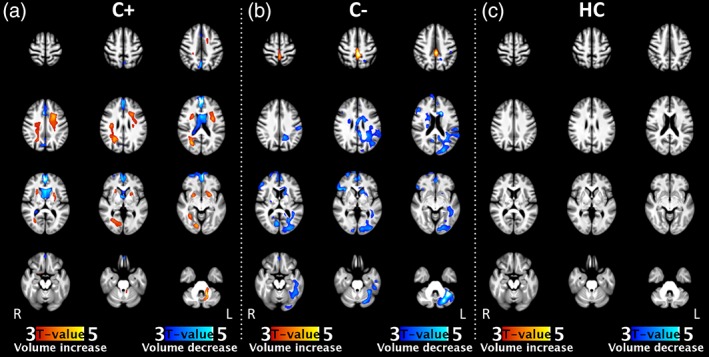
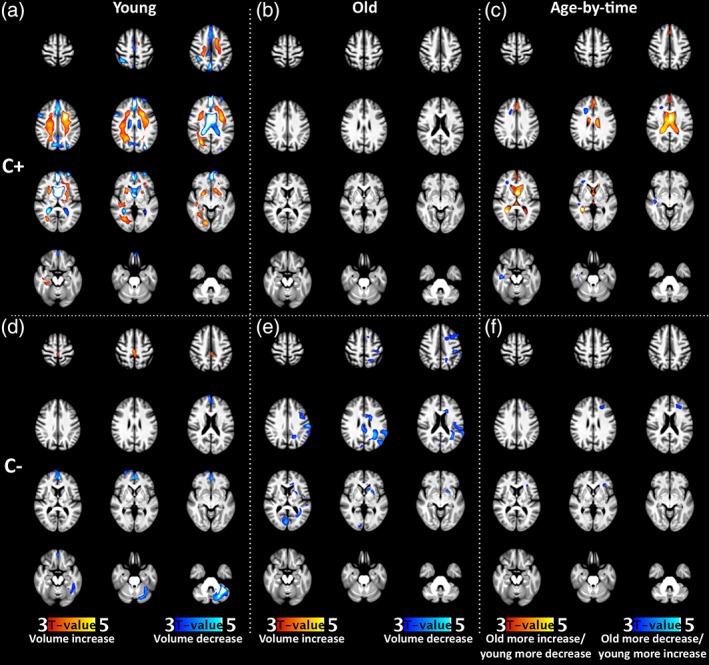
This study investigated volumetric brain changes and cognitive performance in premenopausal and postmenopausal patients treated for early-stage breast cancer. Participants underwent elaborate neurocognitive assessments (neuropsychological testing, cognitive failure questionnaire, and high-resolution T1-weighted structural MRI) before and after chemotherapy. Volumetric brain changes were estimated, using longitudinal deformation-based morphometry, and correlated with cognitive changes. In total, 180 women participated in this study, of whom 72 patients with breast cancer had received adjuvant chemotherapy (C+), 49 patients did not receive chemotherapy (C-), and 59 healthy controls (HC). The population was categorized into two age groups: A young group who were premenopausal and younger than 52 years at baseline (n = 55C+/32C-/41HC), and an older group who were postmenopausal and older than 60 years (n = 17C+/17C-/18HC). Cognitive impairment occurred after chemotherapy in both young and older patients, although older patients showed more decline in processing speed (Trail making test b). White matter volume expansion was observed after chemotherapy, only significantly present in the younger subgroup of patients. In patients not treated with chemotherapy, diffuse gray and white matter volume reduction was observed. Less white matter expansion concurred with more cognitive decline (r > .349, p < .05). In conclusion, we found age-dependent cognitive decline and white matter volume changes in patients with breast cancer after chemotherapy, which could possibly be linked to neuroinflammatory processes. White matter expansion after chemotherapy, more pronounced in premenopausal patients, correlated with less cognitive decline. This suggests such expansion to be age-dependent, possibly caused by a protective response in the younger brain to chemotherapy-induced neurotoxicity.
Keywords: age; brain volume; cancer; chemobrain; chemotherapy; cognition; deformation-based morphometry; longitudinal; menopause; quality of life.
© 2019 Wiley Periodicals, Inc.
Figures

Similar articles
-
Recovery from chemotherapy-induced white matter changes in young breast cancer survivors?Brain Imaging Behav. 2018 Feb;12(1):64-77. doi: 10.1007/s11682-016-9665-8. Brain Imaging Behav. 2018. PMID: 28102529
-
Global and focal brain volume in long-term breast cancer survivors exposed to adjuvant chemotherapy.Breast Cancer Res Treat. 2012 Apr;132(3):1099-106. doi: 10.1007/s10549-011-1888-1. Epub 2011 Dec 29. Breast Cancer Res Treat. 2012. PMID: 22205140
-
Assessing brain volume changes in older women with breast cancer receiving adjuvant chemotherapy: a brain magnetic resonance imaging pilot study.Breast Cancer Res. 2018 May 2;20(1):38. doi: 10.1186/s13058-018-0965-3. Breast Cancer Res. 2018. PMID: 29720224 Free PMC article. Clinical Trial.
-
Chemotherapy-induced brain changes in breast cancer survivors: evaluation with multimodality magnetic resonance imaging.Brain Imaging Behav. 2019 Dec;13(6):1799-1814. doi: 10.1007/s11682-019-00074-y. Brain Imaging Behav. 2019. PMID: 30937827 Review.
-
The Developmental Trajectory of Cancer-Related Cognitive Impairment in Breast Cancer Patients: A Systematic Review of Longitudinal Neuroimaging Studies.Neuropsychol Rev. 2020 Sep;30(3):287-309. doi: 10.1007/s11065-020-09441-9. Epub 2020 Jun 30. Neuropsychol Rev. 2020. PMID: 32607817
Cited by
-
The impact of breast cancer on social cognition in female Colombian patients.BMC Psychol. 2022 Dec 13;10(1):303. doi: 10.1186/s40359-022-01005-1. BMC Psychol. 2022. PMID: 36514122 Free PMC article.
-
Cerebral glucose changes after chemotherapy and their relation to long-term cognitive complaints and fatigue.Front Oncol. 2022 Oct 13;12:1021615. doi: 10.3389/fonc.2022.1021615. eCollection 2022. Front Oncol. 2022. PMID: 36313711 Free PMC article.
-
Brain morphological alterations and their correlation to tumor differentiation and duration in patients with lung cancer after platinum chemotherapy.Front Oncol. 2022 Aug 4;12:903249. doi: 10.3389/fonc.2022.903249. eCollection 2022. Front Oncol. 2022. PMID: 36016623 Free PMC article.
-
Brain gray matter reduction and premature brain aging after breast cancer chemotherapy: a longitudinal multicenter data pooling analysis.Brain Imaging Behav. 2023 Oct;17(5):507-518. doi: 10.1007/s11682-023-00781-7. Epub 2023 May 31. Brain Imaging Behav. 2023. PMID: 37256494 Free PMC article.
-
An Activation Likelihood Estimation Meta-Analysis of Voxel-Based Morphometry Studies of Chemotherapy-Related Brain Volume Changes in Breast Cancer.Cancers (Basel). 2025 May 16;17(10):1684. doi: 10.3390/cancers17101684. Cancers (Basel). 2025. PMID: 40427181 Free PMC article.
References
-
- Ahles, T. A. , Saykin, A. J. , McDonald, B. C. , Li, Y. , Furstenberg, C. T. , Hanscom, B. S. , … Kaufman, P. A. (2010). Longitudinal assessment of cognitive changes associated with adjuvant treatment for breast cancer: Impact of age and cognitive reserve. Journal of Clinical Oncology, 28(29), 4434–4440. 10.1200/JCO.2009.27.0827 - DOI - PMC - PubMed
Publication types
MeSH terms
Substances
Grants and funding
LinkOut - more resources
Full Text Sources
Medical
