. 2019 Oct 1;137(10):1190-1194.
doi: 10.1001/jamaophthalmol.2019.3109.

Association of a Primary Open-Angle Glaucoma Genetic Risk Score With Earlier Age at Diagnosis

Affiliations

Association of a Primary Open-Angle Glaucoma Genetic Risk Score With Earlier Age at Diagnosis

Bao Jian Fan et al. JAMA Ophthalmol. .

Abstract

Importance: Genetic variants associated with primary open-angle glaucoma (POAG) are known to influence disease risk. However, the clinical effect of associated variants individually or in aggregate is not known. Genetic risk scores (GRS) examine the cumulative genetic load by combining individual genetic variants into a single measure, which is assumed to have a larger effect and increased power to detect relevant disease-related associations.

Objective: To investigate if a GRS that comprised 12 POAG genetic risk variants is associated with age at disease diagnosis.

Design, setting, and participants: A cross-sectional study included individuals with POAG and controls from the Glaucoma Genes and Environment (GLAUGEN) study and the National Eye Institute Glaucoma Human Genetics Collaboration (NEIGHBOR) study. A GRS was formulated using 12 variants known to be associated with POAG, and the alleles associated with increasing risk of POAG were aligned in the case-control sets. In case-only analyses, the association of the GRS with age at diagnosis was analyzed as an estimate of disease onset. Results from cohort-specific analyses were combined with meta-analysis. Data collection started in August 2012 for the NEIGHBOR cohort and in July 2008 for the GLAUGEN cohort and were analyzed starting in March 2018.

Main outcomes and measures: Association of a 12 single-nucleotide polymorphism POAG GRS with age at diagnosis in individuals with POAG using linear regression.

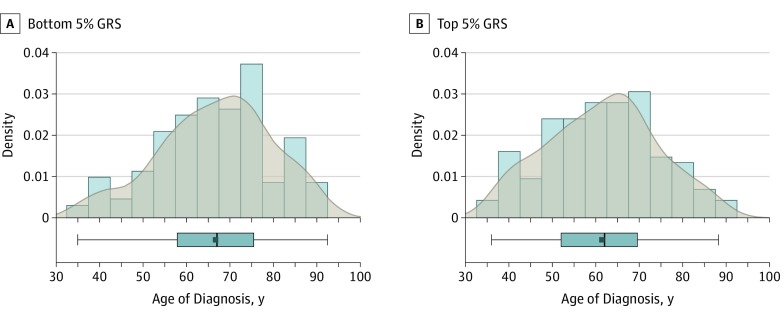
Results: The GLAUGEN study included 976 individuals with POAG and 1140 controls. The NEIGHBOR study included 2132 individuals with POAG and 2290 controls. For individuals with POAG, the mean (SD) age at diagnosis was 63.6 (9.8) years in the GLAUGEN cohort and 66.0 (13.7) years in the NEIGHBOR cohort. For controls, the mean (SD) age at enrollment was 65.5 (9.2) years in the GLAUGEN cohort and 68.9 (11.4) years in the NEIGHBOR cohort. All study participants were European white. The GRS was strongly associated with POAG risk in case-control analysis (odds ratio per 1-point increase in score = 1.24; 95% CI, 1.21-1.27; P = 3.4 × 10-66). In case-only analyses, each higher GRS unit was associated with a 0.36-year earlier age at diagnosis (β = -0.36; 95% CI, -0.56 to -0.16; P = 4.0 × 10⁻⁴). Individuals in the top 5% of the GRS had a mean (SD) age at diagnosis of 5.2 (12.8) years earlier than those in the bottom 5% GRS (61.4 [12.7] vs 66.6 [12.9] years; P = 5.0 × 10⁻⁴).

Conclusions and relevance: A higher dose of POAG risk alleles was associated with an earlier age at glaucoma diagnosis. On average, individuals with POAG with the highest GRS had 5.2-year earlier age at diagnosis of disease. These results suggest that a GRS that comprised genetic variants associated with POAG could help identify patients with risk of earlier disease onset impacting screening and therapeutic strategies.


Conflict of interest statement

Conflict of Interest Disclosures: Dr Hauser reports grants from National Institutes of Health (NIH)/National Eye Institute (NEI) during the conduct of the study. Dr Kraft reports grants from NIH during the conduct of the study. Dr Moroi reports grants from University of Michigan during the conduct of the study. Dr Myers reports grants from NEI during the conduct of the study. Dr Realini reports being a consultant for New World Medical, Aerie Pharmaceuticals, ViSci, and iStarMed outside the submitted work. Dr Rhee reports grants from Allergan and Glaukos; grants and personal fees from Ivantis; and personal fees from Bausch + Lomb, Aerie Pharmaceuticals, and Ocular Therapeutix outside the submitted work. Dr Richards reports grants from the NIH and Foundation Fighting Blindness during the conduct of the study; grants from the NIH and the BrightFocus Foundation outside the submitted work; and book royalties from Elsevier. Dr Schuman reports grants from the NIH during the conduct of the study. Dr Scott reports grants from the NIH during the conduct of the study; personal fees from Brain Canada outside the submitted work; and grants from the NIH and BrightFocus Foundation outside the submitted work. Dr Singh reports grants from the NEI during the conduct of the study; consulting fees from Alcon, Allergan, Aerie Pharmaceuticals, Glaukos, and Novartis outside the submitted work. Dr Sit reports grants from Aerie Pharmaceuticals and personal fees from Allergan, Injectsense Inc, and PolyActiva outside the submitted work. Dr Vollrath reports grants from the NIH during the conduct of the study. Dr Weinreb reports personal fees from Aerie Pharmaceutical, Allergan, Eyenovia, Galimedix Therapeutics, and Unity Biotechnology; nonfinancial support from Heidelberg Engineering, Carl Zeiss Meditec, Genentech, Konan, Optovue, Topcon, Optos, CenterVue, and Bausch + Lomb outside the submitted work; a patent to Toromedes pending; and a patent to Carl Zeiss Meditec with royalties paid. Dr Haines reports grants from the NIH during the conduct of the study. Dr Pasquale reports grants from the NEI during the conduct of the study. Dr Wiggs reports grants from the NEI during the conduct of the study, grants from Aerpio Therapeutics outside the submitted work, and other support from Maze Therapeutics outside the submitted work. No other disclosures are reported.

Figures

Figure.
Figure.. Distribution of Age at Diagnosis Among Cases in the Bottom and Top 5% of the Genetic Risk Score (GRS)
Histogram with kernel density curves and the boxplot for the age at diagnosis in cases (mean [SD] age, 66.6 [12.9] years) in the bottom 5% GRS (9.4 risk alleles; range, 6-10.1) (A) and for the age at diagnosis in cases (mean [SD] age, 61.4 [12.7] years) in the top 5% GRS (18.3 risk alleles; range, 17.3-21) (B); P = 5.0 × 10−4.

References

    1. Wiggs JL, Pasquale LR. Genetics of glaucoma. Hum Mol Genet. 2017;26(r1):r21-r27. doi:10.1093/hmg/ddx184 - DOI - PMC - PubMed
    1. Nannini DR, Kim H, Fan F, Gao X. Genetic risk score is associated with vertical cup-to-disc ratio and improves prediction of primary open-angle glaucoma in Latinos. Ophthalmology. 2018;125(6):815-821. doi:10.1016/j.ophtha.2017.12.014 - DOI - PMC - PubMed
    1. Zhou T, Souzeau E, Siggs OM, et al. . Contribution of mutations in known Mendelian glaucoma genes to advanced early-onset primary open-angle glaucoma. Invest Ophthalmol Vis Sci. 2017;58(3):1537-1544. doi:10.1167/iovs.16-21049 - DOI - PubMed
    1. Wiggs JL, Kang JH, Yaspan BL, et al. ; GENEVA Consortium . Common variants near CAV1 and CAV2 are associated with primary open-angle glaucoma in Caucasians from the USA. Hum Mol Genet. 2011;20(23):4707-4713. doi:10.1093/hmg/ddr382 - DOI - PMC - PubMed
    1. Wiggs JL, Hauser MA, Abdrabou W, et al. . The NEIGHBOR consortium primary open-angle glaucoma genome-wide association study: rationale, study design, and clinical variables. J Glaucoma. 2013;22(7):517-525. doi:10.1097/IJG.0b013e31824d4fd8 - DOI - PMC - PubMed