Review
. 2020 Jan 1;100(1):145-169.
doi: 10.1152/physrev.00030.2018. Epub 2019 Aug 22.

SIRT6, a Mammalian Deacylase with Multitasking Abilities

Affiliations
Review

SIRT6, a Mammalian Deacylase with Multitasking Abilities

Andrew R Chang et al. Physiol Rev. .

Abstract

Mammalian sirtuins have emerged in recent years as critical modulators of multiple biological processes, regulating cellular metabolism, DNA repair, gene expression, and mitochondrial biology. As such, they evolved to play key roles in organismal homeostasis, and defects in these proteins have been linked to a plethora of diseases, including cancer, neurodegeneration, and aging. In this review, we describe the multiple roles of SIRT6, a chromatin deacylase with unique and important functions in maintaining cellular homeostasis. We attempt to provide a framework for such different functions, for the ability of SIRT6 to interconnect chromatin dynamics with metabolism and DNA repair, and the open questions the field will face in the future, particularly in the context of putative therapeutic opportunities.

Keywords: SIRT6; cancer; chromatin deacetylase; epigenetics.


Conflict of interest statement

No conflicts of interest, financial or otherwise, are declared by the authors.

Figures

None
Graphical abstract
FIGURE 1.
FIGURE 1.
Summary of the enzymatic and cellular features of mammalian sirtuins.
FIGURE 2.
FIGURE 2.
Multiple enzymatic functions of SIRT6. Top panel: SIRT6 ADP-ribosyltransferase activity extends to autoribosylation as well as Kap1 and PARP1 ribosylation in response to various cellular stresses. Middle panel: SIRT6-dependent lysine long-chain fatty deacylation occurs on various histone and non-chromatin targets including secreted proteins. Bottom panel: SIRT6, in a fatty acid-dependent process, primarily functions as an H3K9 and H3K56 histone deacetylase to promote chromatin compaction and repress transcription of target genes. Non-histone target genes that have been reported to be directly deacetylated by SIRT6 include GCN5 and PKM2, further implicating SIRT6 as a major player in regulation of genotoxic stress and metabolic homeostasis. Acyl, acylation; Ac, acetylation; Rib, ADP-ribosylation; TNF, tumor necrosis factor; FFA, free fatty acid; TNF-α, tumor necrosis factor-α.
FIGURE 3.
FIGURE 3.
Regulation of SIRT6 in mammalian cells. Top left panel: transcriptional regulation of SIRT6 mRNA expression has been shown to be a delicate interplay between activating transcription factors (AP-1) and repressive factors (PARP1, E2F1) binding the SIRT6 promoter. This interplay has been implicated in cancer initiation. Bottom left panel: endogenous systems of RNA interference via miR-34a and miR-122 may affect the mRNA stability of SIRT6. These microRNAs were found to bind to the 3′-untranslated region (UTR) of SIRT6, leading to decreased SIRT6 expression. Right panel: SIRT6 protein ubiquitination and proteasomal degradation have been demonstrated to be regulated in an MDM2- and CHIP-dependent manner. Deregulation of these modulatory processes contributes to downregulation of SIRT6 in various cancers. P, phosphorylation; Ub, ubiquitination.
FIGURE 4.
FIGURE 4.
Role of SIRT6 in the DNA damage response (DDR). It is now clear that SIRT6 impacts genome integrity and DNA repair in multiple ways. In response to genotoxic stress in the form of DNA damage, JNK-dependent phosphorylation of SIRT6 facilitates its recruitment to double-strand breaks (DSBs). Consequently, SIRT6-dependent enzymatic activities including deacetylation of H3K9 and H3K56 at damage sites and PARP1 ADP-ribosylation assist in the recruitment of DNA repair factors. Depending on the type of damage incurred, SIRT6 utilizes several downstream repair factors to promote homologous recombination (HR), non-homologous end-joining (NHEJ), or base excision repair (BER). P, phosphorylation; R, ADP-ribosylation.
FIGURE 5.
FIGURE 5.
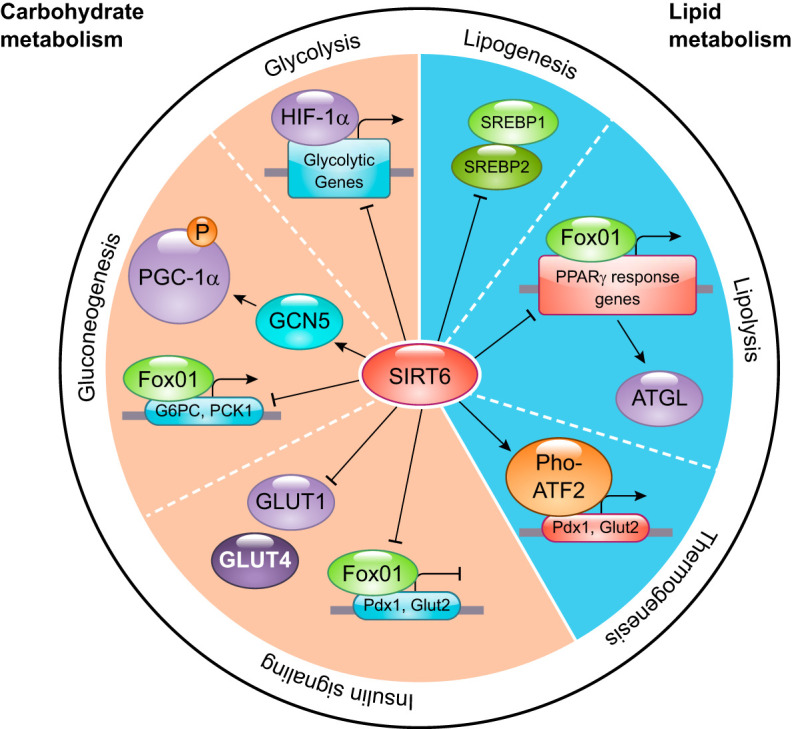
Role of SIRT6 metabolic homeostasis. Early studies identified glycolytic genes as direct targets of SIRT6, in which SIRT6 deacetylated H3K9, repressing these genes and influencing glucose metabolism. At the promoters of key glycolytic genes, SIRT6 deacetylates histone H3K9, thereby repressing the expression of key enzymes and glycolytic genes, including GLUT1, PDK1, and LDHA. Later studies proved extensive roles for SIRT6, acting as both an H3K9 and H3K56 deacetylase, in repressing gene expression in multiple contexts, including a co-repressive function on lipid metabolism, gluconeogenesis, and insulin signaling. In the liver, SIRT6-mediated deacetylation activates GCN5, which then increases peroxisome proliferator-activated receptor-γ coactivator-1α (PGC-1α) acetylation and represses its stimulation of gluconeogenesis. With regard to insulin signaling, SIRT6 induced expression of Pdx1 and Glut2 thereby maintaining the glucose-sensing ability of pancreatic β cells and systemic glucose tolerance. SIRT6 also functions to modulate cellular lipid metabolism through various feedback loops including fatty acid oxidation and cholesterol metabolism. P, phosphorylation; PPARγ, peroxisome proliferator-activated receptor γ; HIF-1α, hypoxia-inducible factor-1α.
FIGURE 6.
FIGURE 6.
Role of SIRT6 in human tumorigenesis. Dual functions for SIRT6 as a tumor suppressor and tumor promoter in various contexts. Several reports demonstrate that SIRT6 functions as a tumor suppressor, inhibiting the initiation and progression of colorectal and pancreatic cancer in vivo through various mechanisms. Likewise, SIRT6 expression has been shown to be downregulated in a number of human malignancies. In contrast to the cancers already mentioned, a variety of malignancies display upregulation of SIRT6 expression. More research is required into whether the timing of SIRT6 loss or gain throughout the stages of tumorigenesis could impact tumor suppressor or oncogenic function.

References

    1. Abifadel M, Varret M, Rabès JP, Allard D, Ouguerram K, Devillers M, Cruaud C, Benjannet S, Wickham L, Erlich D, Derré A, Villéger L, Farnier M, Beucler I, Bruckert E, Chambaz J, Chanu B, Lecerf JM, Luc G, Moulin P, Weissenbach J, Prat A, Krempf M, Junien C, Seidah NG, Boileau C. Mutations in PCSK9 cause autosomal dominant hypercholesterolemia. Nat Genet 34: 154–156, 2003. doi: 10.1038/ng1161. - DOI - PubMed
    1. Ahn BH, Kim HS, Song S, Lee IH, Liu J, Vassilopoulos A, Deng CX, Finkel T. A role for the mitochondrial deacetylase Sirt3 in regulating energy homeostasis. Proc Natl Acad Sci USA 105: 14447–14452, 2008. doi: 10.1073/pnas.0803790105. - DOI - PMC - PubMed
    1. Atsumi Y, Minakawa Y, Ono M, Dobashi S, Shinohe K, Shinohara A, Takeda S, Takagi M, Takamatsu N, Nakagama H, Teraoka H, Yoshioka K. ATM and SIRT6/SNF2H Mediate Transient H2AX Stabilization When DSBs Form by Blocking HUWE1 to Allow Efficient γH2AX Foci Formation. Cell Rep 13: 2728–2740, 2015. doi: 10.1016/j.celrep.2015.11.054. - DOI - PubMed
    1. Bai L, Lin G, Sun L, Liu Y, Huang X, Cao C, Guo Y, Xie C. Upregulation of SIRT6 predicts poor prognosis and promotes metastasis of non-small cell lung cancer via the ERK1/2/MMP9 pathway. Oncotarget 7: 40377–40386, 2016. doi: 10.18632/oncotarget.9750. - DOI - PMC - PubMed
    1. Baker JR, Vuppusetty C, Colley T, Papaioannou AI, Fenwick P, Donnelly L, Ito K, Barnes PJ. Oxidative stress dependent microRNA-34a activation via PI3Kα reduces the expression of sirtuin-1 and sirtuin-6 in epithelial cells. Sci Rep 6: 35871, 2016. doi: 10.1038/srep35871. - DOI - PMC - PubMed

Publication types