. 2019 Aug 22;9(1):12229.
doi: 10.1038/s41598-019-48647-7.

Entangled-photon decision maker

Affiliations

Entangled-photon decision maker

Nicolas Chauvet et al. Sci Rep. .

Abstract

The competitive multi-armed bandit (CMAB) problem is related to social issues such as maximizing total social benefits while preserving equality among individuals by overcoming conflicts between individual decisions, which could seriously decrease social benefits. The study described herein provides experimental evidence that entangled photons physically resolve the CMAB in the 2-arms 2-players case, maximizing the social rewards while ensuring equality. Moreover, we demonstrated that deception, or outperforming the other player by receiving a greater reward, cannot be accomplished in a polarization-entangled-photon-based system, while deception is achievable in systems based on classical polarization-correlated photons with fixed polarizations. Besides, random polarization-correlated photons have been studied numerically and shown to ensure equality between players and deception prevention as well, although the CMAB maximum performance is reduced as compared with entangled photon experiments. Autonomous alignment schemes for polarization bases were also experimentally demonstrated based only on decision conflict information observed by an individual without communications between players. This study paves a way for collective decision making in uncertain dynamically changing environments based on entangled quantum states, a crucial step toward utilizing quantum systems for intelligent functionalities.


Conflict of interest statement

The authors declare no competing interests.

Figures
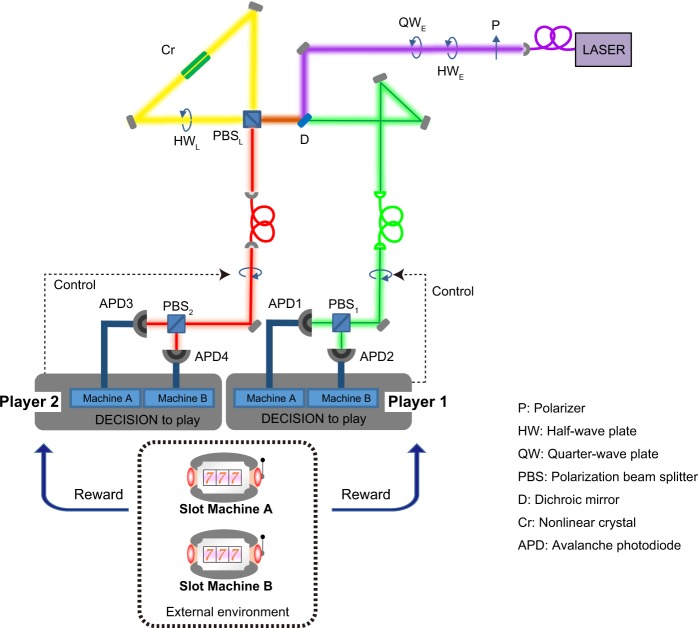
Figure 1
Figure 1
Experimental architecture for solving the CMAB problem using entangled photons. Spontaneous parametric down-conversion is induced in a nonlinear PPKTP crystal inserted in a Sagnac interferometer architecture. The signal light is used for the decision of Player 1, while the idler light is used for that of Player 2. By configuring the half-wave and quarter-wave plates in front of the excitation laser, polarization-correlated or polarization-entangled photon pairs can be equally generated. The two slot machines (Machines A and B) are external environments, which are emulated in the host computer.
Figure 2
Figure 2
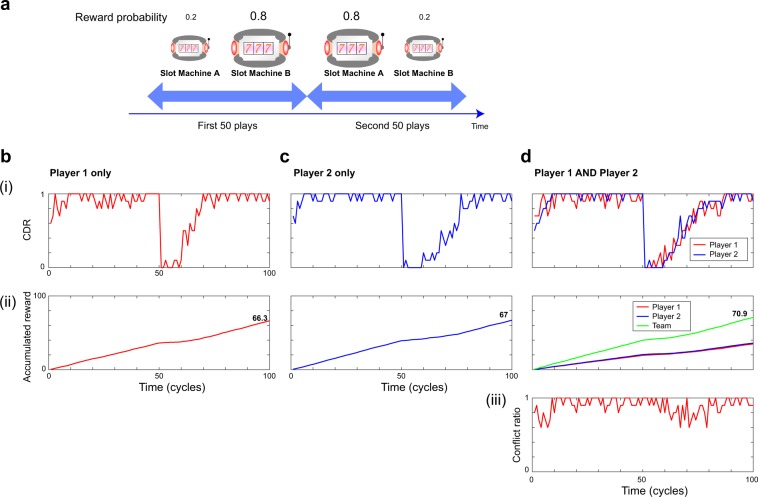
Experimental decision making by a single player and two non-cooperative players. (a) Schematic illustration of the casino setting: the reward probability of Machine B is higher (PB = 0.8) than that of Machine A (PA = 0.2) in the first 50 plays, whereas that of Machine A is higher (PA = 0.8) than that of Machine B (PB = 0.2) in the second 50 plays. (b) Decision making when only Player 1 plays the casino. (i) The CDR, which is the ratio of choosing the higher-reward-probability slot machine over the number of trials, adaptively approaches unity, meaning that Player 1 is making good decisions. (ii) The accumulated reward linearly increases over time. (c) Decision making when only Player 2 plays the machines. (d) Decision making when both Players 1 and 2 play the machines. The CDRs of both players adaptively approach unity; that is, both players choose the higher-reward-probability machine. However, making the same decision causes conflict between their decisions, limiting the rewards for each of the players as well as the team rewards (ii). (iii) The conflict ratio, which is the ratio of the occurrence of identical decisions by the two players over the number of trials.
Figure 3
Figure 3
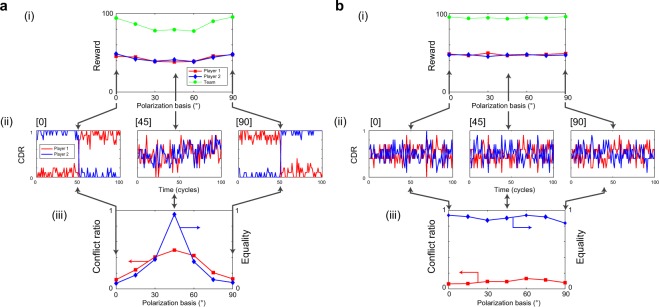
Experimental collective decision making using polarization-correlated and polarization-entangled photon pairs. (a) Detailed analysis of the case of orthogonally polarized photon pairs. (b) Detailed analysis of the case of entangled photon pairs, where the low conflict ratio and high equality are preserved regardless of the polarization basis.
Figure 4
Figure 4
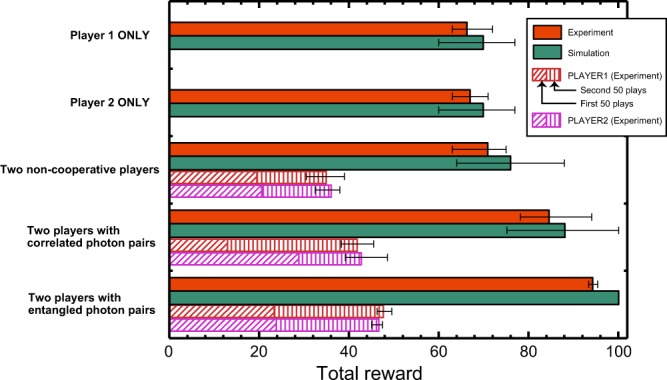
Comparison of total rewards. Comparison of the accumulated total reward after 100 plays, averaged over 10 repetitions, between the cases of a single player, two non-cooperative players, and two players with polarization-correlated and entangled photon pairs.
Figure 5
Figure 5
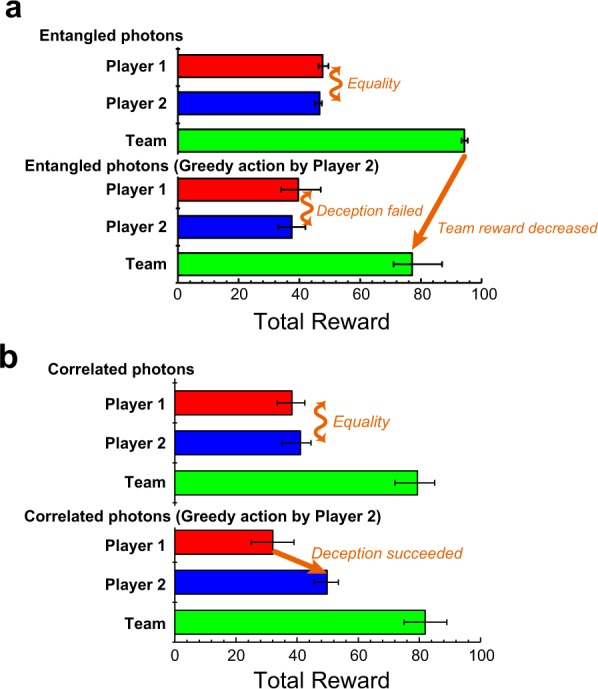
Prevention of deception or greedy action. Comparison of individual’s and team’s accumulated rewards at cycle 100. (a) With polarization-entangled photons, the accumulated reward of Player 2 is almost equal to that of Player 1, meaning that deception failed. Furthermore, the total team reward decreases. (b) With polarization-correlated photons, the reward accumulated by Player 2 is greater than that of Player 1, namely, deception is accomplished.
Figure 6
Figure 6
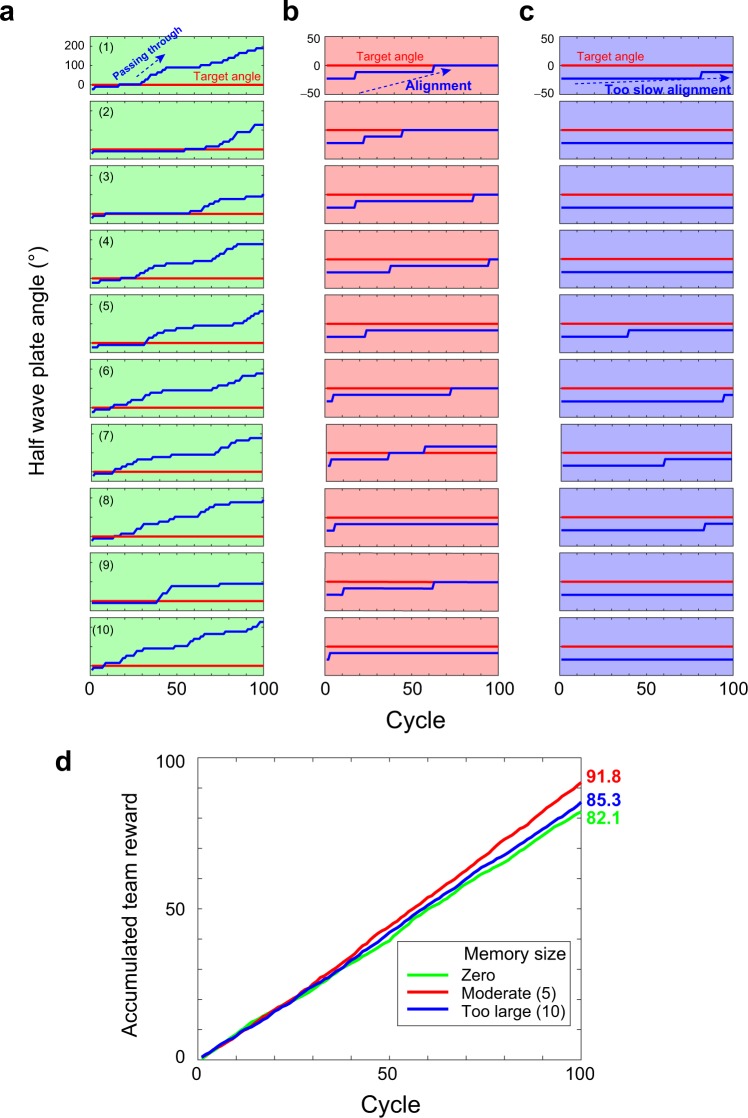
Autonomous polarization basis alignment under Assumptions I and II. Without any prior information, autonomous alignment should be possible by gradually rotating one of the half-wave plates. (a) However, due to the error signals that sometimes occur even when the polarization bases are aligned, the mechanism does not work well since the system passes through the optimal situation. (b) By referring to the recent history of the events involving decision conflict, robustness against errors is accomplished. (c) With too much reference to past events, the reaction becomes very slow.

References

    1. Brunner D, Soriano MC, Mirasso CR, Fischer I. Parallel photonic information processing at gigabyte per second data rates using transient states. Nat. Commun. 2013;4:1364. doi: 10.1038/ncomms2368. - DOI - PMC - PubMed
    1. Inagaki T, et al. A coherent Ising machine for 2000-node optimization problems. Science. 2016;354:603–606. doi: 10.1126/science.aah4243. - DOI - PubMed
    1. Shen Y, et al. Deep learning with coherent nanophotonic circuits. Nat. Photon. 2017;11:441–446. doi: 10.1038/nphoton.2017.93. - DOI
    1. Sutton, R. S. & Barto, A. G. Reinforcement Learning: An Introduction (The MIT Press, 1998).
    1. Silver D, et al. Mastering the game of go without human knowledge. Nature. 2017;550:354. doi: 10.1038/nature24270. - DOI - PubMed

Publication types