Review
. 2019 Jul 30:13:139-178.
doi: 10.2147/BTT.S207246. eCollection 2019.

Remicade® (infliximab): 20 years of contributions to science and medicine

Affiliations
Review

Remicade® (infliximab): 20 years of contributions to science and medicine

Richard Melsheimer et al. Biologics. .

Abstract

On August 24, 1998, Remicade® (infliximab), the first tumor necrosis factor-α (TNF) inhibitor, received its initial marketing approval from the US Food and Drug Administration for the treatment of Crohn's disease. Subsequently, Remicade was approved in another five adult and two pediatric indications both in the USA and across the globe. In the 20 years since this first approval, Remicade has made several important contributions to the advancement of science and medicine: 1) clinical trials with Remicade established the proof of concept that targeted therapy can be effective in immune-mediated inflammatory diseases; 2) as the first monoclonal antibody approved for use in a chronic condition, Remicade helped in identifying methods of administering large, foreign proteins repeatedly while limiting the body's immune response to them; 3) the need to establish Remicade's safety profile required developing new methods and setting new standards for postmarketing safety studies, specifically in the real-world setting, in terms of approach, size, and duration of follow-up; 4) the study of Remicade has improved our understanding of TNF's role in the immune system, as well as our understanding of the pathophysiology of a range of diseases characterized by chronic inflammation; and 5) Remicade and other TNF inhibitors have transformed treatment practices in these chronic inflammatory diseases: remission has become a realistic goal of therapy and long-term disability resulting from structural damage can be prevented. This paper reviews how, over the course of its development and 20 years of use in clinical practice, Remicade was able to make these contributions.

Keywords: Crohn’s disease; Remicade; TNF inhibition; immune-mediated inflammatory disease; infliximab; monoclonal antibody; rheumatoid arthritis.


Conflict of interest statement

RM, AG, and IA are current employees of Janssen Pharmaceuticals and stockholders in Johnson & Johnson, Janssen’s parent company. TS is a former Janssen employee and a stockholder in, and receives a pension from Johnson & Johnson. The authors report no other conflicts of interest in this work.

Figures
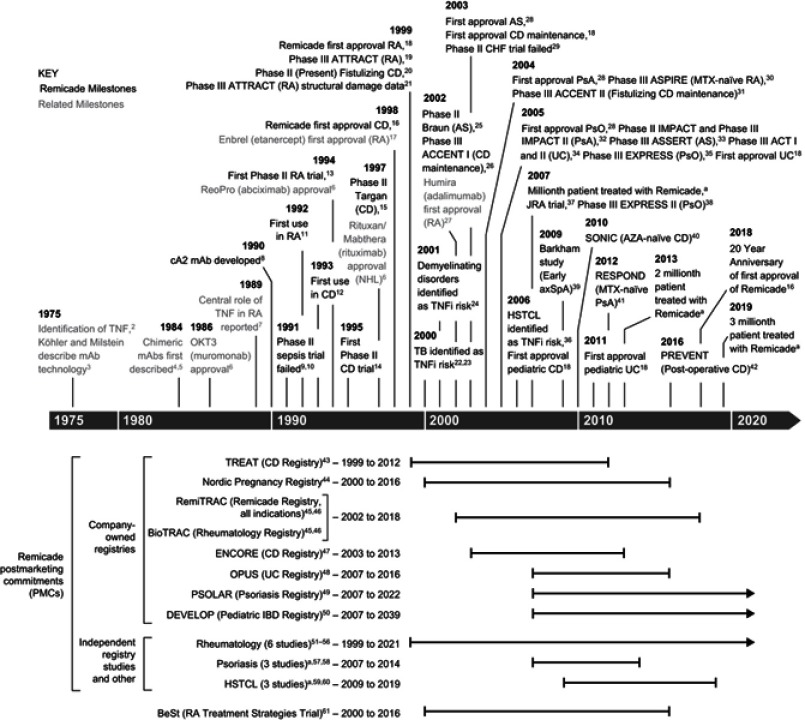
Figure 1
Figure 1
Key milestones in the development of Remicade. Note: aJanssen, data on file. Abbreviations: AS, ankylosing spondylitis; axSpA, axial spondyloarthritis; CD, Crohn’s disease; CHF, congestive heart failure; HSTCL, hepatosplenic T-cell lymphoma; IBD, inflammatory bowel disease; JRA, juvenile rheumatoid arthritis; MTX, methotrexate; mAb, monoclonal antibody; NHL, non-Hodgkin’s lymphoma; PBO, placebo; PsA, psoriatic arthritis; PsO, psoriasis; RA, rheumatoid arthritis; TB, tuberculosis; TNF, tumor necrosis factor; TNFi, TNF inhibition; UC, ulcerative colitis.
Figure 2
Figure 2
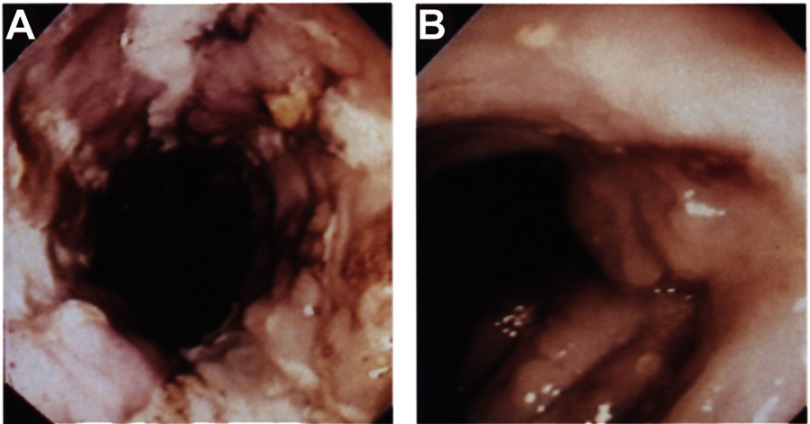
Healing of colonic ulcerations in a Crohn's disease patient (A) before treatment and (B) 4 weeks after a single infusion of Remicade 10 mg/kg. Notes: Gastroenterology by American Gastroenterological Association. Reproduced with permission of W.B./Saunders Co., from Treatment of Crohn’s disease with anti-tumor necrosis factor chimeric monoclonal antibody (cA2). van Dulleman HM, van Deventer SJ, Hommes DW, et al.  Gastroenterology, volume 109, issue 1, 1995.
Figure 3
Figure 3
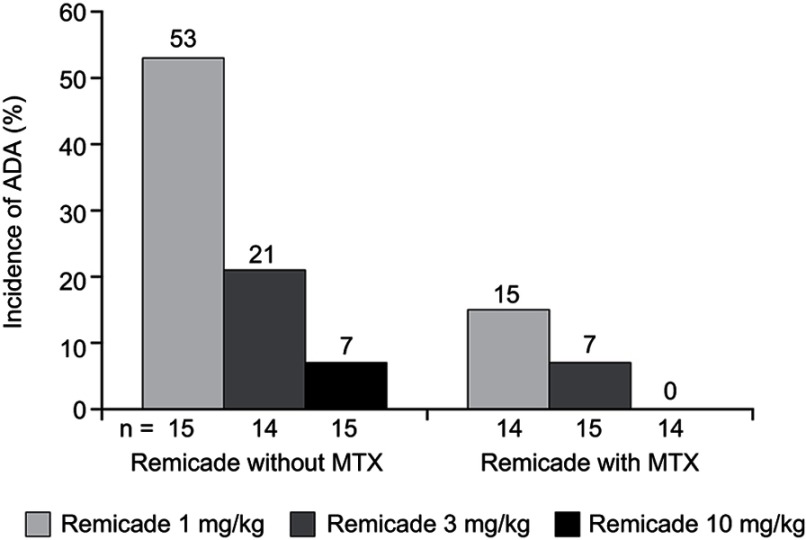
Incidence of ADAs in a phase II trial of MTX-refractory RA patients, by Remicade dose and use of concomitant MTX. ADAs were measured by a drug-sensitive immunoassay. Note: Data from Maini et al. Abbreviations: ADA, anti-drug antibody; MTX, methotrexate; RA, rheumatoid arthritis.
Figure 4
Figure 4
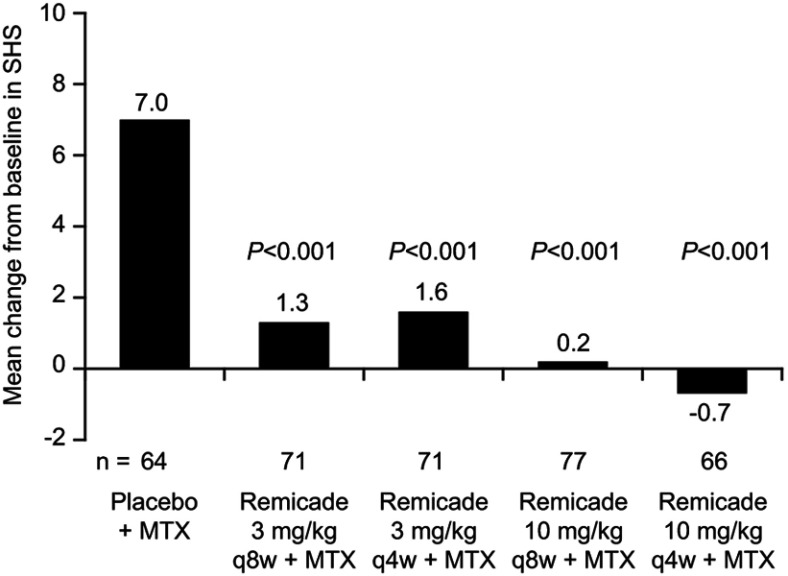
Progression of structural damage in RA at week 54 in the ATTRACT trial. Notes: Data from Lipsky. P-values vs placebo + MTX arm. Abbreviations: MTX, methotrexate; q4w, every 4 weeks; q8w, every 8 weeks; SHS, Sharp/van der Hejde score.
Figure 5
Figure 5
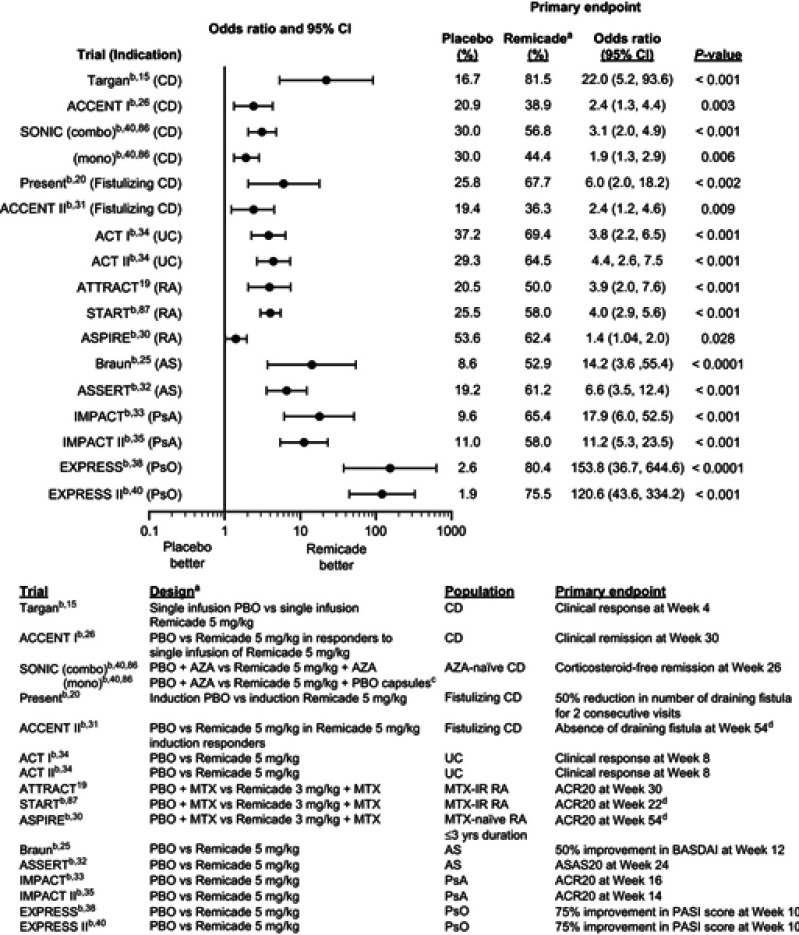
Efficacy of Remicade in pivotal phase II/III clinical trials in adult indications: odds ratio of primary endpoint. Notes: aMost trials evaluated multiple doses of Remicade. In the treatment arms shown (the generally approved doses), the Remicade dosing regimen tested was induction (infusions at weeks 0, 2, and 6) followed by q8w maintenance, with the exceptions of the Targan and Present studies, where single infusion and induction only, respectively, were tested, and of the AS trials (Braun and ASSERT), where induction followed by q6w maintenance was tested. bJanssen, data on file. cPBO of AZA. dMajor secondary endpoint. The primary endpoint was a continuous variable for which an odds ratio was not calculated. Abbreviations: ACR20, American College of Rheumatology 20% response; AS, ankylosing spondylitis; ASAS20, Ankylosing Spondylitis Activity Score 20% response; AZA, azathioprine; BASDAI, Bath Ankylosing Spondylitis Disease Activity Index; CD, Crohn’s disease; MTX, methotrexate; MTX-IR, methotrexate inadequate responders; PASI 75, Psoriasis Area and Severity Index 75% reduction; PBO, placebo; PsA, psoriatic arthritis; PsO, psoriasis; q6w, every 6 weeks; q8w, every 8 weeks; RA, rheumatoid arthritis; UC, ulcerative colitis.
Figure 6
Figure 6
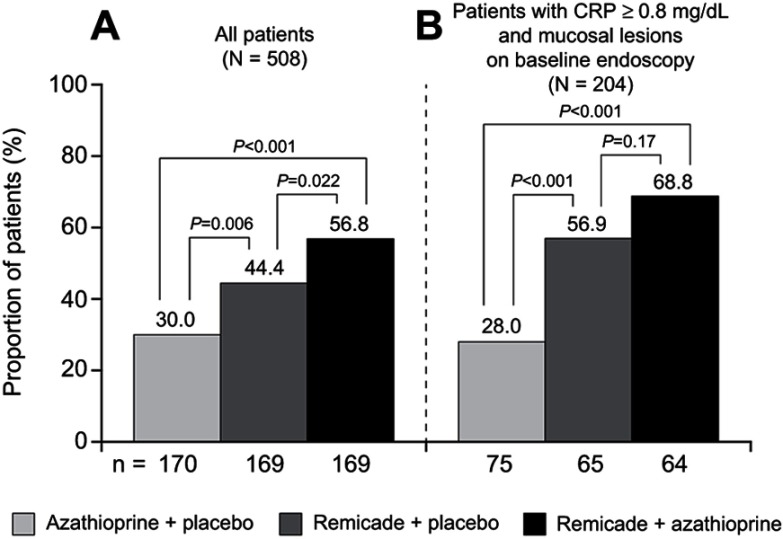
SONIC trial: primary endpoint (steroid-free remission) at week 26 in (A) all patients and (B) patients with elevated CRP (≥0.8 mg/dL) and mucosal lesions at baseline. (A) From Colombel JF, Sandborn WJ, Reinisch W, et al. Infliximab, azathioprine, or combination therapy for Crohn’s disease. N Engl J Med. 2010;362:1383–1395. Copyright © 2010 Massachusetts Medical Society. Reprinted with permission from Massachusetts Medical Society; and (B) from Colombel JF, Sandborn WJ, Reinisch W, et al. Infliximab, azathioprine, or combination therapy for Crohn’s disease. N Engl J Med. 2010;362(15):1383–1395. Supplementary Material. Copyright © 2010 Massachusetts Medical Society. Reprinted with permission from Massachusetts Medical Society. Abbreviation: CRP, C-reactive protein.
Figure 7
Figure 7
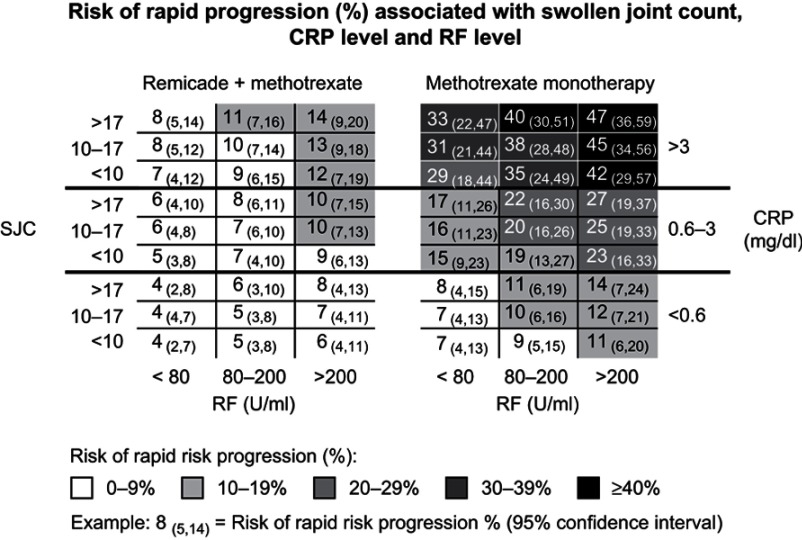
Prediction model of rapid radiographic progression in RA: matrix model from the ASPIRE trial in MTX-naïve, early RA. Rapid progression was defined as a threshold change in modified Sharp/van der Heijde (SHS) score of ≥5 units/year. From Vastesaeger N, Xu S, Aletaha D, et al. A pilot risk model for the prediction of rapid radiographic progression in rheumatoid arthritis. Rheumatology. 2009;48(9):1114–1121. doi:10.1093/rheumatology/kep155. Reproduced by permission of Oxford University Press on behalf of the British Society for Rheumatology. Abbreviations: CRP, C-reactive protein; MTX, methotrexate; RA, rheumatoid arthritis; RF, rheumatoid factor; SJC, swollen joint count, 28 joints assessed.
Figure 8
Figure 8
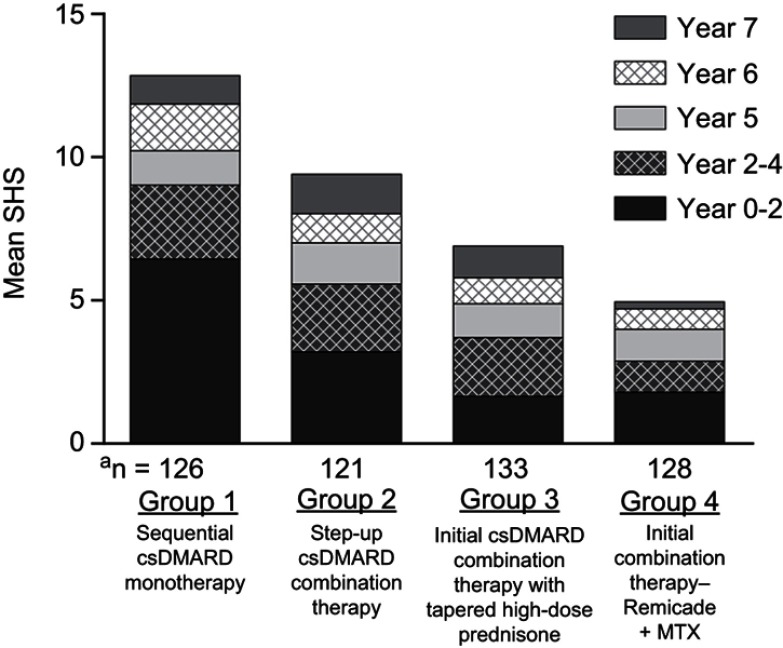
Cumulative progression of joint damage through year 7 in BeSt. Reproduced with permission from Van den Broek M, Lems WF, Allaart CF. BeSt practice: the success of early-targeted treatment in rheumatoid arthritis. Clin Exp Rheumatol. 30(4 Suppl 73):S35–S38. Copyright © 2012 Clinical and Experimental Rheumatology SAS. aSample size represents the population originally randomized to each arm. Numbers of patients at the end of each year of follow-up differed. Abbreviations: csDMARD, conventional synthetic disease-modifying anti-rheumatic drug; MTX, methotrexate; SHS, Sharp/van der Heijde score.

References

    1. REMICADE® [Package Insert]. Horsham, PA: Janssen Pharmaceuticals Inc; 2013.
    1. Carswell EA, Old LJ, Kassel RL, Green S, Fiore N, Williamson B. An endotoxin-induced serum factor that causes necrosis of tumors. Proc Natl Acad Sci U S A. 1975;72(9):3666–3670. doi:10.1073/pnas.72.6.2091 - DOI - PMC - PubMed
    1. Köhler G, Milstein C. Continuous cultures of fused cells secreting antibody of predefined specificity. Nature. 1975;256(5517):495–497. doi:10.1038/256495a0 - DOI - PubMed
    1. Morrison SL, Johnson MJ, Herzenberg LA, Oi VT. Chimeric human antibody molecules: mouse antigen-binding domains with human constant region domains. Pro Natl Acad Sci U S A. 1984;81(21):6851–6855. doi:10.1073/pnas.81.21.6851 - DOI - PMC - PubMed
    1. Boulianne GL, Hozumi N, Shulman MJ. Production of functional chimeric mouse/human antibody. Nature. 1984;312(5995):643–646. doi:10.1038/312643a0 - DOI - PubMed