Comparative Study
. 2019 Aug 8:10:1846.
doi: 10.3389/fimmu.2019.01846. eCollection 2019.

Highly Efficient Generation of Pigs Harboring a Partial Deletion of the CD163 SRCR5 Domain, Which Are Fully Resistant to Porcine Reproductive and Respiratory Syndrome Virus 2 Infection

Affiliations
Comparative Study

Highly Efficient Generation of Pigs Harboring a Partial Deletion of the CD163 SRCR5 Domain, Which Are Fully Resistant to Porcine Reproductive and Respiratory Syndrome Virus 2 Infection

Chunhe Guo et al. Front Immunol. .

Abstract

Porcine reproductive and respiratory syndrome virus (PRRSV) 1 and 2 differ in their recognition of CD163. Substitution of porcine CD163 SRCR5 domain with a human CD163-like SRCR8 confers resistance to PRRSV 1 but not PRRSV 2. The deletion of CD163 SRCR5 has been shown to confer resistance to PRRSV 1 in vivo and both PRRSV 1 and 2 in vitro. However, the anti-PRRSV 2 activity of modifying the CD163 SRCR5 domain has not yet been reported. Here, we describe the highly efficient generation of two pig breeds (Liang Guang Small Spotted and Large White pigs) lacking a short region of CD163 SRCR5, including the ligand-binding pocket. We generated a large number of gene-edited Large White pigs of the F0 generation for use in viral challenge studies. The results of this study show that these pigs are completely resistant to infection by species 2 PRRSV, JXA1, and MY strains. There were no clinical symptoms, pathological abnormalities, viremia, or anti-PRRSV antibodies in the CD163 SRCR5-edited pigs compared to wild-type controls after viral challenge. Porcine alveolar macrophages (PAMs) isolated from CD163 SRCR5-edited Large White pigs also displayed resistance to PRRSV in vitro. In addition, CD163 SRCR5-edited PAMs still exhibited a cytokine response to PRRSV infection, and no significant difference was observed in cytokine expression compared to wild-type PAMs. Taken together, these data suggest that CD163 SRCR5-edited pigs are resistant to PRRSV 2, providing a basis for the establishment of PRRSV-resistant pig lines for commercial application and further investigation of the essential region of SRCR5 involved in virus infection.

Keywords: CD163; CRISPR/Cas9; PRRSV; SRCR5; resistance.


Figures
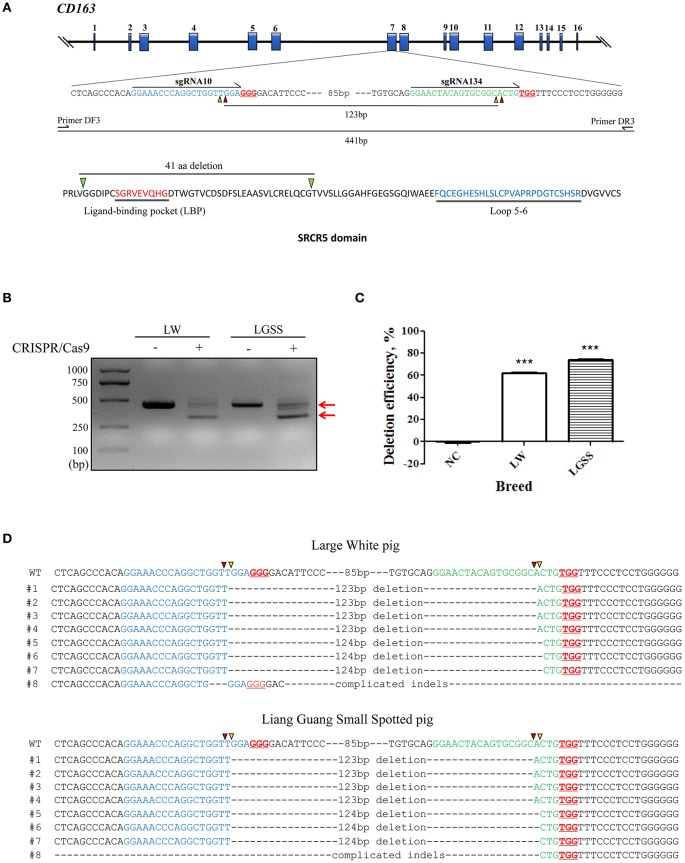
Figure 1
Figure 1
Generation of the precise partial deletion of CD163 SRCR5 in porcine embryonic fibroblasts (PEFs) using CRISPR/Cas9. (A) Schematic of the CD163 gene and target sites of sgRNAs designed for targeting SRCR5 in the exon 7. The 16 exons of CD163 are indicated by blue rectangles. Arrows indicate the sequence used for the guide segment of sgRNA10 and 134. The NGG nucleotide protospacer adjacent motif sequences are underlined in red. Red and yellow triangles represent the predicted cleavage sites of sgRNAs. A precise excision with paired sgRNAs results in a 123 bp in-frame deletion including ligand-binding pocket (LBP). The primer pair DF3/DR3 was used to amplify a 441 bp product from the intact allele of CD163 gene and a truncated product of 317 bp if the deletion (123 bp) has occurred. Two regions (LBP and loop 5–6) of SRCR5 are shown. (B) PCR products identifying the presence of the targeted deletion of CD163 SRCR5 induced by paired sgRNAs. The upper red arrow indicates the position of the 441 bp full length PCR product, and the lower red arrow indicates the expected positions of the truncated PCR product in the event of deletion. LW, Large White pig; LGSS, Liang Guang Small Spotted pig; M, marker. (C) The efficiency of the targeted deletion in PEFs was quantified by qPCR. ***p < 0.001 compared to negative control. (D) Sequence analysis of cloned PCR products. The guide segments of sgRNA 10 and 134 are shown in blue and green, respectively. Red and yellow triangles represent the predicted cleavage sites of sgRNAs. WT, wild-type DNA sequence. Data are representative of the results of three independent experiments (means ± SE). Significant differences are indicated as follows: ***p < 0.001.
Figure 2
Figure 2
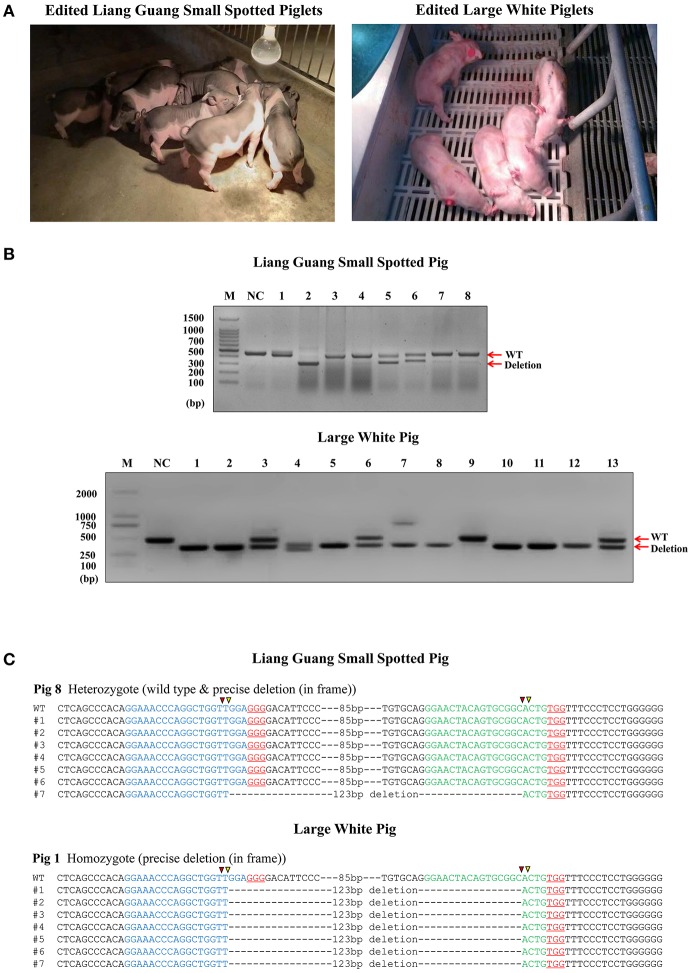
Generation of pigs harboring a precise partial deletion of CD163 SRCR5. (A) Representative photos of CD163-edited Liang Guang Small Spotted piglets and Large White piglets. (B) Genotyping of edited piglets. DNA was extracted from ear biopsies and genotype was assessed by PCR across the target sites of the paired sgRNAs. The PCR product of the unmodified genome is predicted to be 441 bp, while the deletion (123 bp) should result in a 317 bp PCR product. NC, negative control using the PCR product from wild-type genomic DNA. Each numbered lane indicates the PCR product from one healthy gene-edited piglet. (C) Sequencing of the cloned PCR products shows a representative Liang Guang Small Spotted piglet carrying a heterologous in frame deletion (123 bp) in CD163 SRCR5, and a representative Large White piglet carrying a homologous in frame deletion (123 bp) in CD163 SRCR5. Red and yellow triangles are predicted cutting sites of Cas9 nuclease.
Figure 3
Figure 3
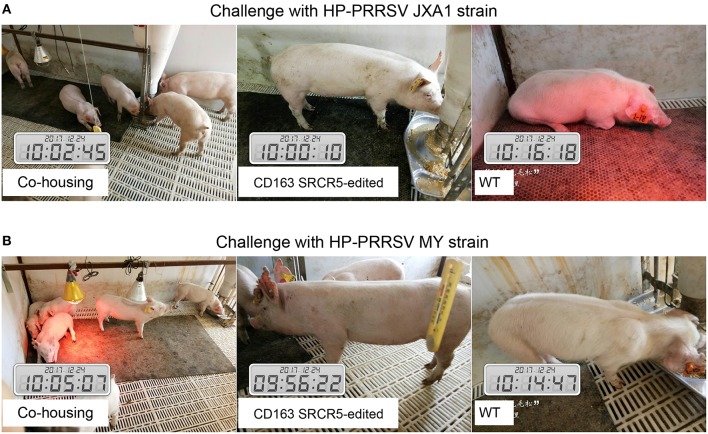
CD163 SRCR5-edited pigs do not show clinical symptoms after PRRSV challenge. (A,B) Sixteen piglets were divided into two groups, of which four CD163 SRCR5-edited Large White piglets and four WT piglets were mixed as a group. These piglets were co-housed and given access to food and water ad libitum. One group was challenged with the PRRSV JXA1 strain (A), the other group was challenged with the PRRSV MY strain (B). Clinical signs related to PRRSV, including respiratory and neurological symptoms, were observed and recorded every day post challenge. Pictures were taken on day 21 post challenge.
Figure 4
Figure 4
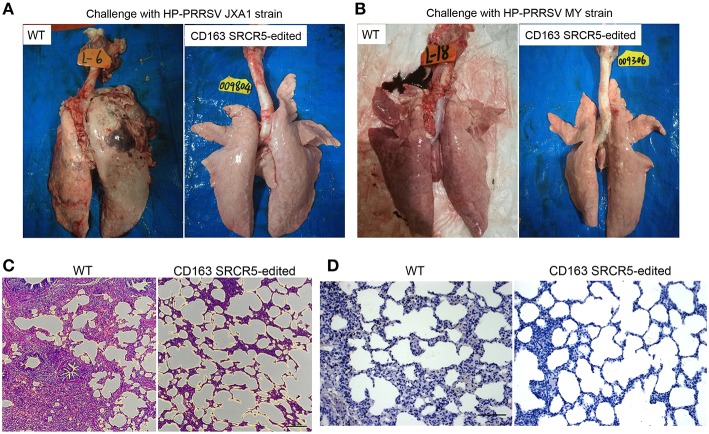
CD163 SRCR5-edited pigs exhibit normal histopathology after PRRSV challenge. Lungs were isolated from CD163 SRCR5-edited and WT animals on day 42 post PRRSV challenge. Pathological changes of lung lesions were observed and assessed using visual examination, Hematoxylin and Eosin (H&E) staining and immunohistochemistry. (A,B) Photographs of the dorsal side of lungs from CD163 SRCR5-edited and WT animals challenged with PRRSV JXA1 (A) and MY (B) strains. (C) Lung paraffin sections were stained with H&E (scale bar, 100 μm). (D) Immunohistochemistry analysis of the PRRSV antigen (brown) in lung paraffin sections (scale bar, 50 μm). The macrophages stain intensely dark brown due to the presence of the PRRSV antigen.
Figure 5
Figure 5
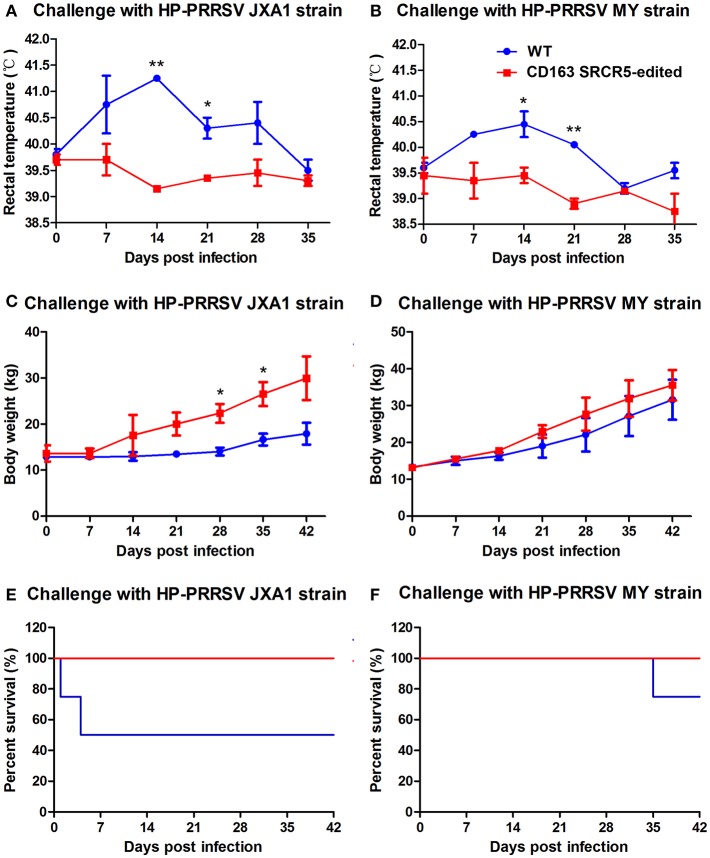
CD163 SRCR5-edited pigs survive post PRRSV challenge. (A–F) Rectal temperature (A,B) and body weights (C,D) were measured on day 0 prior to challenge and the days 7, 14, 21, 28, 35, 42 post-challenge with PRRSV JXA1 and MY strains. (E,F) The mortality and survival curve of piglets during PRRSV JXA1 (E) and MY (F) strain challenges. The red line represents CD163 SRCR5-edited pigs, and the blue line represents WT controls. Data are representative of the results of three independent experiments (means ± SE). Significant differences are indicated as follows: *P < 0.05, **P < 0.01.
Figure 6
Figure 6
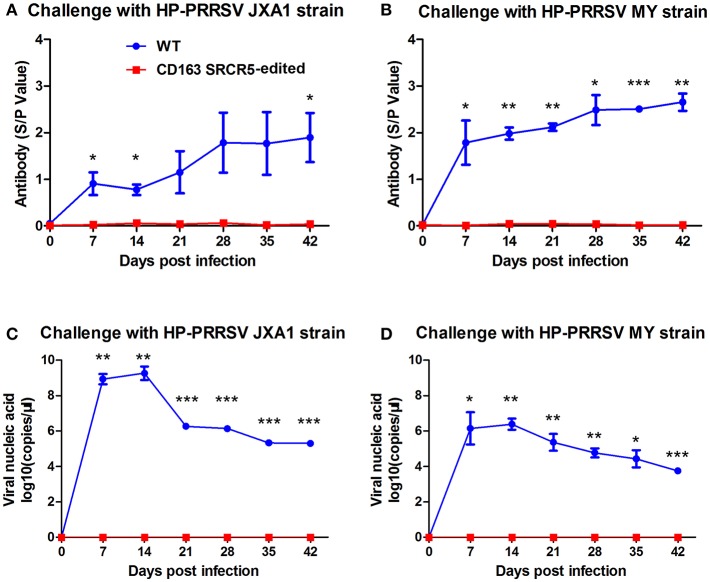
Viremia and anti-PRRSV antibodies are not present in CD163 SRCR5-edited animals. (A,B) Blood samples were collected to detect anti-PRRSV antibody titers on days 0, 7, 14, 21, 28, 35, and 42 post PRRSV JXA1 (A) and MY (B) challenge in CD163 SRCR5-edited animals and WT controls. The absorbance was detected at a wavelength of 570 nm. Antibody titers are represented as sample absorbance/positive absorbance (S/P). (C,D) Viral nucleic acid copy numbers in blood samples were measured on the designated days post JXA1 (C) and MY (D) inoculation of CD163 SRCR5-edited and WT animals. The red line represents CD163 SRCR5-edited pigs and the blue line represents WT controls. Data are representative of the results of three independent experiments (means ± SE). Significance is indicated as follows: *P < 0.05, **P < 0.01, ***P < 0.001.
Figure 7
Figure 7
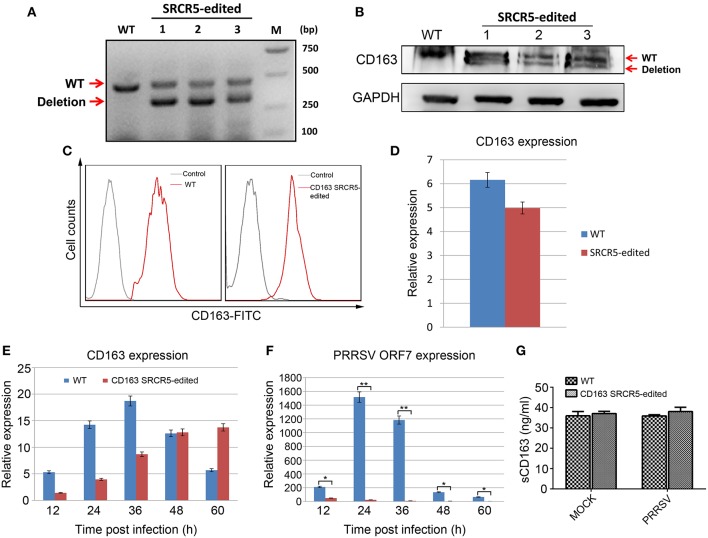
Resistance of PAMs isolated from CD163 SRCR5-edited piglets to PRRSV 2 in vitro. (A) RT-PCR analysis of CD163 expression in PAMs from three heterologous offspring of CD163 SRCR5-edited Large White pig 13. (B) Western blot analysis of CD163 protein expression from three heterologous offspring of CD163 SRCR5-edited Large White pig 13. (C) Expression of membranous CD163 in CD163 SRCR5-edited and WT PAMs was detected by flow cytometry. The gray line represents control cells and the red line represents the CD163-FITC positive cells. (D) CD163 mRNA expression was determined by qRT-PCR in SRCR5-edited cells and WT cells. (E,F) CD163 SRCR5-edited PAMs and WT controls were infected with JXA1 strain (MOI = 1). The expression of CD163 and PRRSV ORF7 was detected at 12, 24, 36, 48, and 60 h post infection (hpi). (G) CD163 SRCR5-edited PAMs and WT controls were either mock infected or infected with JXA1 strain (MOI = 1) for 24 h. The level of soluble CD163 in the supernatants was measured using an ELISA kit. Data are representative of the results of three independent experiments (means ± SE). Significant differences are indicated as follows: *P < 0.05, **P < 0.01.
Figure 8
Figure 8
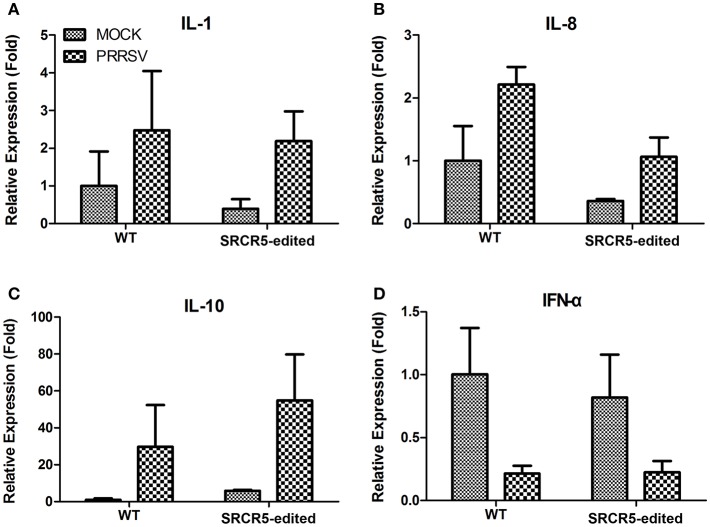
Expression of cytokines in PAMs isolated from CD163 SRCR5-edited piglets. (A–D) CD163 SRCR5-edited PAMs and WT PAMs were either mock infected or infected with JXA1 strain (MOI = 1) for 24 h. The expression of inflammatory cytokines IL-1β (A), IL-8 (B), IL-10 (C), and IFN-α (D) were analyzed using qRT-PCR. Relative expression (fold) in comparison with mock infected WT PAMs (set up as 1) is shown. Data are representative of the results of three independent experiments (means ± SE).

References

    1. Cho JG, Dee SA. Porcine reproductive and respiratory syndrome virus. Theriogenology. (2006) 66:655–62. 10.1016/j.theriogenology.2006.04.024 - DOI - PubMed
    1. Alvarez J, Valdes-Donoso P, Tousignant S, Alkhamis M, Morrison R, Perez A. Novel analytic tools for the study of porcine reproductive and respiratory syndrome virus (PRRSv) in endemic settings: lessons learned in the U.S. Porcine Health Manag. (2016) 2:3 10.1186/s40813-016-0019-0 - DOI - PMC - PubMed
    1. Zhou L, Yang H. Porcine reproductive and respiratory syndrome in China. Virus Res. (2010) 154:31–7. 10.1016/j.virusres.2010.07.016 - DOI - PubMed
    1. Guo Z, Chen XX, Li R, Qiao S, Zhang G. The prevalent status and genetic diversity of porcine reproductive and respiratory syndrome virus in China: a molecular epidemiological perspective. Virol J. (2018) 15:2 10.1186/s12985-017-0910-6 - DOI - PMC - PubMed
    1. Zhao K, Ye C, Chang XB, Jiang CG, Wang SJ, Cai XH, et al. Importation and recombination are responsible for the latest emergence of highly pathogenic porcine reproductive and respiratory syndrome virus in China. J Virol. (2015) 89:10712–6. 10.1128/JVI.01446-15 - DOI - PMC - PubMed

Publication types

MeSH terms