


Incidence of fractures in young women with breast cancer - a retrospective cohort study
- PMID: 31440445
- PMCID: PMC6698802
- DOI: 10.1016/j.jbo.2019.100254
Incidence of fractures in young women with breast cancer - a retrospective cohort study
Abstract
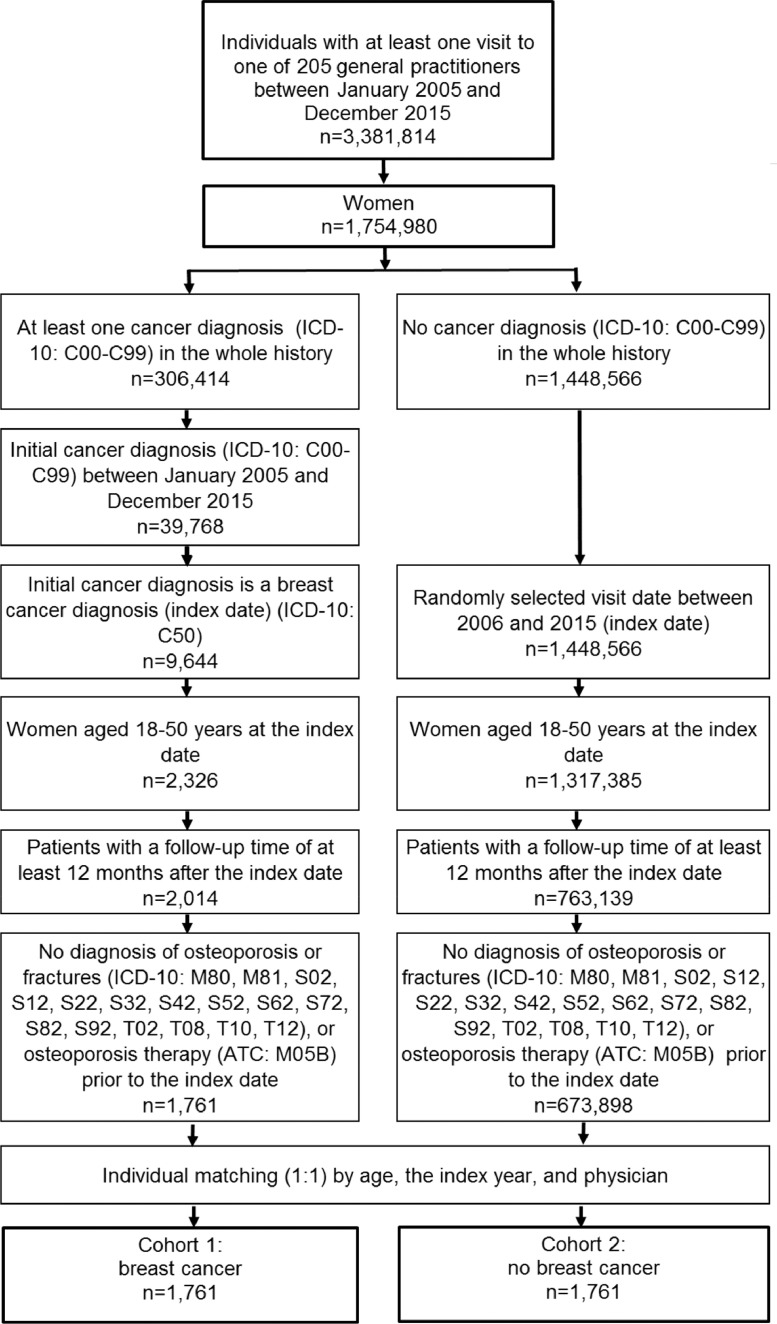
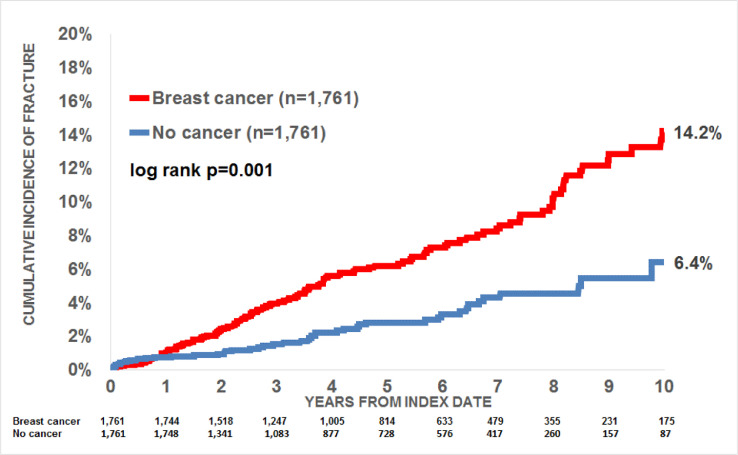
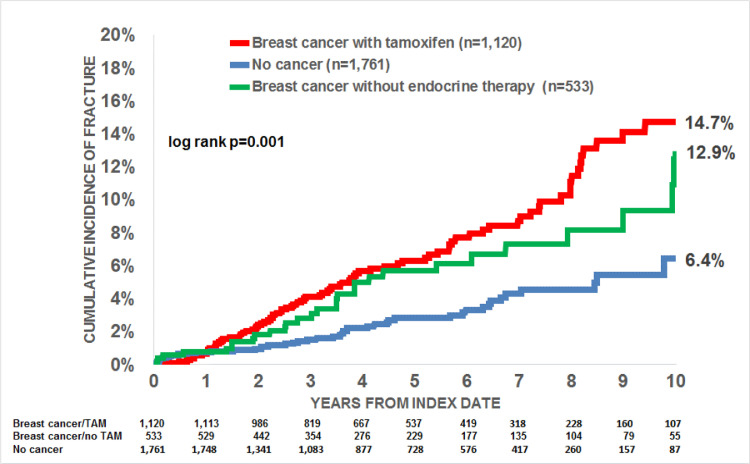
In recent years, cancer treatment-induced bone loss (CTIBL) and increased risk of fracture has become an emerging problem as breast cancer (BC) survival has increased due to early diagnosis and improved treatments. In premenopausal women with BC, chemotherapy and tamoxifen are the treatments of choice in hormone receptor-negative and hormone receptor-positive BC respectively. Their effect on fracture risk has only been investigated in a few small-scale studies. Therefore, we investigated the fracture risk in a cohort study based on data from the Disease Analyzer database (IQVIA) and included 1761 individuals with BC and 1761 healthy women for comparison. After applying similar inclusion criteria, patients with BC were matched 1:1 to those without BC with regard to age, index year, and physician. Within 10 years of the index date, 6.4% of healthy women and 14.2% with BC sustained a fracture (log-rank p-value < 0.001), showing a positive association between breast cancer and fractures (adjusted hazard ratio (HR)=2.39, p < 0.001). When analyzing women with BC with and without tamoxifen treatment, 14.7% with and 12.9% without tamoxifen sustained a fracture. However, after adjustment, the HR was 2.58 (p < 0.001) for women on tamoxifen versus healthy women and 1.63 (p = 0.181) for women with BC without tamoxifen treatment versus healthy women. In conclusion, premenopausal women with BC with or without tamoxifen treatment had an increased incidence of fractures compared to healthy women, but this difference was only significant when comparing tamoxifen users versus healthy women. More studies are needed to identify the specific risk factors of women at high risk.
Keywords: Breast cancer; Chemotherapy; Fracture; Osteoporosis; Premenopausal women; Tamoxifen.
Conflict of interest statement
All authors declare that they have no conflicts of interest with regard to this article.
Figures
References
-
- C.E. DeSantis, J. Ma, A. Goding Sauer, L.A. Newman, A. Jemal, Breast cancer statistics, 2017, racial disparity in mortality by state, CA: Cancer J. Clin.67(6) (2017) 439–448. - PubMed
-
- Schmidt N., Jacob L., Coleman R., Kostev K., Hadji P. The impact of treatment compliance on fracture risk in women with breast cancer treated with aromatase inhibitors in the United Kingdom. Breast Cancer Res. Treat. 2016;155(1):151–157. - PubMed
-
- Aebi S., Davidson T., Gruber G., Cardoso F. Primary breast cancer: ESMO clinical practice guidelines for diagnosis, treatment and follow-up. Ann. Oncol. Off. J. Eur. Soc. Med. Oncol. 2011;22(Suppl 6):vi12–vi24. - PubMed
-
- Senkus E., Kyriakides S., Ohno S., Penault-Llorca F., Poortmans P., Rutgers E., Zackrisson S., Cardoso F. Primary breast cancer: ESMO clinical practice guidelines for diagnosis, treatment and follow-up. Ann. Oncol. Off. J. Eur. Soc. Med. Oncol. 2015;26(Suppl 5):v8–30. - PubMed
LinkOut - more resources
Full Text Sources
Molecular Biology Databases
