doi: 10.3201/eid2509.190205.
Use of Human Intestinal Enteroids to Detect Human Norovirus Infectivity
- PMID: 31441758
- PMCID: PMC6711227
- DOI: 10.3201/eid2509.190205
Item in Clipboard
Use of Human Intestinal Enteroids to Detect Human Norovirus Infectivity
Emerg Infect Dis.
2019 Sep.
Abstract
Tools to detect human norovirus infectivity have been lacking. Using human intestinal enteroid cultures inoculated with GII.Pe-GII.4 Sydney-infected fecal samples, we determined that a real-time reverse transcription PCR cycle threshold cutoff of 30 may indicate infectious norovirus. This finding could be used to help guide infection control.
Keywords: Ct cutoff; Cycle threshold; Hong Kong; enteric infections; enteroids; human norovirus; infectivity; rRT-PCR; real-time reverse transcription PCR; viruses.
Figures
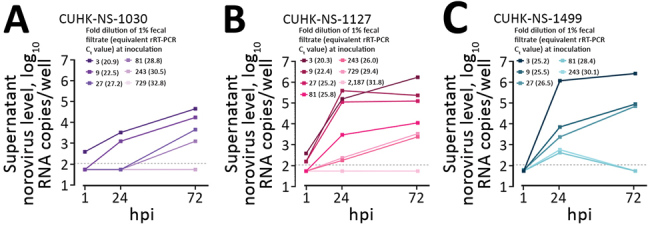
Performance of a human intestinal enteroid (HIE) line and an antigen-based enzyme immunoassay (EIA) to detect human norovirus in clinical fecal samples from 3 patients in Hong Kong. Replication kinetics of 3 human pandemic norovirus genogroup II genotype 4 (GII.Pe-GII.4 Sydney) strains (CUHK-NS-1030, from a 1-year-old boy; CUHK-NS-1127, from a 79-year-old man; CUHK-NS-1499, from a 46-year-old man) were tested in a monolayer culture of the adult stem cell–derived HIE line J2. We used 3-fold serial dilutions of norovirus-containing fecal filtrates to challenge J2 seeded on 96-well cell culture plates. Norovirus RNA levels in the culture supernatant at the indicated times were measured by rRT-PCR by using a 10-fold serially diluted standard of in vitro–transcribed norovirus RNA of genotype GII.Pe-GII.4 Sydney. Horizontal dotted lines denote the lower limit of detection of the rRT-PCR (13.8 RNA copies/reaction or 110 RNA copies/well) as determined by probit analysis. Samples with undetectable norovirus RNA were arbitrarily assigned a value equal to half of the lower limit of detection for calculation purpose. To convert the unit from RNA copies/well to RNA copies/mL, multiply the value by a factor of 10. hpi, hours postinoculation; rRT-PCR, real-time reverse transcription PCR.
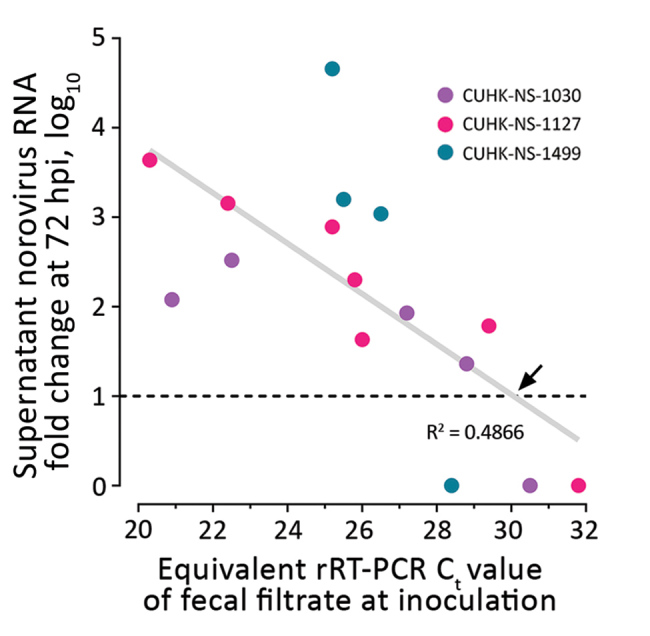
Estimation of a cutoff for rRT-PCR Ct value of inoculating fecal filtrate indicative of the ability to generate productive norovirus replication (i.e., containing infectious norovirus) in a human intestinal enteroid (HIE) line. We tested 3 strains of pandemic human norovirus genogroup II genotype 4 (GII.Pe-GII.4 Sydney) (CUHK-NS-1030, from a 1-year-old boy; CUHK-NS-1127, from a 79-year-old man; CUHK-NS-1499, from a 46-year-old man). We used 3-fold serial dilutions of norovirus-containing fecal filtrates to inoculate a monolayer culture of the adult stem cell–derived HIE line J2 seeded on 96-well cell culture plates. Productive norovirus replication was defined as having a supernatant viral RNA level increase of > 10-fold at 72 hpi from baseline (1 hpi) (horizontal dotted line). RNA fold change data were derived from those shown in Figure 1 and were arbitrarily defined as 1 for those without observable viral RNA replication. For each strain, only the first dilution that resulted in undetectable viral RNA is shown and was included in downstream data analysis. The diagonal gray line denotes the best-fit line from linear regression, and the equation is Y = −0.2818X + 9.47, where Y represents RNA fold change and X represents Ct value. The black arrow specifies a Cf cutoff of 30.1 of inoculating fecal filtrate that yields productive norovirus replication as estimated from regression analysis. Ct, cycle threshold; CUHK, Chinese University of Hong Kong; hpi, hours postinoculation; rRT-PCR, real-time reverse transcription PCR.
References
Publication types
MeSH terms
Grants and funding
LinkOut - more resources
Full Text Sources
Medical