


Reassessment of the Species in the Euwallacea Fornicatus (Coleoptera: Curculionidae: Scolytinae) Complex after the Rediscovery of the "Lost" Type Specimen
- PMID: 31443370
- PMCID: PMC6780773
- DOI: 10.3390/insects10090261
Reassessment of the Species in the Euwallacea Fornicatus (Coleoptera: Curculionidae: Scolytinae) Complex after the Rediscovery of the "Lost" Type Specimen
Abstract
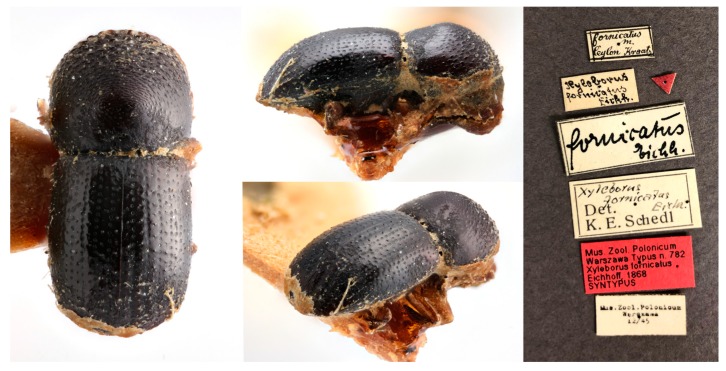
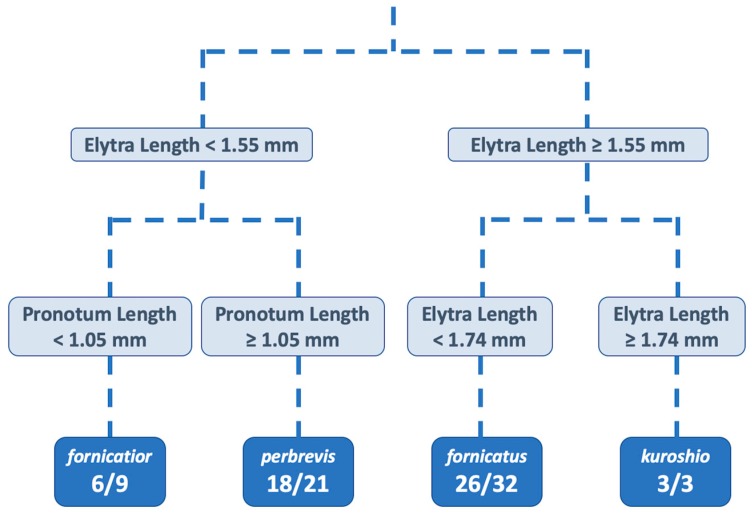
Ambrosia beetles of the Euwallacea fornicatus (Eichhoff, 1868) species complex are emerging tree pests, responsible for significant damage to orchards and ecosystems around the world. The species complex comprises seven described species, all of which are nearly identical. Given that the morphology-defined species boundaries have been ambiguous, historically, there has been much disagreement on species validity, which was compounded by the presumed loss of the type series of E. fornicatus. The species complex was recently reviewed using morphometrics to associate the type specimens to the clades delineated with molecular data under the assumption of the lost type series. We rediscovered a syntype of Xyleborus fornicatus, and reevaluated the species in the complex using morphometrics. We propose the following taxonomic changes to the species complex: Euwallacea fornicatus (=E. tapatapaoensis (Schedl, 1951); = E. whitfordiodendrus (Schedl, 1942)) syn. res.); E. fornicatior (Eggers, 1923) (=E. schultzei (Schedl, 1951) syn. nov.); E. kuroshio (Gomez and Hulcr, 2018) and E. perbrevis (Schedl, 1951) stat. res. These taxonomic changes shift the species name associated with the widely used common names for two taxa, namely: Euwallacea fornicatus should be used for the "Polyphagous Shot Hole Borer", and E. perbrevis for the "Tea Shot Hole Borer clade a". A lectotype is designated for X. fornicatus in order to stabilize the use of the name.
Keywords: ambrosia beetle; invasive species; species delineation; taxonomy.
Conflict of interest statement
The authors declare no conflict of interest. The sponsors had no role in the design, execution, interpretation, or writing of the study.
Figures
References
-
- Kirkendall L.R., Biedermann P.H.W., Jordal B.H. Evolution and diversity of bark and ambrosia beetles. In: Vega F.E., Hofstetter R.W., editors. Biology and Ecology of Native and Invasive Species. Academic Press; London, UK: 2015. pp. 85–156.
-
- Hulcr J., Atkinson T.H., Cognato A.I., Jordal B.H., McKenna D.D. Morphology, taxonomy, and phylogenetics of bark beetles. In: Vega F.E., Hofstetter R.W., editors. Biology and Ecology of Native and Invasive Species. Academic Press; London, UK: 2015. pp. 41–84.
-
- Stouthamer R., Rugman-Jones P., Thu P.Q., Eskalen A., Thibault T., Hulcr J., Wang L.-J., Jordal B.H., Chen C.-Y., Cooperband M., et al. Tracing the origin of a cryptic invader: Phylogeography of the Euwallacea fornicatus (Coleoptera: Curculionidae: Scolytinae) species complex. Agric. For. Entomol. 2017;19:366–375. doi: 10.1111/afe.12215. - DOI
-
- Wood S.L. Nomenclatural changes and new species of Scolytidae (Coleoptera), part IV. Great Basin Nat. 1989;49:167–185. doi: 10.5962/bhl.part.22642. - DOI
-
- Wood S.L., Bright D.E. A catalog of Scolytidae and Platypodidae (Coleoptera), Part 2: Taxonomic index. Great Basin Nat. Mem. 1992;13:1–1533.
Grants and funding
LinkOut - more resources
Full Text Sources
Miscellaneous
