


Measurement of Key Constructs in a Holistic Framework for Assessing Self-Management Effectiveness of Pediatric Asthma
- PMID: 31443605
- PMCID: PMC6747253
- DOI: 10.3390/ijerph16173060
Measurement of Key Constructs in a Holistic Framework for Assessing Self-Management Effectiveness of Pediatric Asthma
Abstract
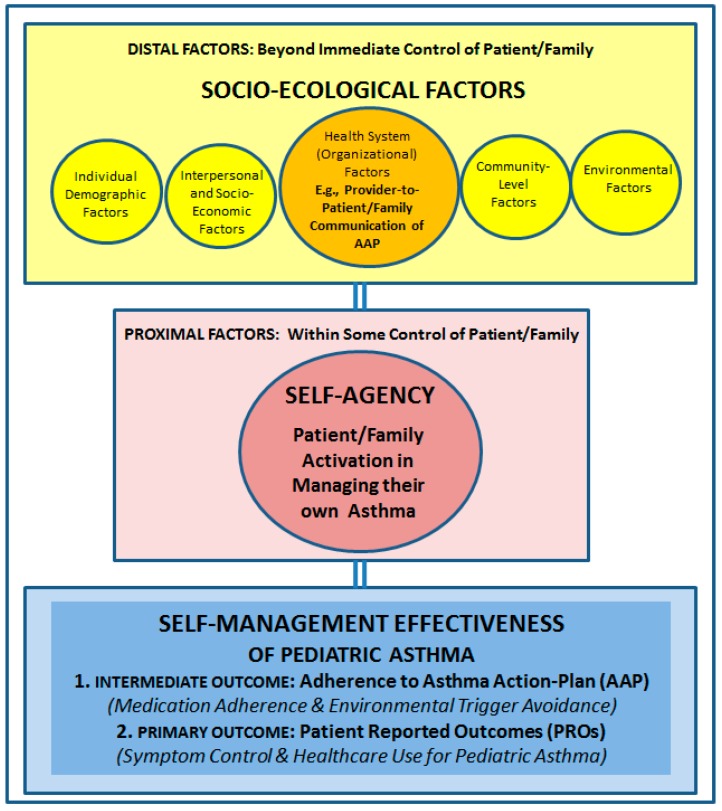
The 2007 U.S. National Institutes of Health EPR-3 guidelines emphasize the importance creating a provider-patient partnership to enable patients/families to monitor and take control of their asthma, so that treatment can be adjusted as needed. However, major shortfalls continue to be reported in provider adherence to EPR-3 guidelines. For providers to be more engaged in asthma management, they need a comprehensive set of resources for measuring self-management effectiveness of asthma, which currently do not exist. In a previously published article in the Journal of Asthma and Allergy, the authors conducted a literature review, to develop a holistic framework for understanding self-management effectiveness of pediatric asthma. The essence of this framework, is that broad socioecological factors can influence self-agency (patient/family activation), to impact self-management effectiveness, in children with asthma. A component of socio-ecological factors of special relevance to providers, would be the quality of provider-patient/family communication on asthma management. Therefore, the framework encompasses three key constructs: (1) Provider-patient/family communication; (2) Patient/family activation; and (3) Self-management effectiveness. This paper conducts an integrative review of the literature, to identify existing, validated measures of the three key constructs, with a view to operationalizing the framework, and discussing its implications for asthma research and practice.
Keywords: asthma management; evidence-based guidelines; holistic framework; medication adherence; pediatric asthma; practice improvement; self-management effectiveness measures.
Conflict of interest statement
The authors declare no conflict of interest.
Figures
References
-
- Centers for Disease Control and Prevention . National Asthma Control Program. Centers for Disease Control and Prevention; Atlanta, GA, USA: 2013. Asthma self-management education and environmental management: Approaches to enhancing reimbursement.
-
- Akinbami L. Asthma Prevalence, Health Care Use and Mortality: United States (2003–2005) CDC National Center for Health Statistics; Hyattsville, MD, USA: 2011. - PubMed
-
- Pinnock H., Epiphaniou E., Pearce G., Parke H., Greenhalgh T., Sheikh A., Griffiths C.J., Taylor S.J. Implementing supported self-management for asthma: A systematic review and suggested hierarchy of evidence of implementation studies. BMC Med. 2015;13:127. doi: 10.1186/s12916-015-0361-0. - DOI - PMC - PubMed
-
- NIH National Asthma Education & Prevention Program . Guidelines for the Diagnosis and Management of Asthma. Expert Panel Report 3. United States Department of Health and Human Services; Washington, DC, USA: 2007.
Publication types
MeSH terms
LinkOut - more resources
Full Text Sources
Medical
