


Improved precision of epigenetic clock estimates across tissues and its implication for biological ageing
- PMID: 31443728
- PMCID: PMC6708158
- DOI: 10.1186/s13073-019-0667-1
Improved precision of epigenetic clock estimates across tissues and its implication for biological ageing
Abstract
Background: DNA methylation changes with age. Chronological age predictors built from DNA methylation are termed 'epigenetic clocks'. The deviation of predicted age from the actual age ('age acceleration residual', AAR) has been reported to be associated with death. However, it is currently unclear how a better prediction of chronological age affects such association.
Methods: In this study, we build multiple predictors based on training DNA methylation samples selected from 13,661 samples (13,402 from blood and 259 from saliva). We use the Lothian Birth Cohorts of 1921 (LBC1921) and 1936 (LBC1936) to examine whether the association between AAR (from these predictors) and death is affected by (1) improving prediction accuracy of an age predictor as its training sample size increases (from 335 to 12,710) and (2) additionally correcting for confounders (i.e., cellular compositions). In addition, we investigated the performance of our predictor in non-blood tissues.
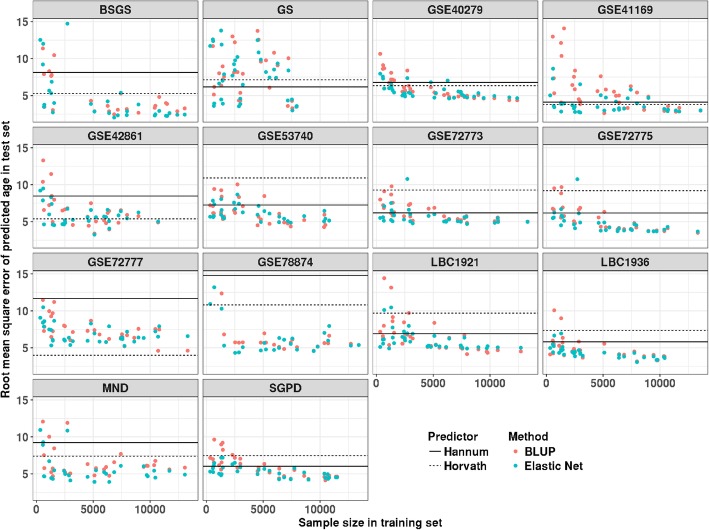
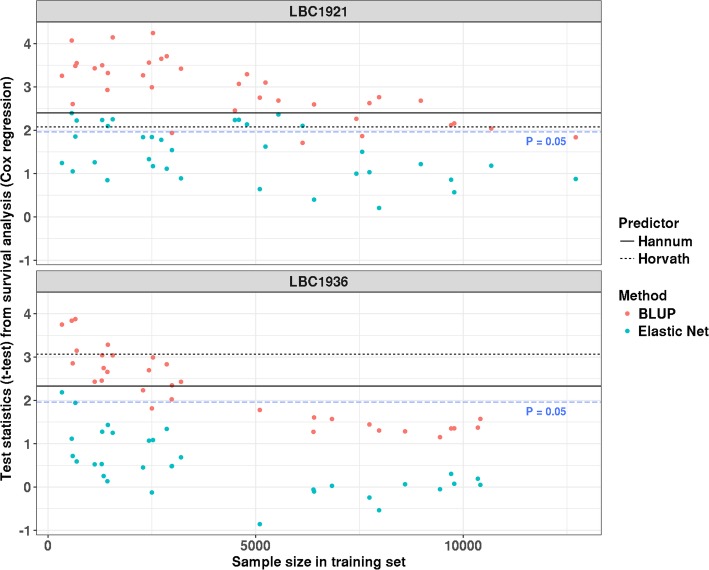
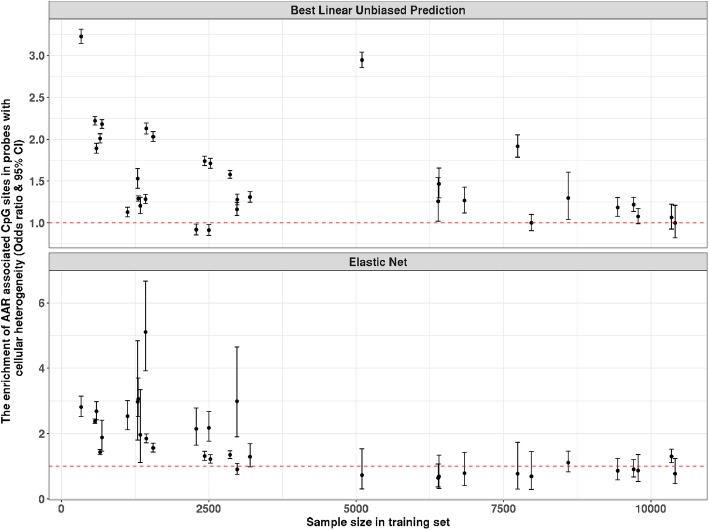
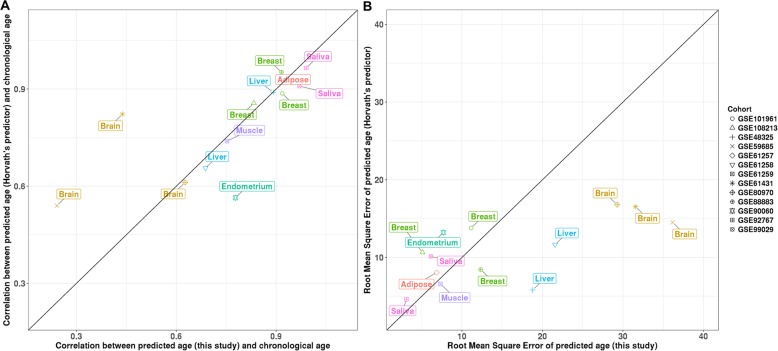
Results: We found that in principle, a near-perfect age predictor could be developed when the training sample size is sufficiently large. The association between AAR and mortality attenuates as prediction accuracy increases. AAR from our best predictor (based on Elastic Net, https://github.com/qzhang314/DNAm-based-age-predictor ) exhibits no association with mortality in both LBC1921 (hazard ratio = 1.08, 95% CI 0.91-1.27) and LBC1936 (hazard ratio = 1.00, 95% CI 0.79-1.28). Predictors based on small sample size are prone to confounding by cellular compositions relative to those from large sample size. We observed comparable performance of our predictor in non-blood tissues with a multi-tissue-based predictor.
Conclusions: This study indicates that the epigenetic clock can be improved by increasing the training sample size and that its association with mortality attenuates with increased prediction of chronological age.
Keywords: Age prediction; Ageing; DNA methylation; Epigenetic clock; Mortality.
Conflict of interest statement
The authors declare that they have no competing interests.
Figures
Comment in
-
Application of array-based age prediction models to post-mortem tissue samples.Forensic Sci Int Genet. 2024 Jan;68:102940. doi: 10.1016/j.fsigen.2023.102940. Epub 2023 Sep 30. Forensic Sci Int Genet. 2024. PMID: 37857127
References
Publication types
MeSH terms
Grants and funding
LinkOut - more resources
Full Text Sources
Other Literature Sources
Medical
