


An exploratory spatial analysis of overweight and obesity among children and adolescents in Shandong, China
- PMID: 31444183
- PMCID: PMC6707763
- DOI: 10.1136/bmjopen-2018-028152
An exploratory spatial analysis of overweight and obesity among children and adolescents in Shandong, China
Abstract
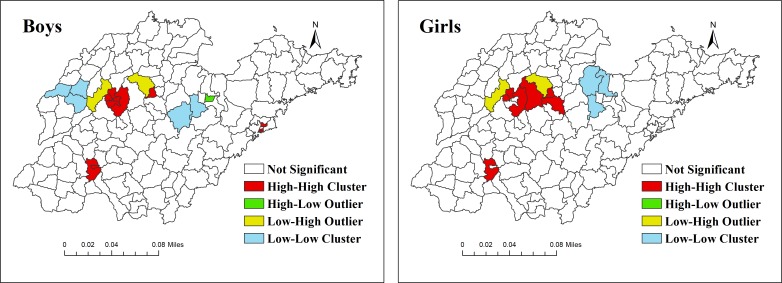
Objective: Identifying the spatial patterns of childhood overweight/obesity (OW/OB) can help to guide resource allocation for preventive intervention in China. This study aims to estimate rates of childhood OW/OB across counties within Shandong Province, using geographic techniques to identify sex-specific spatial patterns of childhood OW/OB as well as the presence of spatial clusters.
Design: Cross-sectional study.
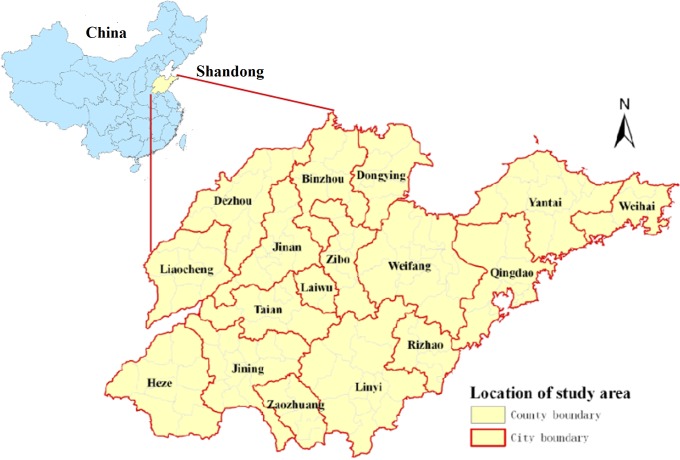
Setting: Shandong Province in China.
Participants and methods: Data on 6 216 076 children and adolescents aged 7-18 years from the Primary and Secondary Schoolchildren Physical Examination Database for Shandong Province were used in this study. Spatial patterns of sex-specific prevalence of childhood OW/OB were mapped. Global autocorrelation statistic (Moran's I) and the Local Indicator of Spatial Association (LISA) were applied to assess the degree of spatial autocorrelation.
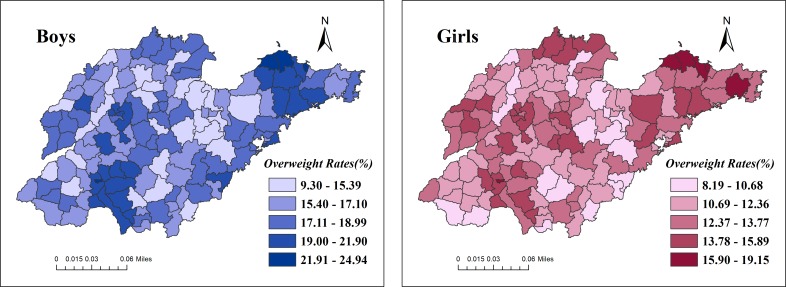
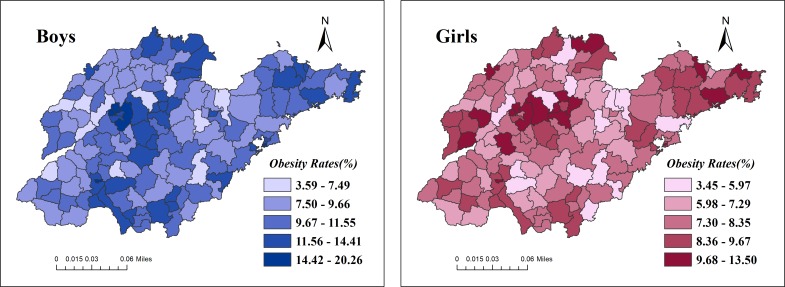
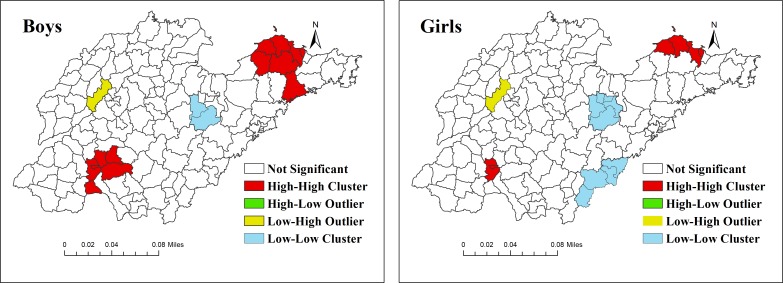
Results: The overall prevalence of childhood OW/OB in Shandong province were 15.05% and 9.23%, respectively. Maps of the sex-specific prevalence of OW/OB demonstrate a marked geographical variation of childhood OW/OB in different regions. Prevalence of childhood OW/OB had a significant positive spatial autocorrelation among both boys and girls. LISA analysis identified significant clusters (or 'hot spots') of childhood OW/OB in the eastern coastal region, central region and southwestern region.
Conclusions: The prevalence of childhood OW/OB is highly spatially clustered. Geographically focused appropriate intervention should be introduced in current childhood OW/OB prevention and control strategy.
Keywords: child and adolescent; geographic location; obesity; overweight; spatial analysis.
© Author(s) (or their employer(s)) 2019. Re-use permitted under CC BY-NC. No commercial re-use. See rights and permissions. Published by BMJ.
Conflict of interest statement
Competing interests: None declared.
Figures
References
-
- WHO Childhood overweight and obesity, 2018. Available: http://www.who.int/dietphysicalactivity/childhood/en/
-
- Abarca-Gómez L, Abdeen ZA, Hamid ZA, et al. Worldwide trends in body-mass index, underweight, overweight, and obesity from 1975 to 2016: a pooled analysis of 2416 population-based measurement studies in 128·9 million children, adolescents, and adults. Lancet 2017;390:2627–42. 10.1016/S0140-6736(17)32129-3 - DOI - PMC - PubMed
Publication types
MeSH terms
LinkOut - more resources
Full Text Sources
Medical
Miscellaneous
