


Passive Sensing of Health Outcomes Through Smartphones: Systematic Review of Current Solutions and Possible Limitations
- PMID: 31444874
- PMCID: PMC6729117
- DOI: 10.2196/12649
Passive Sensing of Health Outcomes Through Smartphones: Systematic Review of Current Solutions and Possible Limitations
Abstract
Background: Technological advancements, together with the decrease in both price and size of a large variety of sensors, has expanded the role and capabilities of regular mobile phones, turning them into powerful yet ubiquitous monitoring systems. At present, smartphones have the potential to continuously collect information about the users, monitor their activities and behaviors in real time, and provide them with feedback and recommendations.
Objective: This systematic review aimed to identify recent scientific studies that explored the passive use of smartphones for generating health- and well-being-related outcomes. In addition, it explores users' engagement and possible challenges in using such self-monitoring systems.
Methods: A systematic review was conducted, following Preferred Reporting Items for Systematic Reviews and Meta-Analyses guidelines, to identify recent publications that explore the use of smartphones as ubiquitous health monitoring systems. We ran reproducible search queries on PubMed, IEEE Xplore, ACM Digital Library, and Scopus online databases and aimed to find answers to the following questions: (1) What is the study focus of the selected papers? (2) What smartphone sensing technologies and data are used to gather health-related input? (3) How are the developed systems validated? and (4) What are the limitations and challenges when using such sensing systems?
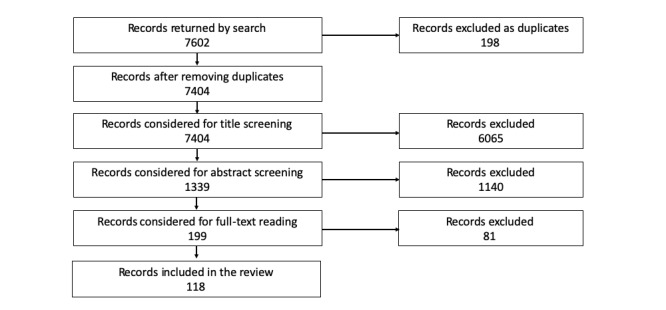
Results: Our bibliographic research returned 7404 unique publications. Of these, 118 met the predefined inclusion criteria, which considered publication dates from 2014 onward, English language, and relevance for the topic of this review. The selected papers highlight that smartphones are already being used in multiple health-related scenarios. Of those, physical activity (29.6%; 35/118) and mental health (27.9; 33/118) are 2 of the most studied applications. Accelerometers (57.7%; 67/118) and global positioning systems (GPS; 40.6%; 48/118) are 2 of the most used sensors in smartphones for collecting data from which the health status or well-being of its users can be inferred.
Conclusions: One relevant outcome of this systematic review is that although smartphones present many advantages for the passive monitoring of users' health and well-being, there is a lack of correlation between smartphone-generated outcomes and clinical knowledge. Moreover, user engagement and motivation are not always modeled as prerequisites, which directly affects user adherence and full validation of such systems.
Keywords: digital health; digital medicine; health care; mHealth; mhealth; mobile phone; self-management; smartphone; systematic review.
©Alina Trifan, Maryse Oliveira, José Luís Oliveira. Originally published in JMIR Mhealth and Uhealth (http://mhealth.jmir.org), 23.08.2019.
Conflict of interest statement
Conflicts of Interest: None declared.
Figures
References
-
- Huang K, Ding X, Xu J, Guanling C, Ding W. Monitoring sleep and detecting irregular nights through unconstrained smartphone sensing. UIC-ATC-ScalCom; August 10-14, 2015; Beijing, China. IEEE; 2015. pp. 36–45. - DOI
-
- Moher D, Liberati A, Tetzlaff J, Altman DG, PRISMA Group Preferred reporting items for systematic reviews and meta-analyses: the PRISMA statement. PLoS Med. 2009 Jul 21;6(7):e1000097. doi: 10.1371/journal.pmed.1000097. http://dx.plos.org/10.1371/journal.pmed.1000097 - DOI - PMC - PubMed
-
- Higgins JP, Altman DG, Gøtzsche PC, Jüni P, Moher D, Oxman AD, Savovic J, Schulz KF, Weeks L, Sterne JA, Cochrane Bias Methods Group. Cochrane Statistical Methods Group The Cochrane Collaboration's tool for assessing risk of bias in randomised trials. Br Med J. 2011 Oct 18;343:d5928. doi: 10.1136/bmj.d5928. http://europepmc.org/abstract/MED/22008217 - DOI - PMC - PubMed
Publication types
MeSH terms
LinkOut - more resources
Full Text Sources
Other Literature Sources
Miscellaneous
