. 2019 Dec;87(12):1241-1248.
doi: 10.1002/prot.25808. Epub 2019 Oct 1.

Template-based modeling by ClusPro in CASP13 and the potential for using co-evolutionary information in docking

Affiliations

Template-based modeling by ClusPro in CASP13 and the potential for using co-evolutionary information in docking

Kathryn A Porter et al. Proteins. 2019 Dec.

Abstract

As a participant in the joint CASP13-CAPRI46 assessment, the ClusPro server debuted its new template-based modeling functionality. The addition of this feature, called ClusPro TBM, was motivated by the previous CASP-CAPRI assessments and by the proven ability of template-based methods to produce higher-quality models, provided templates are available. In prior assessments, ClusPro submissions consisted of models that were produced via free docking of pre-generated homology models. This method was successful in terms of the number of acceptable predictions across targets; however, analysis of results showed that purely template-based methods produced a substantially higher number of medium-quality models for targets for which there were good templates available. The addition of template-based modeling has expanded ClusPro's ability to produce higher accuracy predictions, primarily for homomeric but also for some heteromeric targets. Here we review the newest additions to the ClusPro web server and discuss examples of CASP-CAPRI targets that continue to drive further development. We also describe ongoing work not yet implemented in the server. This includes the development of methods to improve template-based models and the use of co-evolutionary information for data-assisted free docking.

Keywords: homology modeling; method development; modeling of protein complexes; protein-protein interaction; template-based.


Figures

Figure 1.
Figure 1.
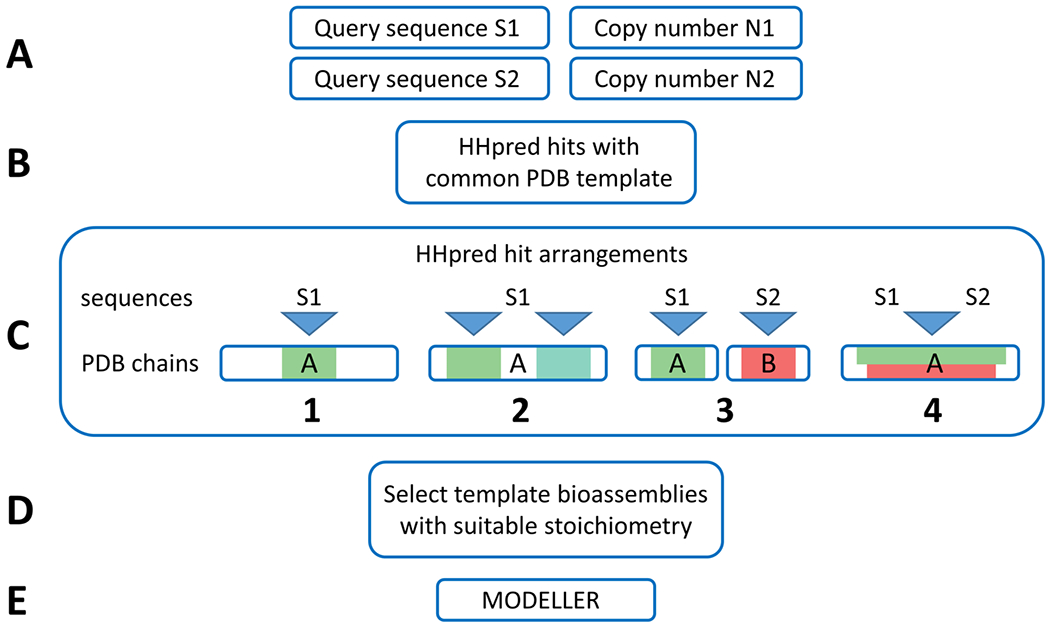
General outline of the ClusPro template-based modeling (TBM) protocol. (A) ClusPro TBM takes component sequences and their corresponding copy numbers in the modeled assembly as inputs. (B) HHpred is used to find potential templates for each query sequence, and HHpred hits sharing a common structural template are identified. (C) The HHpred hits are combined to obtain potential assembly-generating arrangements for each template structure (arrangements in the figure are examples, and are not necessarily generated as a part of a single server job). (D) The arrangements are evaluated on their ability to produce a model with user-specified stoichiometry based on biological assemblies specified in the template PDB file. (E) Arrangements passing the stoichiometry filter are used to construct the assembly models using MODELLER.
Figure 2.
Figure 2.
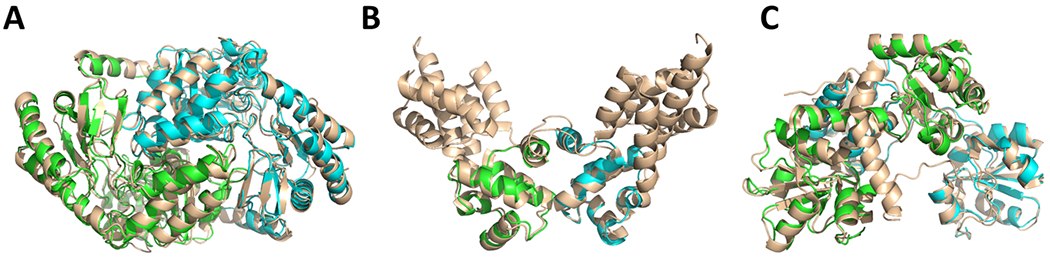
Examples of successful ClusPro TBM predictions based on different HHpred hit arrangements. (A) Model of T152/T1003 (green and cyan) overlapped with its homodimeric template (wheat, PDB 2W8T). (B) A model of T142/H0974 (green and cyan) overlapped with its homodimeric template (wheat, PDB 4RYK). (C) Modeled subunits (green and cyan) of T141/T0976 aligned to different locations on the same chain of the template protein (wheat, PDB 1YT8).
Figure 3.
Figure 3.
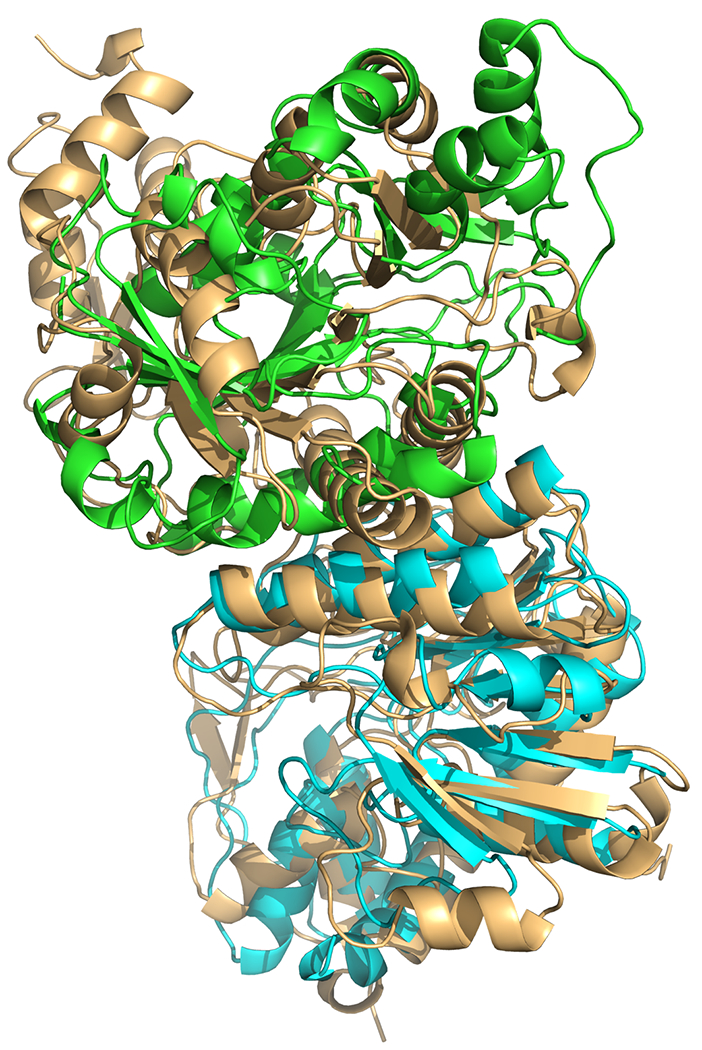
A model (green, cyan) of T137/T0965 superimposed with the native structure (wheat, PDB 6D2V).
Figure 4.
Figure 4.
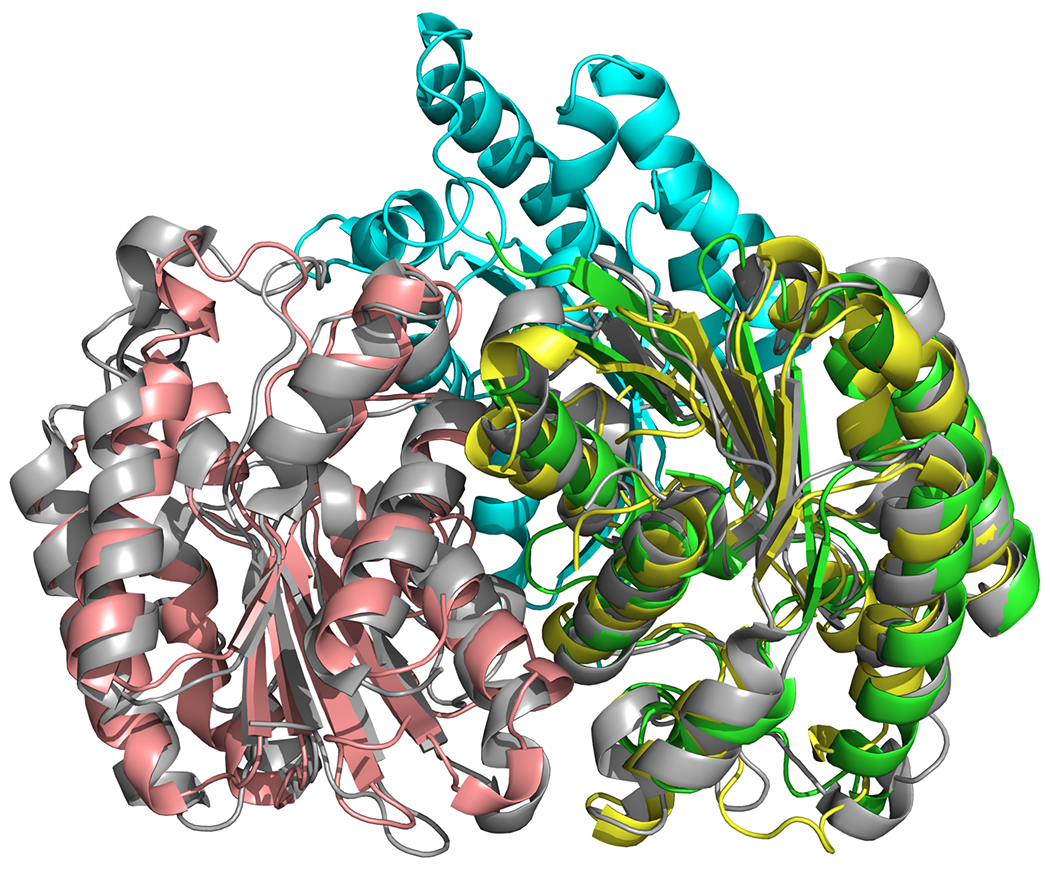
Two different T75/T0776 models (green-cyan and yellow-pink) aligned to one of the subunits of the target structure (gray, PDB 4Q9A).
Figure 5.
Figure 5.
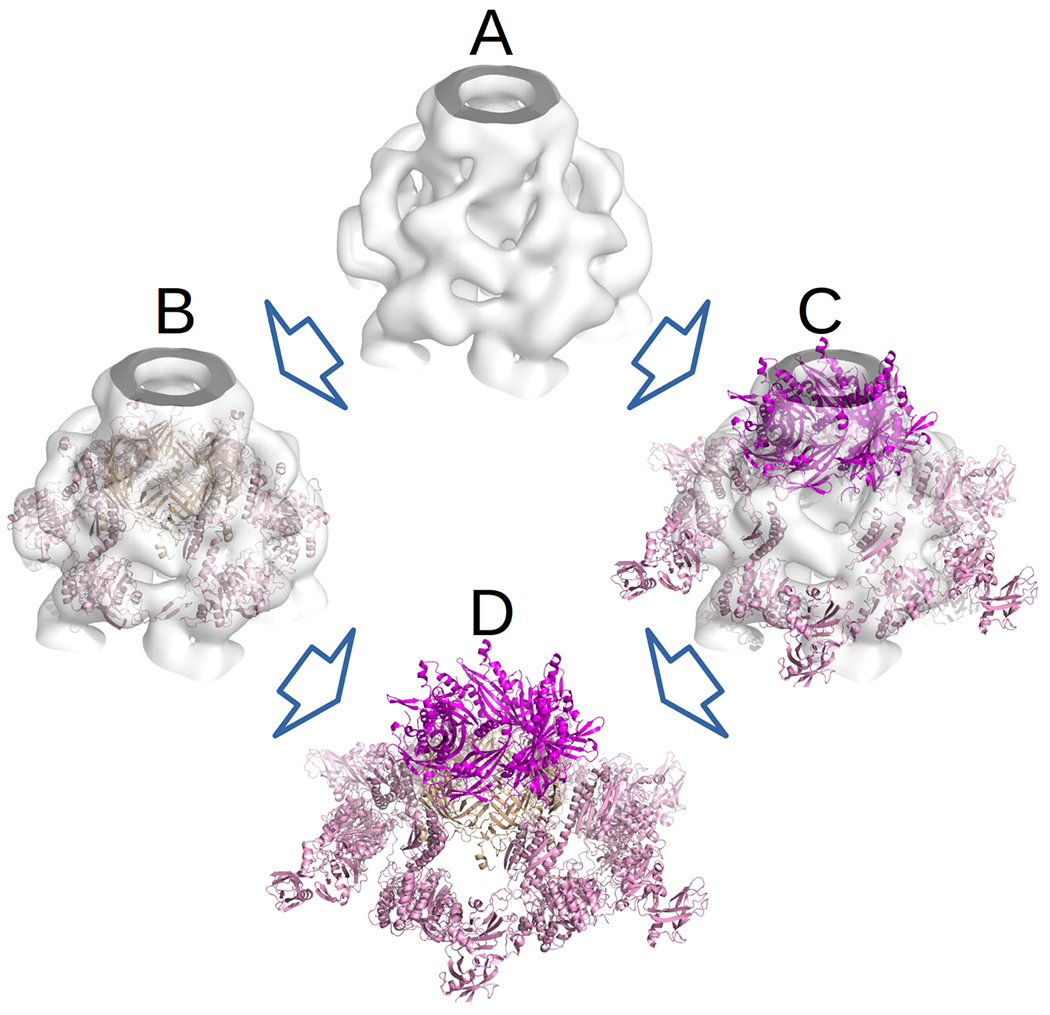
Template based modeling of target T159/H1021 assisted by low-resolution Electron Microscopy data. A) EM density map (EMDB-2419). B) Partial template for subunits A and B aligned to the EM map C) Partial template for subunits B and C aligned to the EM map. D) Mutual arrangement of the templates induced by the EM map.

References

    1. Rose PW, Prlic A, Altunkaya A, et al. The RCSB protein data bank: integrative view of protein, gene and 3D structural information. Nucleic Acids Res. 2017;45(D1):D271–D281. - PMC - PubMed
    1. Carroni M, Saibil HR. Cryo electron microscopy to determine the structure of macromolecular complexes. Methods. 2016;95:78–85. - PMC - PubMed
    1. Kundrotas PJ, Zhu Z, Janin J, Vakser IA. Templates are available to model nearly all complexes of structurally characterized proteins. Proc Natl Acad Sci U S A. 2012;109(24):9438–9441. - PMC - PubMed
    1. Lensink MF, Wodak SJ. Docking, scoring, and affinity prediction in CAPRI. Proteins. 2013;81(12):2082–2095. - PubMed
    1. Lensink MF, Velankar S, Wodak SJ. Modeling protein-protein and protein-peptide complexes: CAPRI 6th edition. Proteins. 2017;85(3):359–377. - PubMed

Publication types