


Effects of Childhood and Adult Persistent Attention-Deficit/Hyperactivity Disorder on Risk of Motor Vehicle Crashes: Results From the Multimodal Treatment Study of Children With Attention-Deficit/Hyperactivity Disorder
- PMID: 31445873
- PMCID: PMC9747063
- DOI: 10.1016/j.jaac.2019.08.007
Effects of Childhood and Adult Persistent Attention-Deficit/Hyperactivity Disorder on Risk of Motor Vehicle Crashes: Results From the Multimodal Treatment Study of Children With Attention-Deficit/Hyperactivity Disorder
Abstract
Objective: To determine motor vehicle crash (MVC) risk in adults with a history of childhood attention-deficit/hyperactivity disorder (ADHD) and persistent ADHD symptoms.
Method: Participants with (n = 441) and without (n = 239; local normative comparison group) childhood ADHD from the Multimodal Treatment of Attention-Deficit/Hyperactivity Disorder (MTA) Study were included. Participants provided self-reports on total number of MVCs they had been involved in and the time of licensure. Driving experience was estimated as the number of months since licensure. Total number of MVCs by adulthood was regressed on baseline ADHD status adjusting for sex, age at follow-up, driving experience, baseline oppositional defiant disorder/conduct disorder comorbidity, baseline household income level, adult oppositional defiant disorder/conduct disorder symptoms, adolescent and adult substance use, and adult antisocial personality disorder symptoms. We repeated the analysis using adult ADHD status (persistent versus desistant versus local normative comparison group) and symptom level as the predictor variables. Results are presented as incidence rate ratio (IRR) and CI.
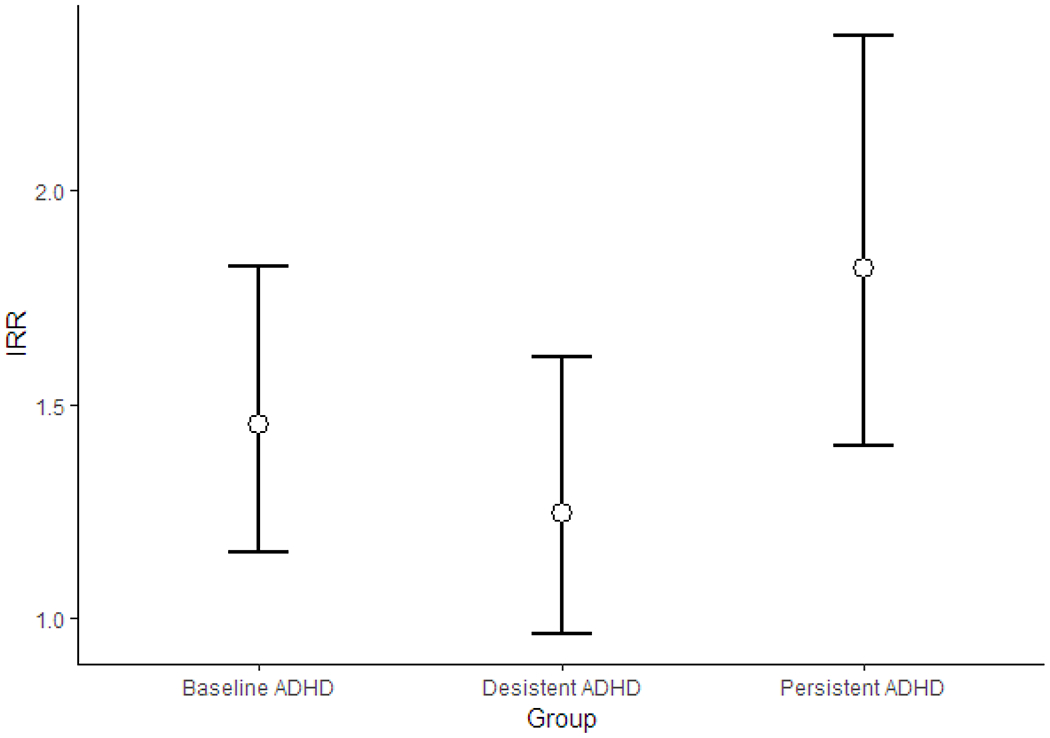
Results: Childhood ADHD was associated with a higher number of MVCs (IRR = 1.45, CI = 1.15-1.82), and adult ADHD symptom persistence was associated with more MVCs than desistance (IRR = 1.46, CI = 1.14-1.86). ADHD desistance was not associated with a significantly increased risk for MVCs compared with the local normative comparison group (IRR = 1.24, CI = 0.96-1.61). Concurrent symptoms of inattention and hyperactivity/impulsivity predicted MVC risk.
Conclusion: Persistence of ADHD into adulthood is a stronger predictor of MVC risk than childhood-limited ADHD.
Clinical trial registration information: Multimodal Treatment of Attention Deficit Hyperactivity Disorder (MTA) Study; https://clinicaltrials.gov; NCT00000388.
Keywords: ADHD persistence; attention-deficit/hyperactivity disorder (ADHD); comorbidity; driving; motor vehicle crashes.
Copyright © 2019 American Academy of Child and Adolescent Psychiatry. All rights reserved.
Figures
Comment in
-
Editorial: Paving the Way Toward Improving Safety Among Drivers With Attention-Deficit/Hyperactivity Disorder.J Am Acad Child Adolesc Psychiatry. 2020 Aug;59(8):923-925. doi: 10.1016/j.jaac.2020.02.012. Epub 2020 Mar 5. J Am Acad Child Adolesc Psychiatry. 2020. PMID: 32147569 Free PMC article.
References
-
- Diagnostic and Statistical Manual of Mental Disorders: DSM-5 (5th edition). 2014.
-
- Caye A, Spadini AV, Karam RG et al. Predictors of persistence of ADHD into adulthood: a systematic review of the literature and meta-analysis. Eur Child Adolesc Psychiatry. 2016;25(11):1151–1159. - PubMed
-
- Faraone S, Biederman J, Mick E. The age-dependent decline of attention deficit hyperactivity disorder: a meta-analysis of follow-up studies. Psychol Med. 2005;36(02):159. - PubMed
-
- Centers for Disease Control and Prevention, National Center for Injury Prevention and Control. Web-based Injury Statistics Query and Reporting System (WISQARS) [online]. 2005. [2019 Mar. 21]. Available from URL: www.cdc.gov/injury/wisqars
Publication types
MeSH terms
Associated data
Grants and funding
- R01 DA039881/DA/NIDA NIH HHS/United States
- U01 MH050461/MH/NIMH NIH HHS/United States
- N01MH12009/MH/NIMH NIH HHS/United States
- N01 DA085550/DA/NIDA NIH HHS/United States
- N01MH12012/MH/NIMH NIH HHS/United States
- N01 DA085554/DA/NIDA NIH HHS/United States
- U01 MH050440/MH/NIMH NIH HHS/United States
- N01MH12011/MH/NIMH NIH HHS/United States
- N01 DA085551/DA/NIDA NIH HHS/United States
- N01MH12007/MH/NIMH NIH HHS/United States
- N01 DA085552/DA/NIDA NIH HHS/United States
- U01 MH050453/MH/NIMH NIH HHS/United States
- N01MH12004/MH/NIMH NIH HHS/United States
- N01 DA085549/DA/NIDA NIH HHS/United States
- U01 MH050467/MH/NIMH NIH HHS/United States
- N01MH12010/MH/NIMH NIH HHS/United States
- N01 DA085553/DA/NIDA NIH HHS/United States
- N01MH12008/MH/NIMH NIH HHS/United States
- N01 DA085548/DA/NIDA NIH HHS/United States
