Review
. 2019 Aug 6:10:1836.
doi: 10.3389/fimmu.2019.01836. eCollection 2019.

Metastatic Latency, a Veiled Threat

Affiliations
Review

Metastatic Latency, a Veiled Threat

Kangsan Kim et al. Front Immunol. .

Abstract

Metastatic relapse is observed in cancer patients with no clinical evidence of disease for months to decades after initial diagnosis and treatment. Disseminated cancer cells that are capable of entering reversible cell cycle arrest are believed to be responsible for these late metastatic relapses. Dynamic interactions between the latent disseminated tumor cells and their surrounding microenvironment aid cancer cell survival and facilitate escape from immune surveillance. Here, we highlight findings from preclinical models that provide a conceptual framework to define and target the latent metastatic phase of tumor progression. The hope is by identifying patients harboring latent metastatic cells and providing therapeutic options to eliminate metastatic seeds prior to their emergence will result in long lasting cures.

Keywords: dormancy; immune-surveillance; latency; metastasis; microenvironment; minimal residual disease.


Figures
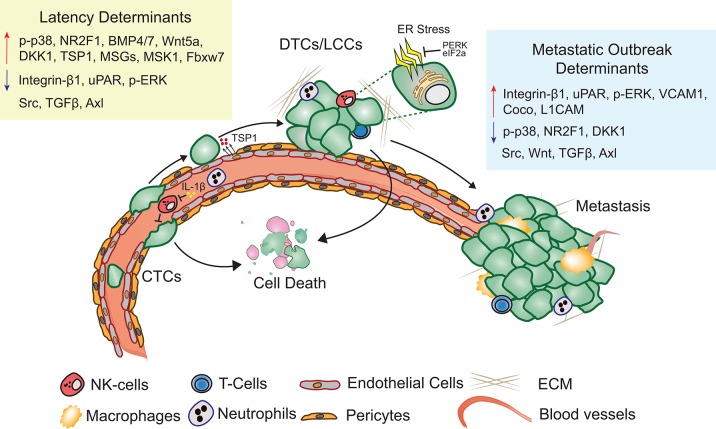
Figure 1
Figure 1
Metastatic latency. Upon extravasation, many DTCs perish, few surviving LCCs adapt to and modify the surrounding microenvironment, eventually giving rise to metastasis. Key molecular determinants of latency and metastatic outbreak are highlighted (Refer text for more details).

References

    1. Pollard JW. Defining metastatic cell latency. N Engl J Med. (2016) 375:280–2. 10.1056/NEJMcibr1606716 - DOI - PMC - PubMed
    1. Goss PE, Chambers AF. Does tumour dormancy offer a therapeutic target? Nat Rev Cancer. (2010) 10:871–7. 10.1038/nrc2933 - DOI - PubMed
    1. Hedley BD, Chambers AF. Tumor dormancy and metastasis. Adv Cancer Res. (2009) 102:67–101. 10.1016/S0065-230X(09)02003-X - DOI - PubMed
    1. Meng S, Tripathy D, Frenkel EP, Shete S, Naftalis EZ, Huth JF, et al. . Circulating tumor cells in patients with breast cancer dormancy. Clin Cancer Res. (2004) 10:8152–62. 10.1158/1078-0432.CCR-04-1110 - DOI - PubMed
    1. Cote RJ, Rosen PP, Hakes TB, Sedira M, Bazinet M, Kinne DW, et al. . Monoclonal antibodies detect occult breast carcinoma metastases in the bone marrow of patients with early stage disease. Am J Surg Pathol. (1988) 12:333–40. 10.1097/00000478-198805000-00001 - DOI - PubMed

Publication types

LinkOut - more resources
