Review
. 2019 Sep;33(6):760-780.
doi: 10.1037/neu0000557.

Brain-behavior relations and effects of aging and common comorbidities in alcohol use disorder: A review

Affiliations
Review

Brain-behavior relations and effects of aging and common comorbidities in alcohol use disorder: A review

Edith V Sullivan et al. Neuropsychology. 2019 Sep.

Abstract

Objective: Alcohol use disorder (AUD) is a complex, dynamic condition that waxes and wanes with unhealthy drinking episodes and varies in drinking patterns and effects on brain structure and function with age. Its excessive use renders chronically heavy drinkers vulnerable to direct alcohol toxicity and a variety of comorbidities attributable to nonalcohol drug misuse, viral infections, and accelerated or premature aging. AUD affects widespread brain systems, commonly, frontolimbic, frontostriatal, and frontocerebellar networks.

Method and results: Multimodal assessment using selective neuropsychological testing and whole-brain neuroimaging provides evidence for AUD-related specific brain structure-function relations established with double dissociations. Longitudinal study using noninvasive imaging provides evidence for brain structural and functional improvement with sustained sobriety and further decline with relapse. Functional imaging suggests the possibility that some alcoholics in recovery can compensate for impairment by invoking brain systems typically not used for a target task but that can enable normal-level performance.

Conclusions: Evidence for AUD-aging interactions, indicative of accelerated aging, together with increasing alcohol consumption in middle-age and older adults, put aging drinkers at special risk for developing cognitive decline and possibly dementia. (PsycINFO Database Record (c) 2019 APA, all rights reserved).


Figures
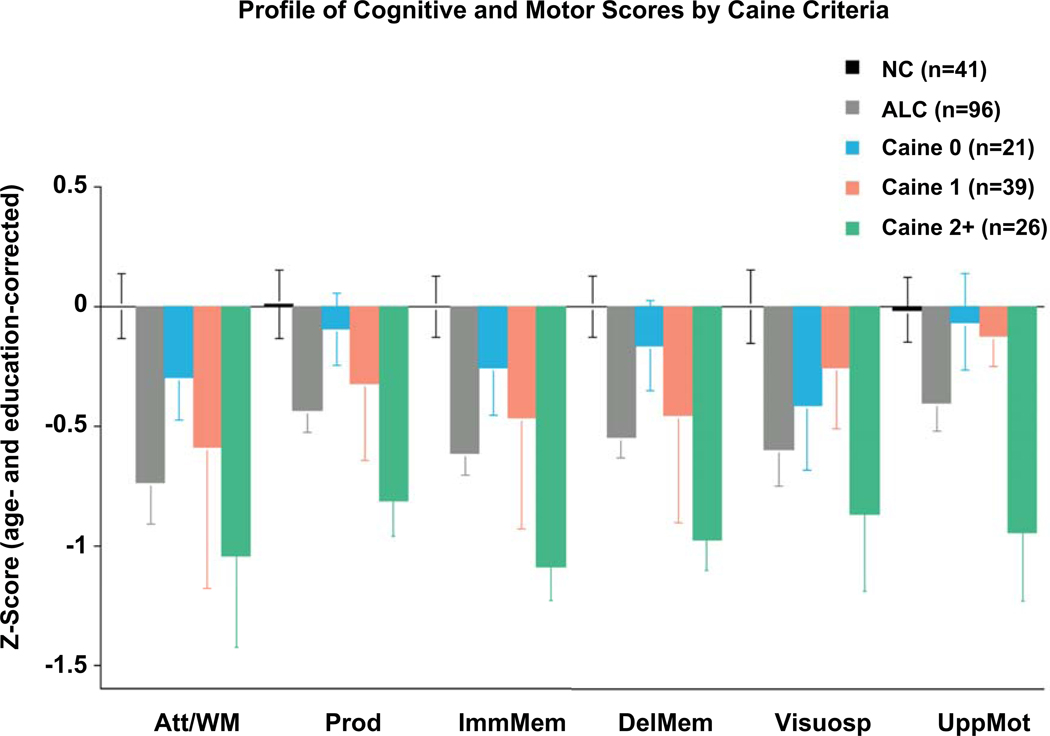
Figure 1.
Figure 1.
Bar graphs depicting the alcohol Caine-categorized subgroups in comparison with the alcoholic group as a whole and the normal group. Att/WM - Attention/Working Memory; Prod - Production; ImmMem – Immediate Memory; DelMem – Delayed Memory; Visuosp –Visuospatial Construction; UppMot – Upper Limb Motor. From Fama et al. (Fama et al., 2017), Figure 2.
Figure 2.
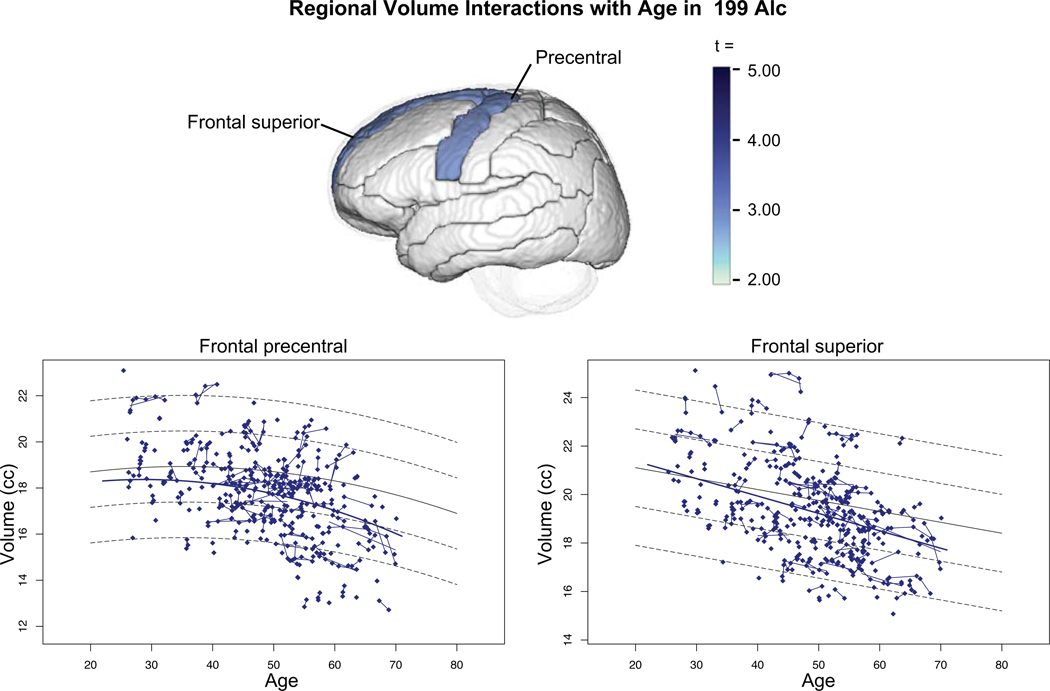
Figure 2.
Color-coded brain regions and scatterplots of significant age-diagnosis interactions in the Alc group only indicating age-related declines in excess of those detected in the controls (gray regression lines). From Pfefferbaum et al. (Pfefferbaum, Zahr, et al., 2018), Supplemental Figure 2.
Figure 3.
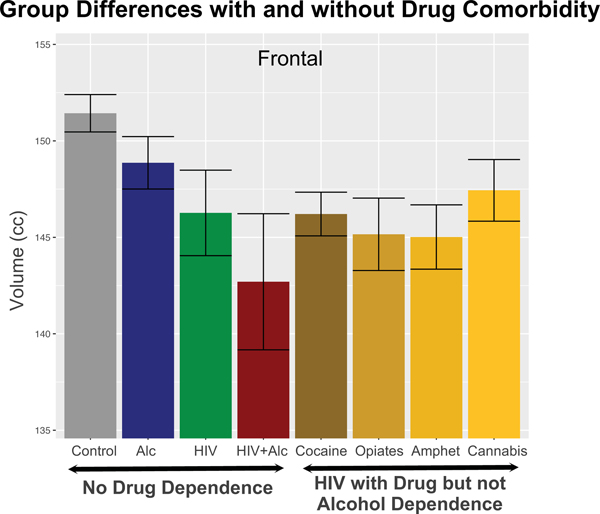
Figure 3.
Mean ± 95% CI of the controls and each diagnostic group with and without alcohol or drug dependence in regions showing significant volume deficits. Also shown are volumes by drug-dependent comorbidity: cocaine (Coc’n), opiates, amphetamines (Amph), and cannabis (Cann). From Pfefferbaum et al. (Pfefferbaum, Zahr, et al., 2018), Supplemental Figure 3
Figure 4.
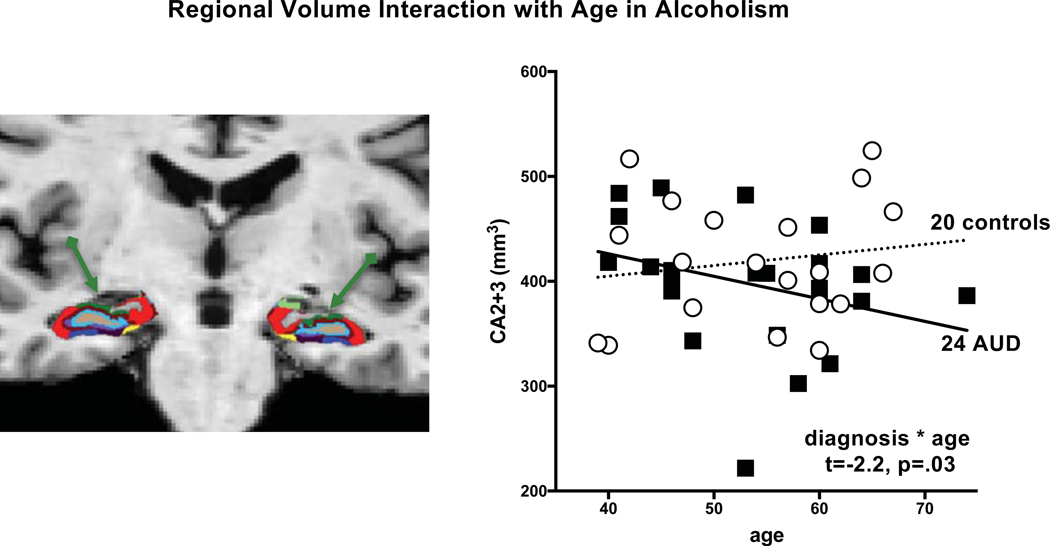
Figure 4.
Left panel: Coronal slice through the hippocampus demonstrating parcellation of a fully processed set of images from a 65 year-old control man. Subfields are color-coded. Right panel: Age x group interaction indicating that older alcoholics had a greater CA2/3 (subfield marked in green) volume deficit for their age than did younger ones. Modified Figures 1 and 4 from Zahr et al. (Zahr et al., 2019).
Figure 5.
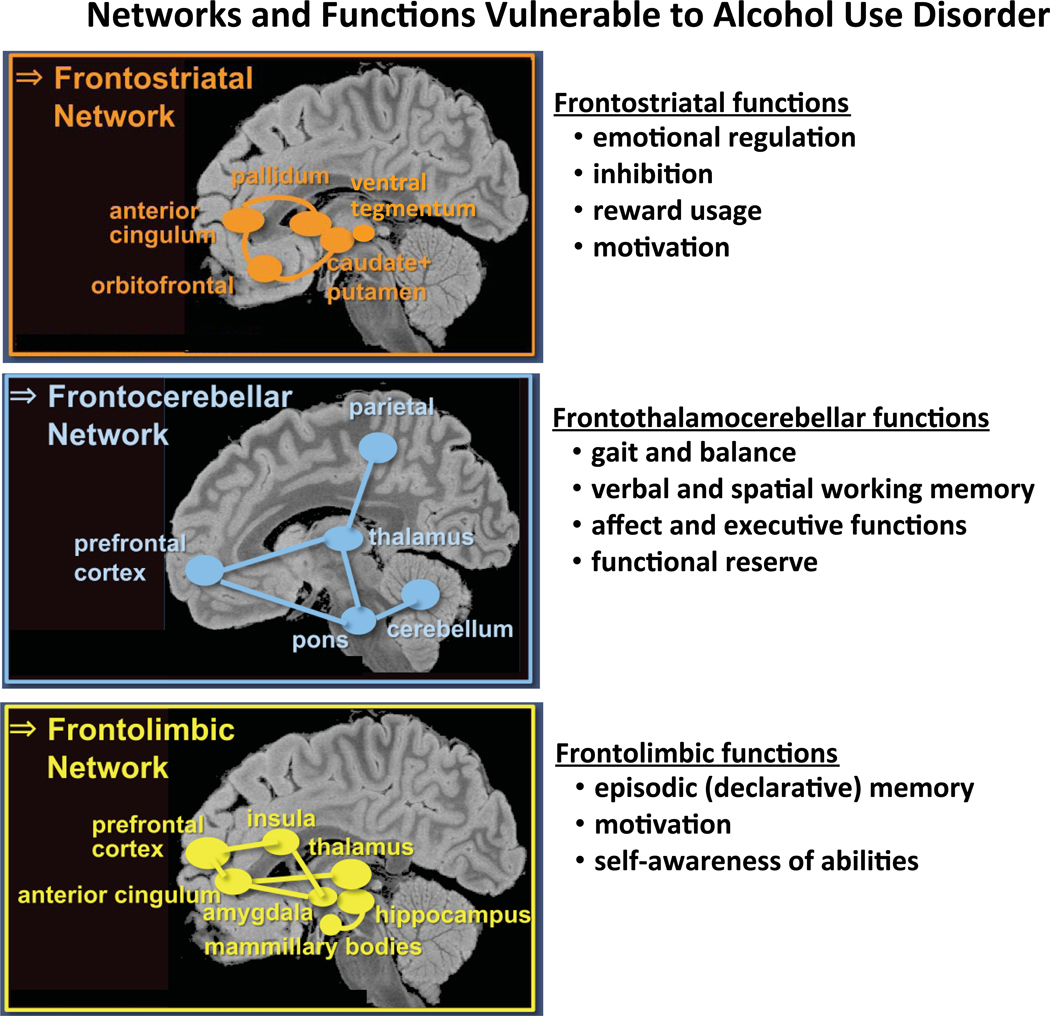
Figure 5.
Brain networks and associated functions found to be vulnerable to Alcohol Use Disorder: Frontostriatal nodes and network enable functions of emotional regulation, inhibition, reward usage, motivation; frontocerebellar nodes and network enable functions of gait and balance, verbal and spatial working memory, affect and executive functions, and provides functional reserve; and frontolimbic nodes and network enables functions of episodic memory to consolidate new information, motivation, self-awareness of abilities and limitations (Zahr, Pfefferbaum, & Sullivan, 2017). We speculate that knowing what is compromised and what is spared might help in therapeutic efforts to redirect neural recruitment from the usual but disrupted paths and networks to functional alternatives, possibly through behavioral therapy or pharmacological efforts for maintaining abstinence and promoting recovery.

References

    1. Adams KM, Gilman S, Koeppe RA, Kluin KJ, Brunberg JA, Dede D, . . . Kroll PD (1993). Neuropsychological deficits are correlated with frontal hypometabolism in positron emission tomography studies of older alcoholic patients. Alcohol Clin Exp Res, 17(2), 205–210. - PubMed

    1. Aho L, Karkola K, Juusela J, & Alafuzoff I (2009). Heavy alcohol consumption and neuropathological lesions: a post-mortem human study. J Neurosci Res, 87(12), 27862792. doi: 10.1002/jnr.22091 - DOI - PubMed
    1. Alba-Ferrara L, Muller-Oehring EM, Sullivan EV, Pfefferbaum A, & Schulte T (2016). Brain responses to emotional salience and reward in alcohol use disorder. Brain Imaging Behav, 10(1), 136–146. doi: 10.1007/s11682-015-9374-8 - DOI - PMC - PubMed
    1. Alber J, Della Sala S, & Dewar M (2014). Minimizing interference with early consolidation boosts 7-day retention in amnesic patients. Neuropsychology, 28(5), 667–675. doi: 10.1037/neu0000091 - DOI - PubMed
    1. Alcohol GBD, & Drug Use C (2018). The global burden of disease attributable to alcohol and drug use in 195 countries and territories, 1990–2016: a systematic analysis for the Global Burden of Disease Study 2016. Lancet Psychiatry. doi: 10.1016/S2215-0366(18)30337-7 - DOI - PMC - PubMed