


Emotional processing and social cognition in alcohol use disorder
- PMID: 31448948
- PMCID: PMC6711390
- DOI: 10.1037/neu0000572
Emotional processing and social cognition in alcohol use disorder
Abstract
Objective: To review deficits in emotional processing and social cognition potentially contributing to the dysfunctional emotion regulation and difficulties with interpersonal relationships observed in individuals with alcohol use disorder (AUD) and to provide directions for future research.
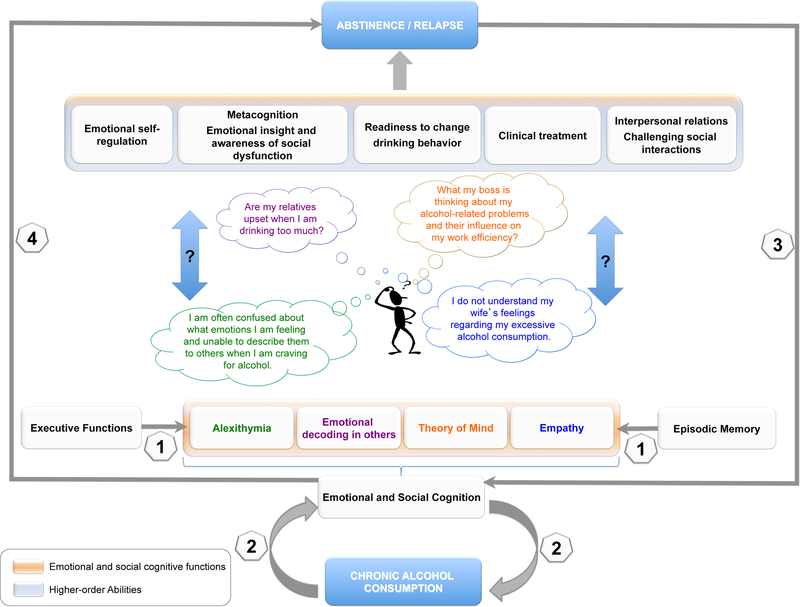
Method: First is presented a review of emotional and social-cognitive impairments in recently detoxified AUD individuals that include alexithymia, difficulties in decoding others' emotions, and reduced theory of mind and empathy skills. Social cognition disorders in AUD pose different issues discussed, such as whether (1) these deficits are consequences of excessive alcohol consumption or premorbid risk factors for addiction, (2) emotional and social impairments impede positive treatment outcome, (3) recovery of social abilities is possible with sustained abstinence, and (4) AUD patients are unaware of their emotional and social dysfunctions. Finally, current knowledge on structural and functional brain correlates of these deficits in AUD are reviewed.
Results: Emotional and social-cognitive functions affected in AUD can potentially compromise efforts to initiate and maintain abstinence by hampering efficacy of clinical treatment. Such dysfunction can obstruct efforts to enable or reinstate higher-order abilities such as emotional self-regulation, motivation to change, success in interpersonal/social interactions, and emotional insight and awareness of social dysfunctions (i.e., accurate metacognition).
Conclusions: The present review highlights the need to account for emotional processing and social cognition in the evaluation and rehabilitation of alcohol-related neurocognitive disorders and to consider psychotherapeutic treatment involving remediation of emotional and social skills as implemented in psychiatric and neurological disorders. (PsycINFO Database Record (c) 2019 APA, all rights reserved).
Conflict of interest statement
Conflict of Interest
The author, Anne-Pascale Le Berre, has no conflicts of interest with the reported data or their interpretation.
Figures
References
-
- Agartz I, Momenan R, Rawlings RR, Kerich MJ, & Hommer DW (1999). Hippocampal volume in patients with alcohol dependence. Arch Gen Psychiatry, 56(4), 356–363. - PubMed
-
- Amenta S, Noel X, Verbanck P, & Campanella S (2013). Decoding of emotional components in complex communicative situations (irony) and its relation to empathic abilities in male chronic alcoholics: an issue for treatment. Alcohol Clin Exp Res, 37(2), 339–347. doi: 10.1111/j.1530-0277.2012.01909.x - DOI - PubMed
-
- American Psychiatric Association, A. P. (2013). American Psychiatric Association: Diagnostic and Statistical Manual of Mental disorders, Fifth Edition. Arlington, VA: American Psychiatric Association.
-
- Baron-Cohen S, & Wheelwright S (2004). The empathy quotient: an investigation of adults with Asperger syndrome or high functioning autism, and normal sex differences. J Autism Dev Disord, 34(2), 163–175. - PubMed
