Disparities in Acceptance of Deceased Donor Kidneys Between the United States and France and Estimated Effects of Increased US Acceptance
- PMID: 31449299
- PMCID: PMC6714020
- DOI: 10.1001/jamainternmed.2019.2322
Disparities in Acceptance of Deceased Donor Kidneys Between the United States and France and Estimated Effects of Increased US Acceptance
Abstract
Importance: Approximately 3500 donated kidneys are discarded in the United States each year, drawing concern from Medicare and advocacy groups.
Objective: To estimate the effects of more aggressive allograft acceptance practices on the donor pool and allograft survival for the population of US wait-listed kidney transplant candidates.
Design, setting, and participants: A nationwide study using validated registries from the United States and France comprising comprehensive cohorts of deceased donors with organs offered to kidney transplant centers between January 1, 2004, and December 31, 2014. Data were analyzed between September 1, 2018, and April 5, 2019.
Main outcomes and measures: The primary outcome was kidney allograft discard. The secondary outcome was allograft failure after transplantation. We used logistic regression to model organ acceptance and discard practices in both countries. We then quantified using computer simulation models the number of kidneys discarded in the United States that a more aggressive system would have instead used for transplantation. Finally, based on actual survival data, we quantified the additional years of allograft life that a redesigned US system would have saved.
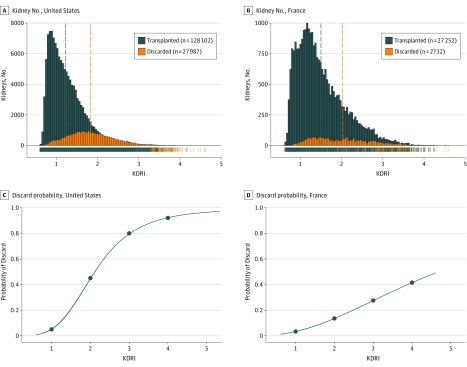
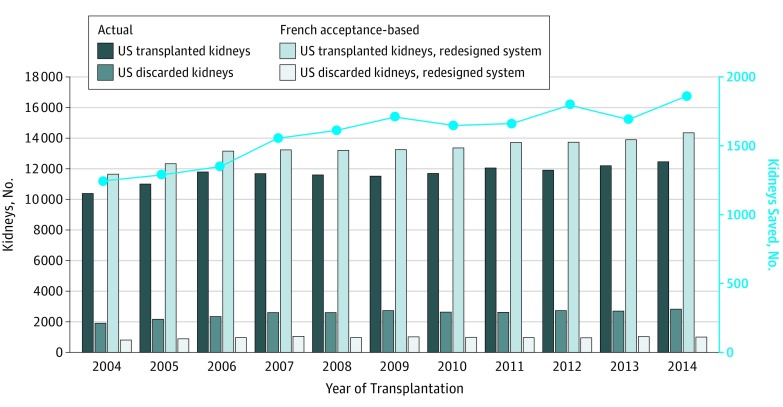
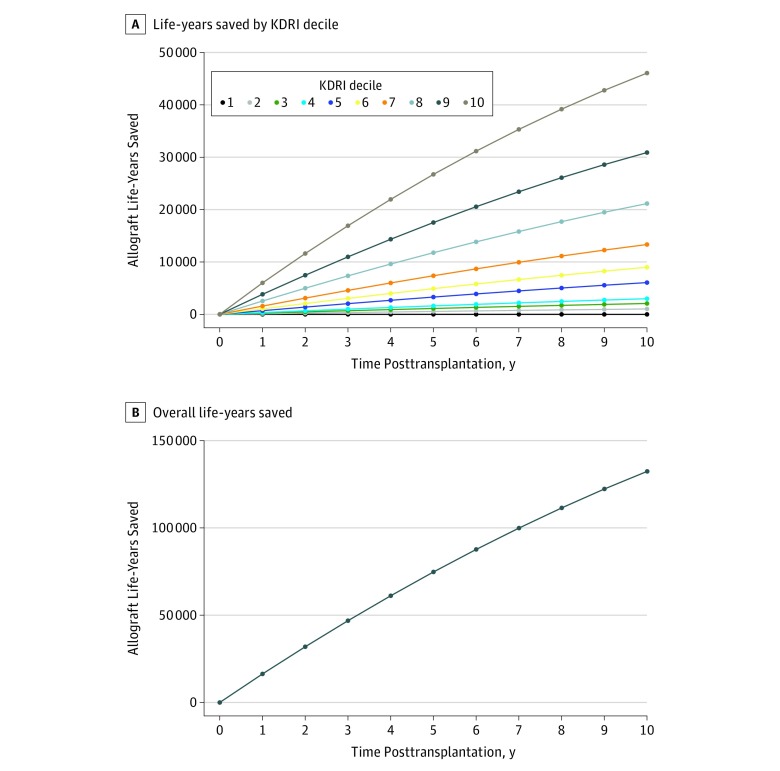
Findings: In the United States, 156 089 kidneys were recovered from deceased donors between 2004 and 2014, of which 128 102 were transplanted, and 27 987 (17.9%) were discarded. In France, among the 29 984 kidneys recovered between 2004 and 2014, 27 252 were transplanted, and 2732 (9.1%, P < .001 vs United States) were discarded. The mean (SD) age of kidneys transplanted in the United States was 36.51 (17.02) years vs 50.91 (17.34) years in France (P < .001). Kidney quality showed little change in the United States over time (mean [SD] kidney donor risk index [KDRI], 1.30 [0.48] in 2004 vs 1.32 [0.46] in 2014), whereas a steadily rising KDRI in France reflected a temporal trend of more aggressive organ use (mean [SD] KDRI, 1.37 [0.47] in 2004 vs 1.74 [0.72] in 2014; P < .001). We applied the French-based allocation model to the population of US deceased donor kidneys and found that 17 435 (62%) of kidneys discarded in the United States would have instead been transplanted under the French system. We further determined that a redesigned system with more aggressive organ acceptance practices would generate an additional 132 445 allograft life-years in the United States over the 10-year observation period.
Conclusions and relevance: Greater acceptance of kidneys from deceased donors who are older and have more comorbidities could provide major survival benefits to the population of US wait-listed patients.
Trial registration: ClinicalTrials.gov identifier: NCT03723668.
Conflict of interest statement
Figures
Comment in
-
The Number of Discarded Kidneys Is Likely Much Larger Than Reported.JAMA Intern Med. 2020 Mar 1;180(3):466-467. doi: 10.1001/jamainternmed.2019.6096. JAMA Intern Med. 2020. PMID: 32119043 No abstract available.
-
The Number of Discarded Kidneys Is Likely Much Larger Than Reported-Reply.JAMA Intern Med. 2020 Mar 1;180(3):467-468. doi: 10.1001/jamainternmed.2019.6099. JAMA Intern Med. 2020. PMID: 32119050 No abstract available.
References
-
- Eurotransplant. https://www.eurotransplant.org/cms/. Accessed January 7, 2019.
-
- Organ Procurement and Transplantation Network (OPTN). https://optn.transplant.hrsa.gov/. Accessed January 7, 2019.
Associated data
LinkOut - more resources
Full Text Sources
Other Literature Sources
Medical
Miscellaneous