Randomized Controlled Trial
. 2019 Aug 24;11(9):2001.
doi: 10.3390/nu11092001.

Tolerability and Safety of a Nutritional Supplement with Potential as Adjuvant in Colorectal Cancer Therapy: A Randomized Trial in Healthy Volunteers

Affiliations
Randomized Controlled Trial

Tolerability and Safety of a Nutritional Supplement with Potential as Adjuvant in Colorectal Cancer Therapy: A Randomized Trial in Healthy Volunteers

Marta Gómez de Cedrón et al. Nutrients. .

Abstract

Bioactive supplements display relevant therapeutic properties when properly applied according to validated molecular effects. Our previous research efforts established the basis to develop a dietary supplement based on a Rosmarinus officinalis supercritical extract. This was enriched in phenolic diterpenes (RE) with proven properties against signaling pathways involved in colon tumorigenesis, and shark liver oil rich in alkylglycerols (AKG) as a bioactive lipid vehicle to improve RE bioavailability and synergize with the potential therapeutic action of the extract. Herein, we have investigated the tolerability and safety of the supplement and the biological and molecular effects from an immuno-nutritional perspective. Sixty healthy volunteers participated in a six week, double-blind, randomized parallel pilot study with two study arms: RE-AKG capsules (CR) and control capsules (CC). Mean age (±SD) of volunteers was 28.32 (±11.39) and 27.5 (±9.04) for the control and the study groups, respectively. Safety of the CR product consumption was confirmed by analyzing liver profile, vital constants, and oxidation markers (LDLox in blood and isoprostanes and thromboxanes in urine). The following were monitored: (1) the phenotyping of plasmatic leukocytes and the ex vivo response of lipopolysaccharide (LPS)-stimulated peripheral blood mononuclear cells (PBMCs); (2) expression of genes associated with immune-modulation, inflammation, oxidative stress, lipid metabolism, and tumorigenesis; and (3) the correlation of selected genetic variants (SNPs) with the differential responses among individuals. The lack of adverse effects on liver profile and oxidation markers, together with adequate tolerability and safe immunological adaptations, provide high-quality information for the potential use of CR as co-adjuvant of therapeutic strategies against colorectal cancer.

Keywords: Rosmarinus officinalis L.; alkylglycerols; colon cancer; immuno-nutrition.


Conflict of interest statement

The authors declare no conflict of interest.

Figures
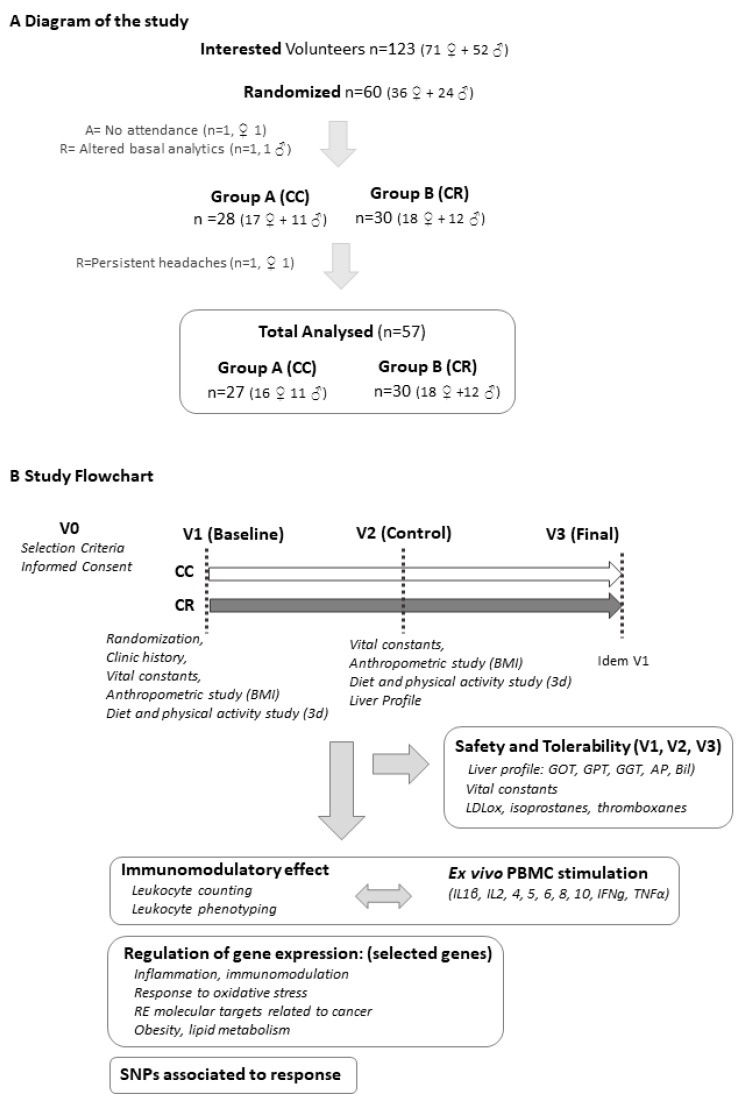
Figure 1
Figure 1
(A) Diagram of the study. (B) Study flowchart, objectives, and analyzed parameters. Abbreviations: CC, control capsules; CR, intervention capsules; BMI, body mass index; PBMC, peripheral blood mononuclear cell; SNPs, single nucleotide polymorphisms.
Figure 2
Figure 2
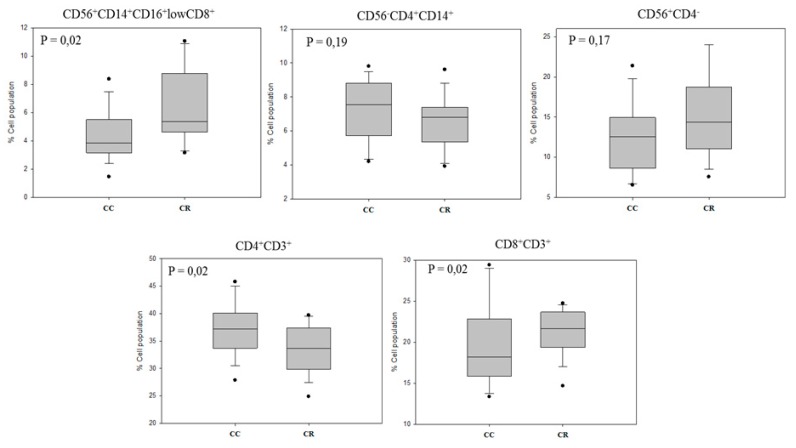
Combined CD analysis to identify leukocyte subpopulations. The phenotyping of leukocyte subpopulations, by combined analysis of CD markers, allows to differentiate among monocytes (CD56+ CD14+ CD16+ lowCD8+), macrophages (CD56 CD4+ CD14+), NK cells (CD56+ CD4), T helper (Th) lymphocytes (CD4+ CD3+), and cytotoxic T lymphocytes (Tcit) (CD8+ CD3+).
Figure 3
Figure 3
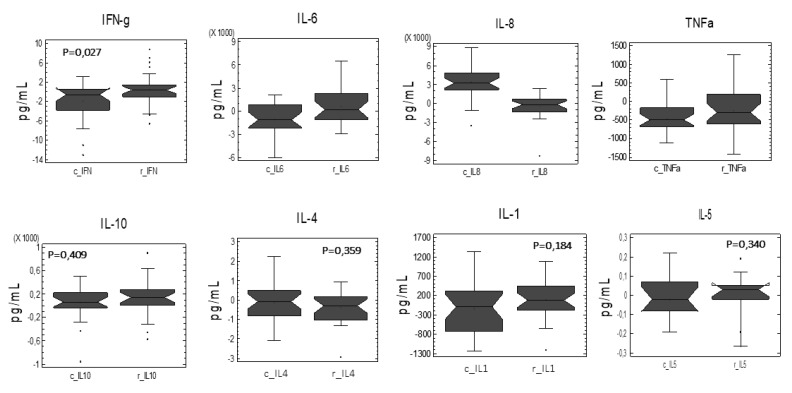
Paired comparisons of the relative variation of each cytokine as a function of the treatment applied. The analysis revealed an increased cellular capacity in response to the LPS stimulation regardless of IFNγ (4-fold, p = 0.027) and IL-6 (1.9-fold, p = 0.011), while decreased IL-8 (6.6-fold, p = 0.001) levels of the CR group compared to control group.
Figure 4
Figure 4
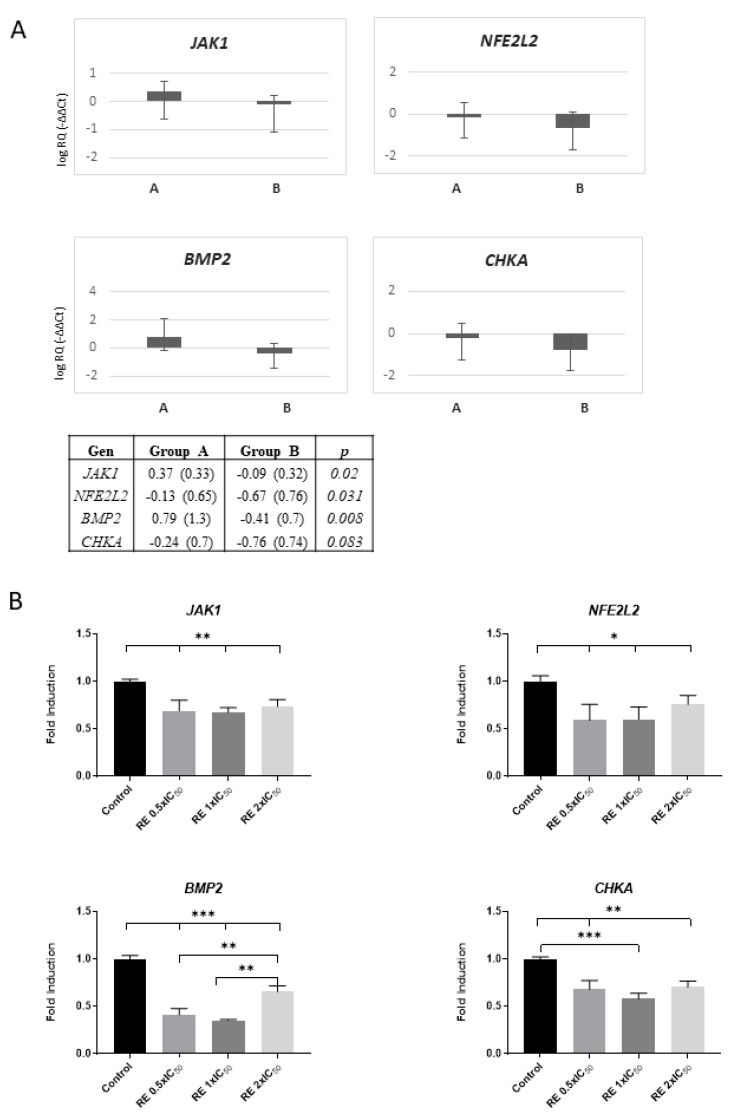
Modulation of the expression of genes related to immunomodulation, inflammation, oxidative stress, and cancer. (A) Genes whose expression were statistically different between groups (CC or CR), regardless of evolution between visits, are shown. JAK1, NFE2L2, and BMP2 were significantly decreased in the study group (CR) compared to control (CC) (p = 0.02, p = 0.031, and p = 0.008, respectively). CHKA was diminished in the study group (CR) between visits, although not significantly (p = 0.083). (B) In vitro validation of the effect of rosemary extract in downregulating the expression of JAK1, NE2L2, BMP2, and CHKA in SW-620 colon cancer cells after treatment with three different doses corresponding to 0.5 × IC50, 1 × IC50, and 2 × IC50 for 4, being the IC50 value in this cell line of 36.46 ± 7.23 mg/mL, as previously described [14]. *, **, *** = p-value < 0.05, 0.01 and 0.005 respectively.
Figure 5
Figure 5
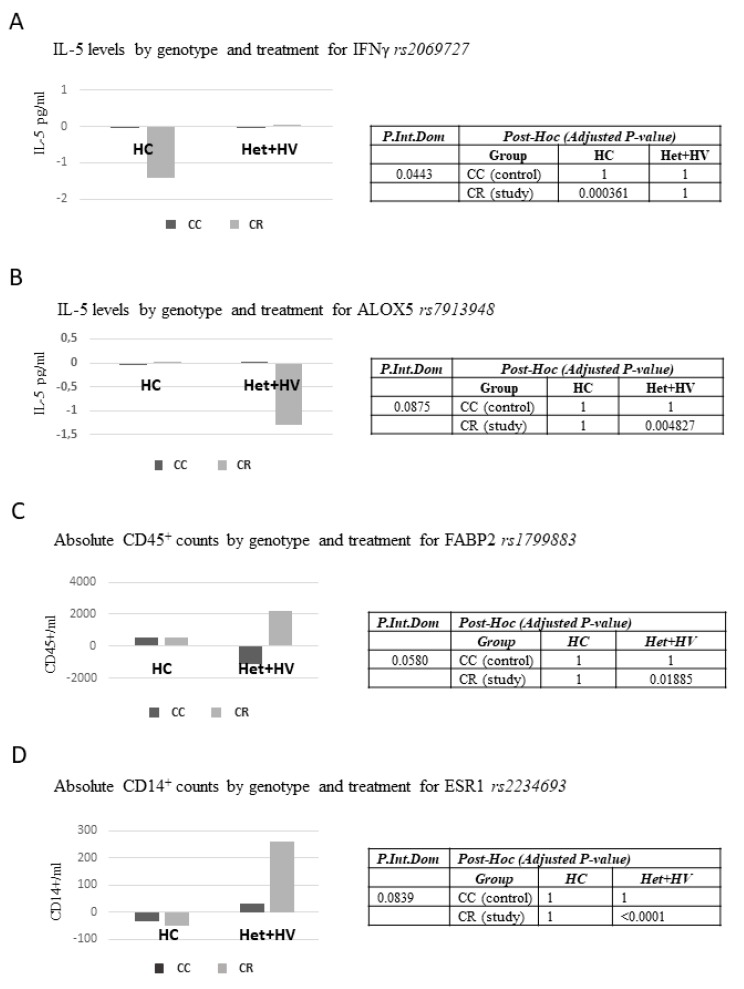
Associations between genetic variants (SNPs) and responses to the nutritional intervention. (A) IL-5 levels by genotype and treatment for INFγ rs2069727; (B) IL-5 levels by genotype and treatment for ALOX5 rs7913948, (C) Absolute CD45+ counts by genotype and treatment for FABP2 rs1799883, (D) Absolute CD14+ counts by genotype and treatment for ESR1 rs2234693.
Figure 6
Figure 6
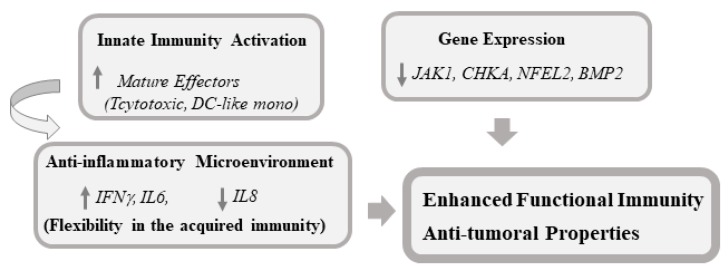
Proposed model of potential main biological benefits of RE-AKG based formula found in this study that encourages its usefulness as co-adjuvant in colon cancer therapy.

References

    1. Suchner U., Kuhn K.S., Furst P. The scientific basis of immunonutrition. Proc. Nutr. Soc. 2000;59:553–563. doi: 10.1017/S0029665100000793. - DOI - PubMed
    1. Senatore F.J., Murali S., Dasanu A.C. Accelerated Premalignant Polyposis and Second Colon Cancers: Incriminating Immunosuppression, Radiotherapy, and Systemic Chemotherapy Agents. J. Gastrointest. Cancer. 2016;47:152–156. doi: 10.1007/s12029-016-9813-9. - DOI - PubMed
    1. Watt S.K., Hasselbalch H.C., Skov V., Kjær L., Thomassen M., Kruse T.A., Burton M., Gögenur I. Whole Blood Gene Expression Profiling in patients undergoing colon cancer surgery identifies differential expression of genes involved in immune surveillance, inflammation and carcinogenesis. Surg. Oncol. 2018;27:208–215. doi: 10.1016/j.suronc.2018.03.002. - DOI - PubMed
    1. Andrews F.J., Griffiths R.D. Glutamine: Essential for immune nutrition in the critically ill. Br. J. Nutr. 2002;87(Suppl. S1):S3–S8. doi: 10.1079/BJN2001451. - DOI - PubMed
    1. Grimble G.K., Westwood O.M. Nucleotides as immunomodulators in clinical nutrition. Curr. Opin. Clin. Nutr. Metab. Care. 2001;4:57–64. doi: 10.1097/00075197-200101000-00011. - DOI - PubMed

Publication types

MeSH terms