. 2020 Jan-Feb;15(1-2):161-173.
doi: 10.1080/15592294.2019.1656158. Epub 2019 Aug 26.

Cannabis use is associated with potentially heritable widespread changes in autism candidate gene DLGAP2 DNA methylation in sperm

Affiliations

Cannabis use is associated with potentially heritable widespread changes in autism candidate gene DLGAP2 DNA methylation in sperm

Rose Schrott et al. Epigenetics. 2020 Jan-Feb.

Abstract

Parental cannabis use has been associated with adverse neurodevelopmental outcomes in offspring, but how such phenotypes are transmitted is largely unknown. Using reduced representation bisulphite sequencing (RRBS), we recently demonstrated that cannabis use is associated with widespread DNA methylation changes in human and rat sperm. Discs-Large Associated Protein 2 (DLGAP2), involved in synapse organization, neuronal signaling, and strongly implicated in autism, exhibited significant hypomethylation (p < 0.05) at 17 CpG sites in human sperm. We successfully validated the differential methylation present in DLGAP2 for nine CpG sites located in intron seven (p < 0.05) using quantitative bisulphite pyrosequencing. Intron 7 DNA methylation and DLGAP2 expression in human conceptal brain tissue were inversely correlated (p < 0.01). Adult male rats exposed to delta-9-tetrahydrocannabinol (THC) showed differential DNA methylation at Dlgap2 in sperm (p < 0.03), as did the nucleus accumbens of rats whose fathers were exposed to THC prior to conception (p < 0.05). Altogether, these results warrant further investigation into the effects of preconception cannabis use in males and the potential effects on subsequent generations.

Keywords: Cannabis; DNA methylation; autism; heritability; sperm.


Figures
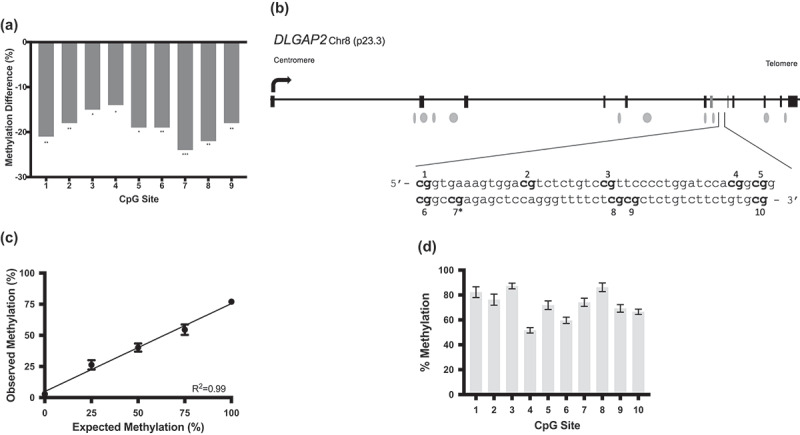
Figure 1.
Figure 1.
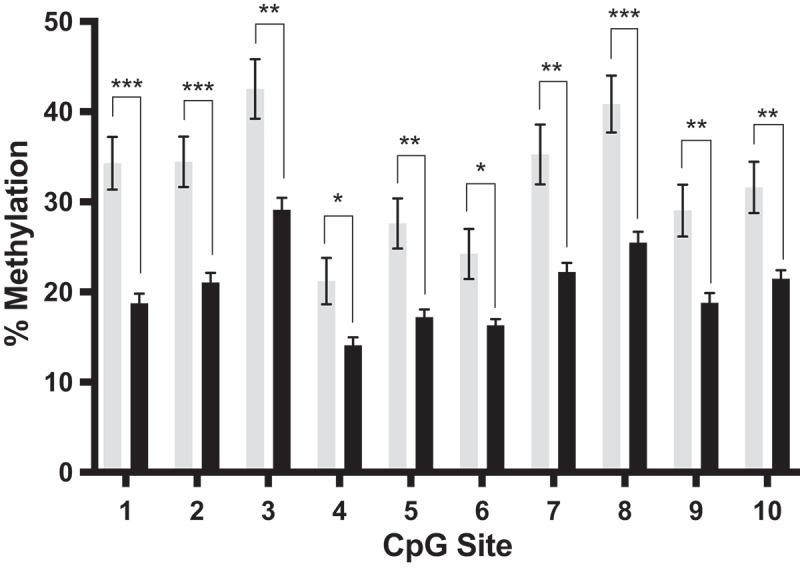
Reduced representation bisulphite sequencing data and DLGAP2 schematic demonstrating the region used for bisulphite pyrosequencing. (a) RRBS data for DLGAP2 from our prior study. This genome-scale analysis identified CpG sites that were differentially methylated in the sperm of cannabis users compared to controls. Results for nine CpG sites, intronically located in DLGAP2, that were significantly hypomethylated in the sperm of cannabis users compared to controls. (b) A gene schematic of DLGAP2. Exons are represented by the rectangular boxes, while the ovals represent CpG islands. The sequence identified by RRBS that was subsequently analysed here is identified in the inset. CpG site 7 (7*) was not initially identified in the RRBS data but included in further analyses, for a total of 10 CpG sites analysed. (c) Pyrosequencing assay validation (performed in triplicate) for DLGAP2. Data points and error bars represent the mean ± SEM, respectively. Error bars not shown had deviations too small for inclusion on the graph. (d) Pyrosequencing results showing the average level of DNA methylation for each of the ten CpG sites of DLGAP2 in human conceptal diploid testes tissues demonstrate that the intron 7 region of DLGAP2 is not an imprint control region. Shown are the mean ± SEM.* = p < 0.05; ** = p < 0.01; *** = p < 0.001.
Figure 2.
Figure 2.
Bisulphite pyrosequencing results for DLGAP2. Bisulphite pyrosequencing of sperm DNA from cannabis exposed (black) and non-user controls (gray), validating our RRBS findings for DLGAP2. Shown are the mean ± SEM. * = p < 0.05; ** = p < 0.005; *** = p < 0.0005.
Figure 3.
Figure 3.
Relationship between DNA methylation and gene expression for DLGAP2. Inverse correlation between DNA methylation and fold-change expression in the region of interest for DLGAP2 in all n = 28 conceptal brain tissues (a), in n = 15 males (b) versus n = 13 females (c) .
Figure 4.
Figure 4.
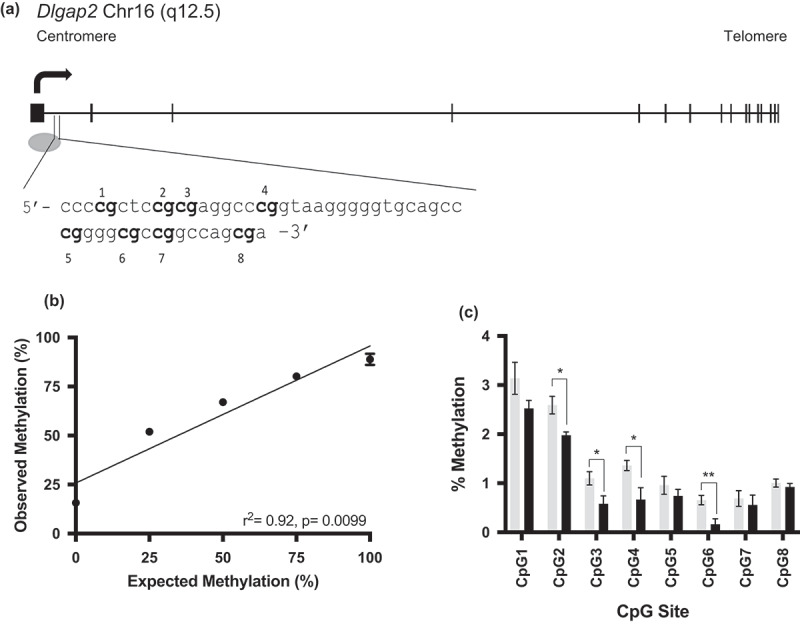
Rat Dlgap2 gene schematic and pyrosequencing assay validation. (a) A gene schematic of Dlgap2. Exons are represented by the rectangular boxes, while the oval represents a CpG island. The sequence of interest is identified in the inset. (b) Pyrosequencing assay validation performed in triplicate for Dlgap2. Error bars represent the SEM. Error bars not shown had deviations too small for inclusion on the graph. (c) Bisulphite pyrosequencing data from control (gray) or 4mg/kg THC exposed (black) rat sperm for Dlgap2. Shown is the mean +/- SEM for each group. * = p < 0.05; ** = p < 0.01.
Figure 5.
Figure 5.
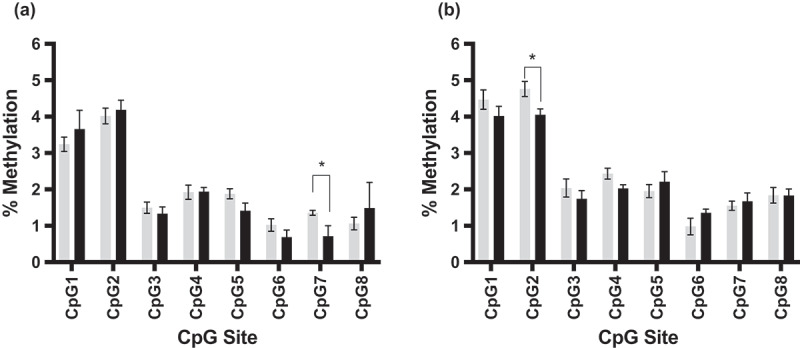
Bisulphite pyrosequencing for rat Dlgap2 in offspring hippocampus and nucleus accumbens. Hippocampal (a) and nucleus accumbens (b) Dlgap2 bisulphite pyrosequencing data for rats born to control (gray) or THC exposed (black) fathers. Shown is the mean +/- SEM for each group. * = p < 0.05.

References

    1. Gunn JK, Rosales CB, Center KE, et al. Prenatal exposure to cannabis and maternal and child health outcomes: a systematic review and meta-analysis. BMJ Open. 2016. April 5;6(4):e009986. - PMC - PubMed
    1. Smart R, Caulkins JP, Kilmer B, et al. Variation in cannabis potency and prices in a newly legal market: evidence from 30 million cannabis sales in Washington state. Addiction. 2017. December;112(12):2167–2177. - PMC - PubMed
    1. Berke J, Gould S. Illinois just became the first state to legalize marijuana sales through the legislature – here are all the states where marijuana is legal. 2018. cited 2019 Jun 25. Available from: https://www.businessinsider.com/legal-marijuana-states-2018-1.
    1. Elsohly MA, Slade D.. Chemical constituents of marijuana: the complex mixture of natural cannabinoids. Life Sci. 2005. December 22;78(5):539–548. - PubMed
    1. ElSohly MA, Mehmedic Z, Foster S, et al. Changes in cannabis potency over the last 2 decades (1995-2014): Analysis of current data in the United States. Biol Psychiatry. 2016. April 1;79(7):613–619. - PMC - PubMed

Publication types