. 2019 Oct;213(2):449-463.
doi: 10.1534/genetics.119.302452. Epub 2019 Aug 26.

Mutations in the PCNA DNA Polymerase Clamp of Saccharomyces cerevisiae Reveal Complexities of the Cell Cycle and Ploidy on Heterochromatin Assembly

Affiliations

Mutations in the PCNA DNA Polymerase Clamp of Saccharomyces cerevisiae Reveal Complexities of the Cell Cycle and Ploidy on Heterochromatin Assembly

Molly Brothers et al. Genetics. 2019 Oct.

Abstract

In Saccharomyces cerevisiae, transcriptional silencing at HML and HMR maintains mating-type identity. The repressive chromatin structure at these loci is replicated every cell cycle and must be re-established quickly to prevent transcription of the genes at these loci. Mutations in a component of the replisome, the proliferating cell nuclear antigen (PCNA), encoded by POL30, cause a loss of transcriptional silencing at HMR We used an assay that captures transient losses of silencing at HML and HMR to perform extended genetic analyses of the pol30-6, pol30-8, and pol30-79 alleles. All three alleles destabilized silencing only transiently and only in cycling cells. Whereas pol30-8 caused loss of silencing by disrupting the function of Chromatin Assembly Factor 1, pol30-6 and pol30-79 acted through a separate genetic pathway, but one still dependent on histone chaperones. Surprisingly, the silencing-loss phenotypes of pol30-6 and pol30-79 depended on ploidy, but not on POL30 dosage or mating-type identity. Separately from silencing loss, the pol30-6 and pol30-79 alleles also displayed high levels of mitotic recombination in diploids. These results established that histone trafficking involving PCNA at replication forks is crucial to the maintenance of chromatin state and genome stability during DNA replication. They also raised the possibility that increased ploidy may protect chromatin states when the replisome is perturbed.

Keywords: POL30; intragenic complementation; nucleosome assembly; recombination; transcriptional silencing.


Figures

Figure 1
Figure 1
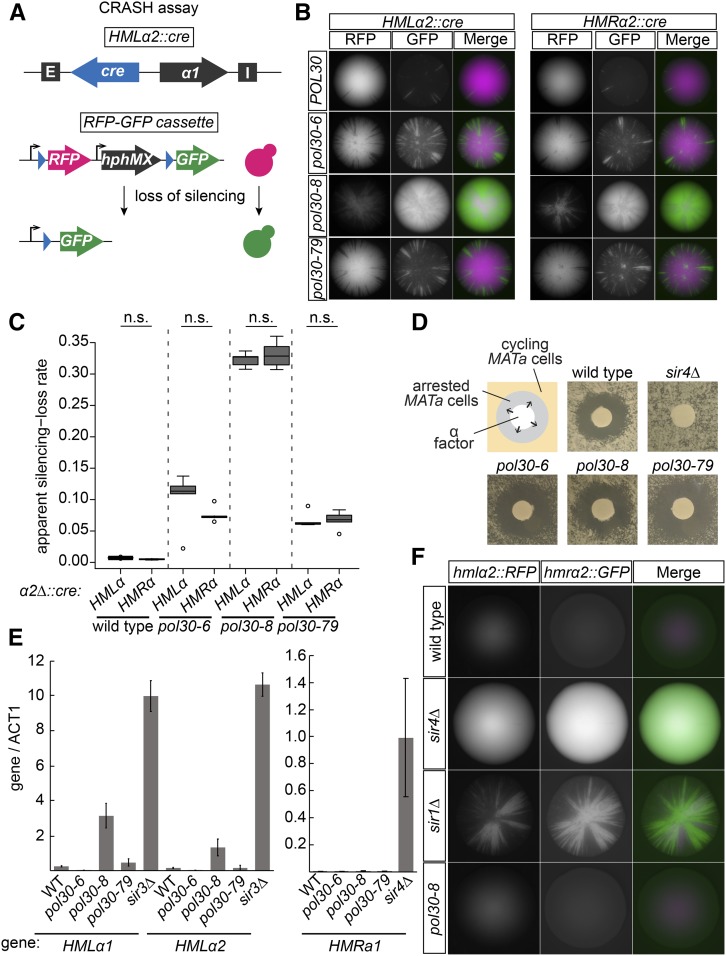
Mutants of POL30 caused transient loss of silencing. (A) Schematic of the CRASH loss-of-silencing assay. Expression of cre from HMLα2::cre occurs when transcriptional silencing is disturbed. In cells that lose silencing even transiently, Cre causes a permanent switch from expressing RFP to expressing GFP. In a similar strain, cre is expressed from HMRα2 to detect loss-of-silencing events at HMR. (B) Colonies of HMLα2::cre (left panel) and HMRα2::cre (right panel) strains for each POL30 allele. Each green sector represents a loss-of-silencing event. Wild-type strains (JRY10790, left and JRY10710, right) had few sectors. Strains containing pol30-6 (JRY11137, left and JRY11186, right), pol30-8 (JRY11188, left and JRY11187, right), or pol30-79 (JRY11141, left and JRY11608, right) had elevated sectoring compared to wild type. (C) The apparent silencing-loss rates for each of the strains in B were quantified by flow cytometry as described in Materials and Methods and in Janke et al. (2018). Significance (Nonsignificant difference = n.s.) was determined by one-way ANOVA and Tukey’s honestly significant difference post hoc test. The center line of each box plot represents the median of at least five biological replicates. The boxes represent the 25th and 75th percentiles. Whiskers represent the range of values within 1.5× the interquartile range. Values extending past 1.5× the interquartile range are marked as outliers (circles). (D) α-Factor halo assay. Filter papers soaked in the mating pheromone α-factor (200 μM in 100 mM sodium acetate) were placed onto a freshly spread lawn of MATa cells of each indicated genotype. MATa cells that maintain silencing at HMLα will arrest in G1 phase around the filter paper, creating a “halo.” Cells that heritably lose silencing at HMLα do not arrest in response to α-factor. Representative images of wild type (JRY4012), sir4Δ (JRY4577), pol30-6 (JRY11645), pol30-8 (JRY11647), and pol30-79 (JRY11649) are shown. (E) Quantitative RT-PCR of α 1 and α2 transcripts from HMLα and a1 from HMRa. Quantification was performed using a standard curve for each set of primers and normalized to ACT1 transcript levels. Error bars represent SD. Bars represent the normalized average of three technical replicates of each indicated strain: WT (JRY11699 matΔ), sir3Δ (JRY9624, matΔhmrΔ) sir4Δ (JRY12174 MATα), pol30-6 (JRY11700 mat Δ), pol30-8 (JRY11701 matΔ), and pol30-79 (JRY11702 matΔ). (F) Genes encoding fluorescence reporters were placed at HMLα2 (RFP) and HMRα2 (GFP) to report on transcription from the two loci. Shown are representative images of colonies from each strain: WT (JRY11129), sir4Δ (JRY11131), sir1Δ (JRY11130) pol30-8 (JRY11132). WT, wild type.
Figure 2
Figure 2
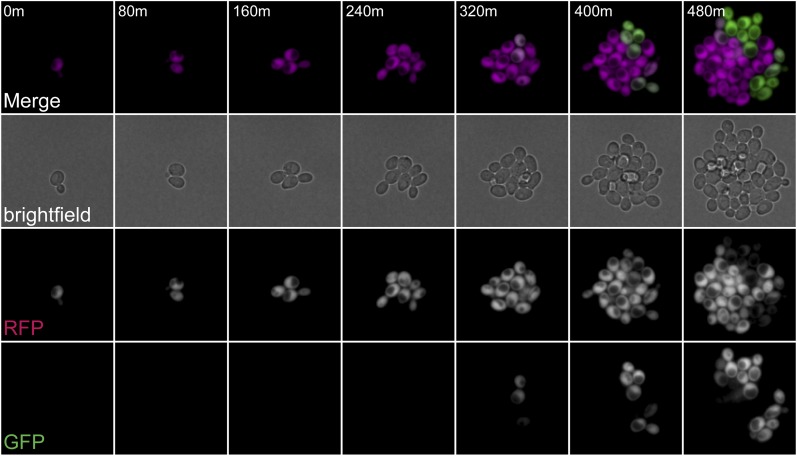
Loss-of-silencing events in strains with defective POL30 alleles occurred predominantly in cycling cells. Representative images of two loss-of-silencing events in one micro-clone of cycling cells in the HMLα2::cre CRASH assay containing the pol30-8 allele (JRY11635, bar1Δ). See Table 1 for calculation of switching rates for all POL30 alleles.
Figure 3
Figure 3
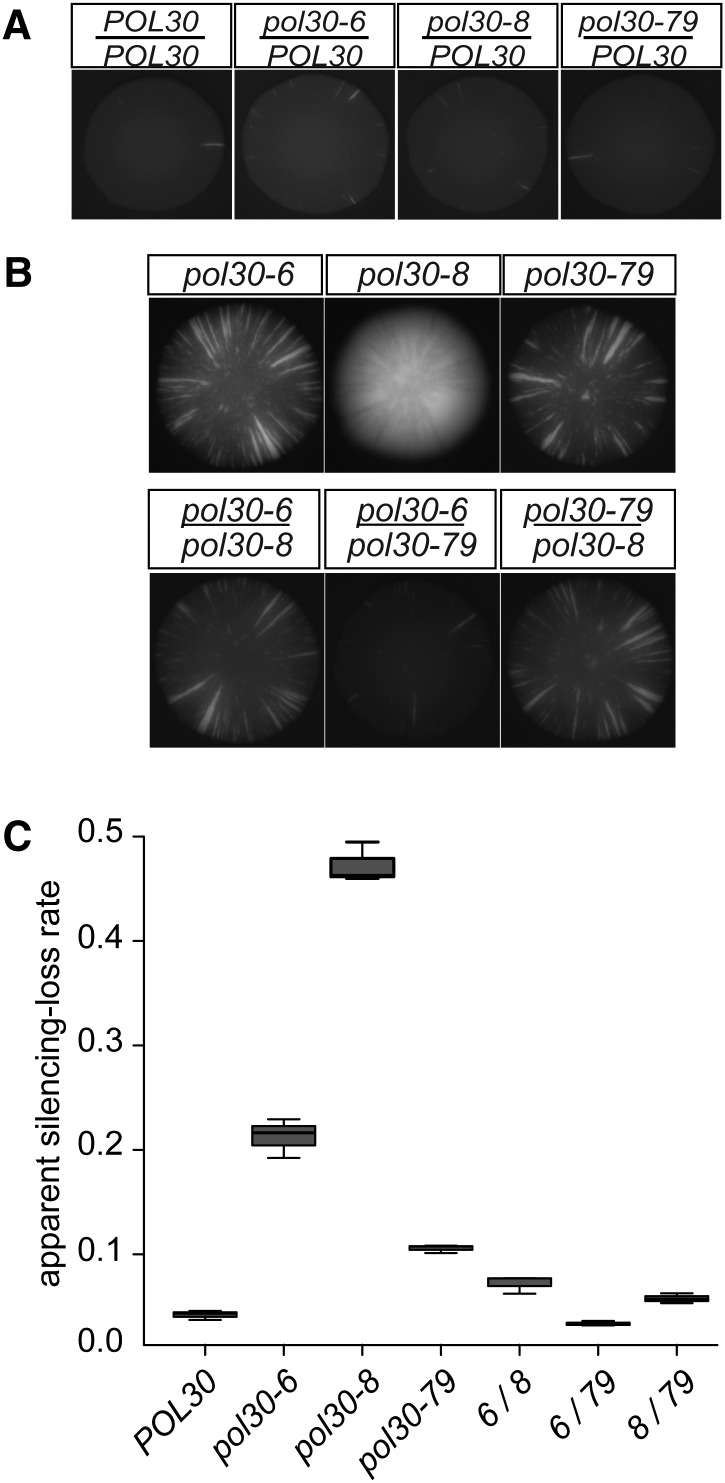
POL30 alleles complemented in diploids. (A) Each pol30 allele was recessive to wild-type POL30 in the CRASH assay POL30/POL30 (JRY11159), pol30-6/POL30 (JRY11160), pol30-8/POL30 (JRY11169), and pol30-79/POL30 (JRY11161). Only the GFP channel is shown. These diploid strains contained only one HMLα2::cre and one RFP-hphMX-GFP cassette. (B) Complementation of pol30-6, pol30-8, and pol30-79 in the CRASH assay. Only the GFP channel is shown. The top row shows representative haploid colonies containing the indicated allele: pol30-6 (JRY11137), pol30-8 (JRY11188), and pol30-79 (JRY11141). The bottom row shows representative diploid colonies containing a combination of the indicated alleles: pol30-6/pol30-8 (JRY11656), pol30-6/pol30-79 (JRY11657), and pol30-8/pol30-79 (JRY11658). Diploid strains contained only one HMLα 2::cre and one RFP-hphMX-GFP cassette. (C) The apparent silencing-loss rates for each of the strains in B and POL30 (JRY10790) were quantified by flow cytometry as described in Figure 1C.
Figure 4
Figure 4
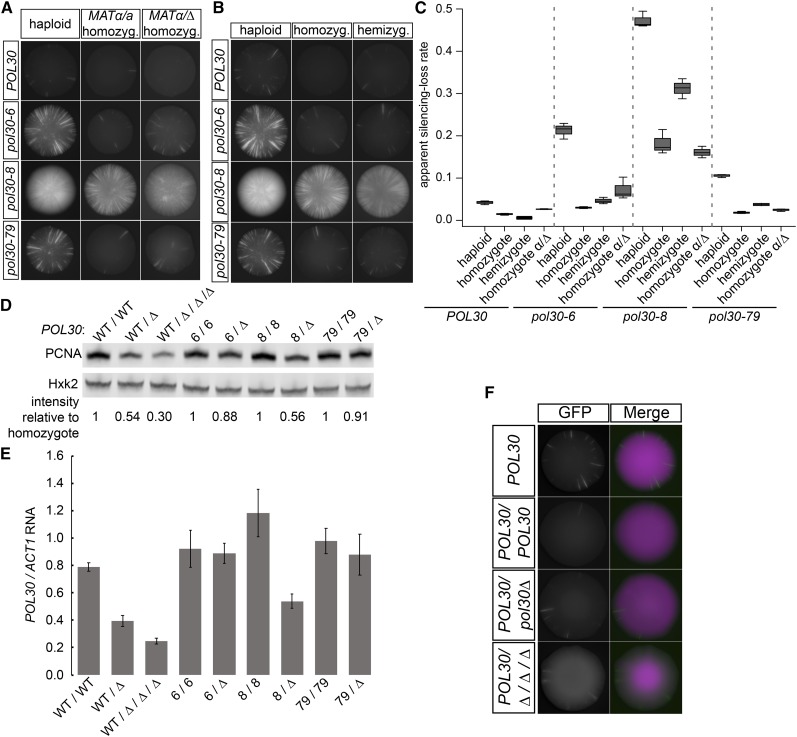
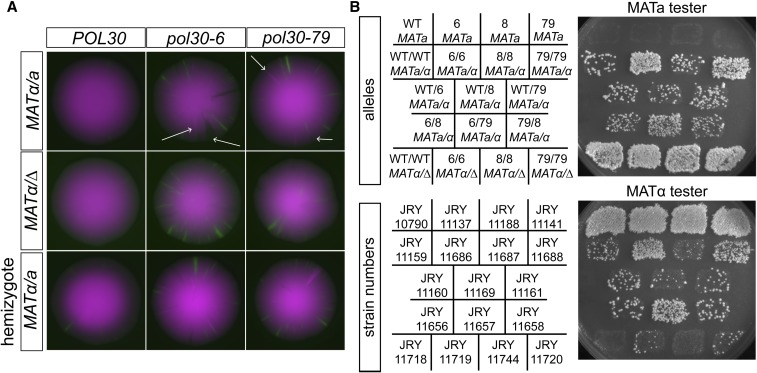
The effect of POL30 mutants on silencing was dependent on ploidy. (A) Representative images of haploids, MATα/MATa homozygotes, and MATα/matΔ homozygotes for each indicated POL30 allele in the CRASH assay. Homozygous diploid strains contained two copies of each indicated allele. Only the GFP channel is shown. Diploid strains contained only one HMLα 2::cre and one RFP-hphMX-GFP cassette. POL30 row: JRY10790, JRY11159, and JRY11718. pol30-6 row: JRY11137, JRY11686, and JRY11719. pol30-8 row: JRY11188, JRY11687, and JRY11744. pol30-79 row: JRY11141, JRY11688, and JRY11720. (B) Representative images of haploids, homozygotes, and hemizygotes for each indicated POL30 allele in the CRASH assay. Homozygotes are diploid strains containing two copies of each indicated allele. Hemizygotes are diploid strains containing one copy of the indicated allele over a deletion of POL30 (pol30Δ). Diploid strains contained only one HMLα2::cre and one RFP-hphMX-GFP cassette. POL30 row: JRY10790, JRY11159, and JRY11745. pol30-6 row: JRY11137, JRY11686, and JRY11822. pol30-8 row: JRY11188, JRY11687, and JRY11749. pol30-79 row: JRY11141, JRY11688, and JRY11823. (C) The apparent silencing-loss rates for each of the strains in A and B were quantified by flow cytometry as described in Figure 1C. (D) Immunoblot analysis of PCNA protein levels in homozygotes and hemizygotes of each allele (same strains as B) as well as a tetraploid containing just one copy of wild-type POL30 (WT/Δ/Δ/Δ, JRY12026). The tetraploid contained two copies of HMLα2::cre and the RFP-hphMX-GFP cassette. Hxk2 levels served as a loading control. POL30 allele nomenclature was abbreviated. Each PCNA band intensity was normalized to Hxk2 intensity. After normalization to Hxk2, the relative intensity of each lane to its corresponding POL30, pol30-6, pol30-8, or pol30-79 homozygote was calculated and displayed. (E) Quantitative RT-PCR analysis of POL30 RNA levels in homozygotes and hemizygotes of each allele and a tetraploid with one copy of wild-type POL30 (same strains as B and D). Quantification was performed as in Figure 1E. (F) Representative images of a wild-type haploid (POL30 JRY10790), homozygote (POL30/POL30 JRY11159), hemizygote (POL30/Δ JRY11745), and tetraploid with one copy of POL30 (POL30/Δ/Δ/Δ JRY12026). The haploids and diploids contained only one HMLα2::cre and one RFP-hphMX-GFP cassette. The tetraploid contained two copies of HMLα2::cre and the RFP-hphMX-GFP cassette. The increased background in the GFP channel of the tetraploid was due to loop-out of one RFP-hphMX cassette, leaving just one RFP-hphMX-GFP cassette able to switch. WT, wild type.
Figure 5
Figure 5
pol30-6 and pol30-79 caused high rates of mitotic recombination and gene conversion in diploids. (A) Representative CRASH colonies of each indicated genotype. The pol30-6 homozygote MATa/MATα diploid (JRY11686) and the pol30-79 homozygote MATa/MATα diploid (JRY11688) both had extrabright sectors and nonfluorescent sectors (examples illustrated by arrows). No, or very few, sectors were observed in POL30 MATa/MATα (JRY11159), POL30 matΔ/ MATα (JRY11718), pol30-6 matΔ/MATα (JRY11719), or pol30-79 matΔ/MATα (JRY11720). Hemizygosity of POL30 (JRY11745), pol30-6 (JRY11822), or pol30-79 (JRY11823) in MATa/ MATα diploids had no effect on the mitotic recombination phenotype. (B) Patch-mating assay. Each indicated strain was patched onto complete medium plates seeded with a freshly plated lawn of either MATa or MATα haploid cells with complementary auxotrophies. After ∼18 hr, mating patches were replica plated onto minimal medium plates. Growth occurs within the patch only if the indicated strains mated with the mating tester lawn. WT, wild type.
Figure 6
Figure 6
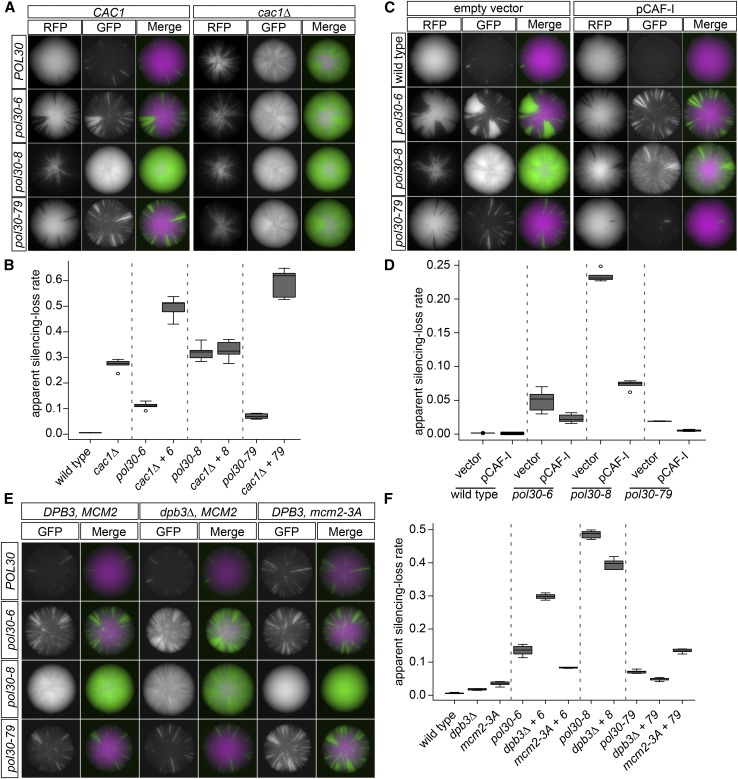
Coordination of histone chaperones by PCNA was required for transcriptional silencing. (A) Double-mutant analysis of POL30 alleles with cac1Δ. Representative images of CRASH colonies. The left panel shows colonies with each of the POL30 alleles with wild-type CAC1 strain: POL30 (JRY10790), pol30-6 (JRY11137), pol30-8 (JRY11188), and pol30-79 (JRY11141). The right panel shows colonies with each of the POL30 alleles in combination with deletion of CAC1 (cac1 Δ): POL30 cac1Δ (JRY11193), pol30-6 cac1Δ (JRY11192), pol30-8 cac1Δ (JRY11189), and pol30-79 cac1Δ (JRY11163). (B) The apparent silencing-loss rates for each of the strains in A were quantified by flow cytometry as described in Figure 1C. (C) Overexpression of the CAF-1 complex in combination with POL30 alleles. Representative images of CRASH colonies. The left panel shows colonies with each of the POL30 alleles in combination with a 2μ vector (pRS425): POL30 (JRY11175), pol30-6 (JRY11176), pol30-8 (JRY11177), and pol30-79 (JRY11178). The right panel shows colonies with each of the POL30 alleles in combination with a 2μ plasmid expressing all three subunits of the CAF-1 complex, CAC1, CAC2, and CAC3 (pJR3418): POL30 pCAF-1 (JRY11165), pol30-6 pCAF-1 (JRY11166), pol30-8 pCAF-1 (JRY11167), and pol30-79 pCAF-1 (JRY11168). (D) The apparent silencing-loss rates for each of the strains in C were quantified by flow cytometry as described in Figure 1C. (E) Double-mutant analysis of POL30 alleles with dpb3Δ and mcm2-3A alleles. Representative images of CRASH colonies. In the left panel are each of the POL30 alleles in a wild-type strain: POL30 (JRY10790), pol30-6 (JRY11137), pol30-8 (JRY11188), and pol30-79 (JRY11141). In the middle panel are each of the POL30 alleles in combination with deletion of DPB3 (dpb3Δ): POL30 dpb3Δ (JRY11760), pol30-6 dpb3Δ (JRY11806), pol30-8 dpb3Δ (JRY11808), and pol30-79 dpb3Δ (JRY11810). In the right panel are each of the POL30 alleles in combination with the mcm2-3A allele: POL30 mcm2-3A (JRY11812), pol30-6 mcm2-3A (JRY11987), pol30-8 mcm2-3A (JRY11989), and pol30-79 mcm2-3A (JRY11991). (F) The apparent silencing-loss rates for each of the strains in E were quantified by flow cytometry as described in Figure 1C. The silencing-loss rate for pol30-8 mcm2-3A double mutant could not be quantified because it uniformly expressed GFP.

References

    1. Alabert C., Jasencakova Z., and Groth A., 2017. Chromatin replication and histone dynamics. Adv. Exp. Med. Biol. 1042: 311–333. 10.1007/978-981-10-6955-0_15 - DOI - PubMed
    1. Aström S. U., Okamura S. M., and Rine J., 1999. Yeast cell-type regulation of DNA repair. Nature 397: 310 10.1038/16833 - DOI - PubMed
    1. Ayyagari R., Impellizzeri K. J., Yoder B. L., Gary S. L., and Burgers P. M., 1995. A mutational analysis of the yeast proliferating cell nuclear antigen indicates distinct roles in DNA replication and DNA repair. Mol. Cell. Biol. 15: 4420–4429. 10.1128/MCB.15.8.4420 - DOI - PMC - PubMed
    1. Bauer G. A., and Burgers P. M., 1990. Molecular cloning, structure and expression of the yeast proliferating cell nuclear antigen gene. Nucleic Acids Res. 18: 261–265. 10.1093/nar/18.2.261 - DOI - PMC - PubMed
    1. Bellelli R., Belan O., Pye V. E., Clement C., Maslen S. L. et al. , 2018. POLE3-POLE4 is a histone H3–H4 chaperone that maintains chromatin integrity during DNA replication. Mol. Cell 72: 112–126.e5. 10.1016/j.molcel.2018.08.043 - DOI - PMC - PubMed

Publication types

MeSH terms