. 2019 Sep 10;116(37):18732-18737.
doi: 10.1073/pnas.1900872116. Epub 2019 Aug 26.

Endogenous fluctuations in the dopaminergic midbrain drive behavioral choice variability

Affiliations

Endogenous fluctuations in the dopaminergic midbrain drive behavioral choice variability

Benjamin Chew et al. Proc Natl Acad Sci U S A. .

Abstract

Human behavior is surprisingly variable, even when facing the same problem under identical circumstances. A prominent example is risky decision making. Economic theories struggle to explain why humans are so inconsistent. Resting-state studies suggest that ongoing endogenous fluctuations in brain activity can influence low-level perceptual and motor processes, but it remains unknown whether endogenous fluctuations also influence high-level cognitive processes including decision making. Here, using real-time functional magnetic resonance imaging, we tested whether risky decision making is influenced by endogenous fluctuations in blood oxygenation level-dependent (BOLD) activity in the dopaminergic midbrain, encompassing ventral tegmental area and substantia nigra. We show that low prestimulus brain activity leads to increased risky choice in humans. Using computational modeling, we show that increased risk taking is explained by enhanced phasic responses to offers in a decision network. Our findings demonstrate that endogenous brain activity provides a physiological basis for variability in complex human behavior.

Keywords: behavioral variability; dopaminergic midbrain; intrinsic brain fluctuations; real-time fMRI; risky decision making.


Conflict of interest statement

The authors declare no conflict of interest.

Figures
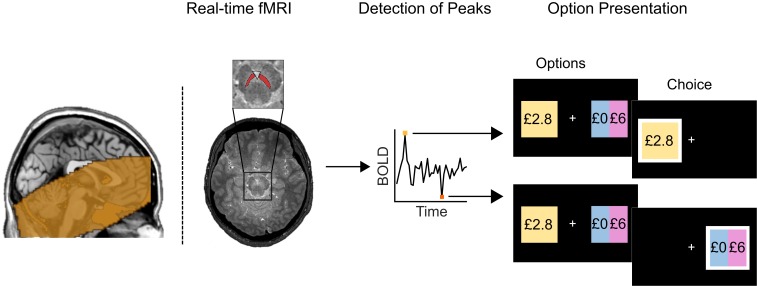
Fig. 1.
Fig. 1.
Schematic of real-time fMRI setup. BOLD activity from anatomically defined SN/VTA is extracted and denoised (removing movement, breathing, and pulsatile artifacts) in real time. The overlay on the sagittal image indicates intersecting coverage across all subjects in the study. Endogenous activity reflecting a low/high background activity state (exceeding a 15th/85th percentile cutoff) triggered presentation of a trial with a choice between a safe option (here, £2.8 guaranteed reward) and a risky option (here, £0 or £6 with equal probability). To ensure similar rates of risk taking across individuals, safe options varied around each subject’s indifference point, which was determined prior to scanning. This design allowed us to efficiently and selectively probe subjects with identical options during very low and very high endogenous SN/VTA activity. Any difference in behavior can therefore be attributed to endogenous SN/VTA activity.
Fig. 2.
Fig. 2.
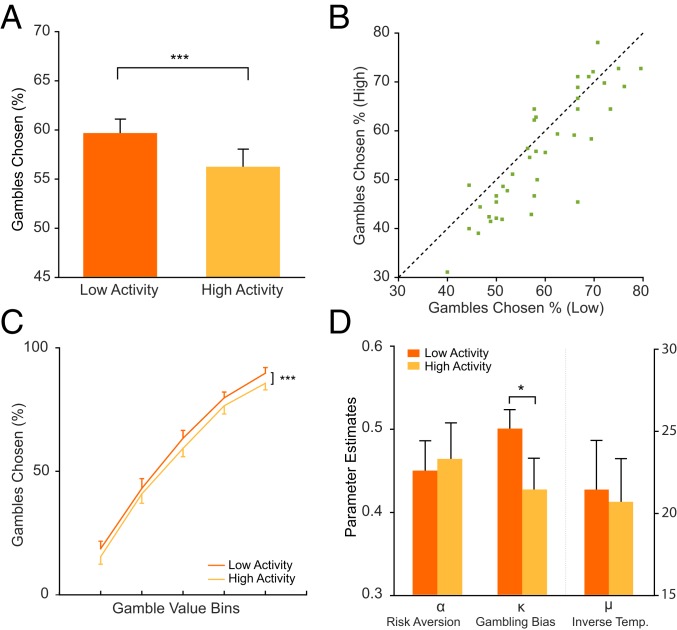
Endogenous fluctuations in SN/VTA BOLD activity modulate value-independent influences on choice. (A) Subjects (n = 43) gambled more when options were presented against a background of low compared to high endogenous SN/VTA activity. (B) This effect of greater risk taking for low than high activity was consistent across subjects. (C) The activity-induced shift in risk taking was independent of value with low endogenous activity leading to increased risk taking irrespective of option value. Differences in objective value between risky and safe options were divided into bins of equal sizes for each subject. (D) Choices were fitted to a parametric decision model based on prospect theory with the best-fitting model including a gambling bias parameter that was higher when endogenous activity was low. Positive gambling bias parameters reflects a tendency to take risks irrespective of option value. *P < 0.05 and ***P < 0.001. Data are mean ± SEM.
Fig. 3.
Fig. 3.
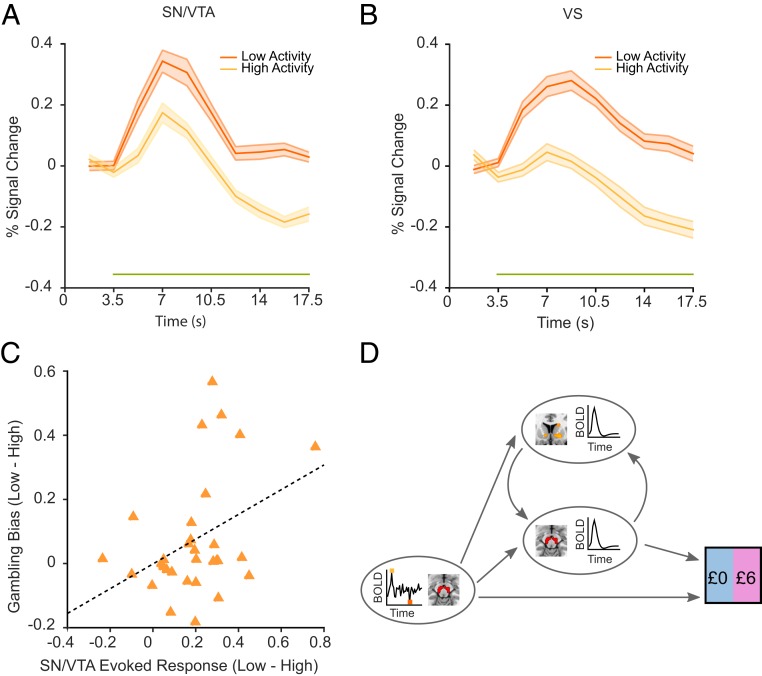
Endogenous fluctuations modulate risk taking via task-evoked responses. (A and B) Endogenous fluctuations lead to distinct task-evoked response patterns with greater BOLD responses in SN/VTA and VS when offers are presented against a background of low endogenous SN/VTA activity. Percent signal change was calculated relative to the 2 volumes following stimulus onset to correct for differences in starting baseline. The green horizontal line indicates statistical significance (P < 0.01). (C) The effect of endogenous SN/VTA activity on risk taking is associated with phasic task-evoked SN/VTA responses. Subjects with a larger difference in task-evoked responses between low and high activity conditions had larger differences in gambling bias parameter κ (r = 0.39; P = 0.03). (D) Mediation analysis shows task-evoked VS responses mediate the influence of endogenous SN/VTA fluctuations on risk taking through their influence on task-evoked SN/VTA responses, indicating the effect of endogenous SN/VTA fluctuations on behavior is under the influence of reciprocal dynamics between SN/VTA and VS.

References

    1. Harless D. W., Camerer C. F., The predictive utility of generalized expected utility theories. Econometrica 62, 1251–1289 (1994).
    1. Fox M. D., Raichle M. E., Spontaneous fluctuations in brain activity observed with functional magnetic resonance imaging. Nat. Rev. Neurosci. 8, 700–711 (2007). - PubMed
    1. Tavor I., et al. , Task-free MRI predicts individual differences in brain activity during task performance. Science 352, 216–220 (2016). - PMC - PubMed
    1. Fox M. D., Snyder A. Z., Zacks J. M., Raichle M. E., Coherent spontaneous activity accounts for trial-to-trial variability in human evoked brain responses. Nat. Neurosci. 9, 23–25 (2006). - PubMed
    1. Sadaghiani S., Poline J.-B., Kleinschmidt A., D’Esposito M., Ongoing dynamics in large-scale functional connectivity predict perception. Proc. Natl. Acad. Sci. U.S.A. 112, 8463–8468 (2015). - PMC - PubMed

Publication types

MeSH terms