. 2019 Aug 26;9(1):12360.
doi: 10.1038/s41598-019-48732-x.

Simultaneous Proton Transfer Reaction-Mass Spectrometry and electronic nose study of the volatile compounds released by Plasmodium falciparum infected red blood cells in vitro

Affiliations

Simultaneous Proton Transfer Reaction-Mass Spectrometry and electronic nose study of the volatile compounds released by Plasmodium falciparum infected red blood cells in vitro

Rosamaria Capuano et al. Sci Rep. .

Abstract

The discovery that Volatile Organic Compounds (VOCs) can be biomarkers for several diseases has led to the conception of their possible application as diagnostic tools. In this study, we aimed at defining of diagnostic signatures for the presence of malaria transmissible stages in infected individuals. To do this, we compared VOCs released by asexual and sexual stage cultures of Plasmodium falciparum, the deadliest species of malaria, with those emitted by uninfected red blood cells (RBCs). VOC analysis was carried out with an innovative set-up, where each sample was simultaneously analysed by proton transfer reaction time of flight mass spectrometry (PTR-ToF-MS) and an electronic nose. PTR-Tof-MS results show that sexual stages are characterized by a larger emission of hexanal, compared with uninfected or asexual stage-infected RBCs, which makes them clearly identifiable. PTR-Tof-MS analysis also detected differences in VOC composition between asexual stages and uninfected RBCs. These results have been substantially replicated by the electronic nose analysis and may open the possibility to develop sensitive and easy-to-use devices able to detect sexual parasite stages in infected individuals. This study also demonstrates that the combination of mass spectrometry with electronic noses is a useful tool to identify markers of diseases and to support the development of optimized sensors.


Conflict of interest statement

The authors declare no competing interests.

Figures
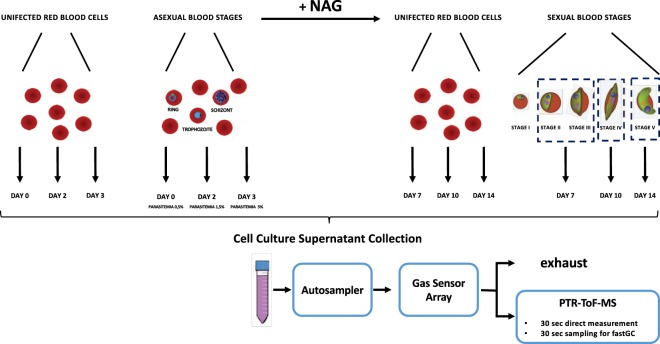
Figure 1
Figure 1
Experimental set-up: RBCs infected with P. falciparum asexual stages were cultured for four days in two biological replicates. Supernatants were sampled at day 0 (0.5% parasitemia in both replicates), day 2 (parasitemia 1.3% and 1.6%) and day 3 (parasitemia 4.2% and 5.9%). At day 4, NAG was added to selectively eliminate the asexual forms. For sake of comparison, NAG was also added to the intact RBC. Gametocyte culture supernatants were sampled at day 7, gametocytes stage II-III (gametocitemia 1.6% and 2.2%); at day 10, gametocytes stage IV and at day 14, gametocyte stage V. Uninfected RBC cultures used as a control were sampled in parallel. Collected supernatants were measured in sequence with electronic nose and PTR-MS.
Figure 2
Figure 2
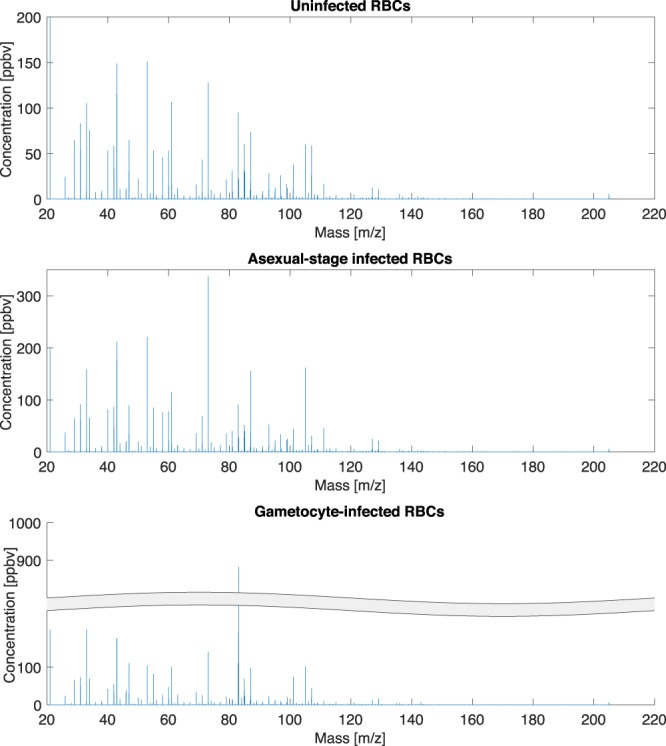
Example of PTR-ToF-MS spectra for each group. The y axis of gametocyte-infected RBC sample is split in order to accommodate the high peak at m/z = 83.086. Figures represents the raw data where the abundance at m/z = 83.086 is overestimated.
Figure 3
Figure 3
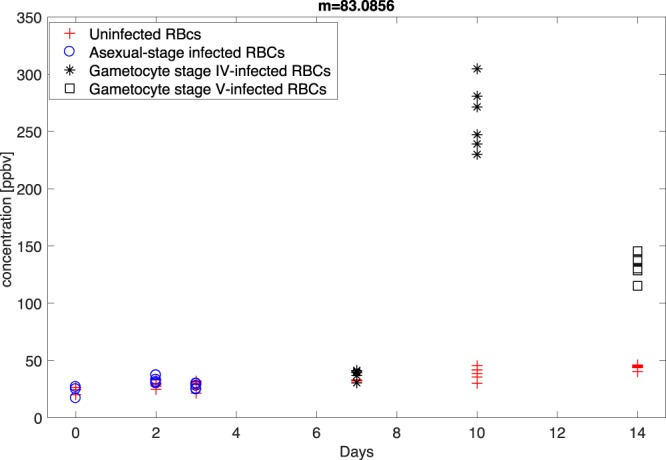
Concentration of m/z = 83.0856 in all samples. This mass is identified as hexanal (dehydratation fragment). The concentrations released by RBCs infected with gametocytes at stages IV and V are evaluated from the concentration of the isotopologue at m/z = 84.089.
Figure 4
Figure 4
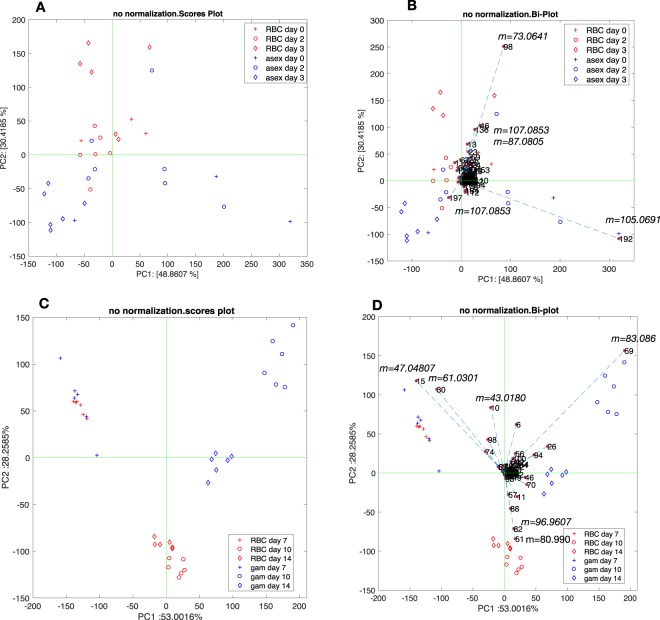
Results of PCA of PTR-MS spectra. (A,B) Shows scores and biplot of the PCA data on uninfected and asexual stage-infected RBCs. All variables in the biplots are labelled with the order number in the spectra. More significant variables are labelled with the corresponding mass. Uninfected RBCs (RBC); asexual blood stages (asex); gametocytes (gam). (C,D) Show the scores and the biplot of the PCA data on uninfected and gametocyte-infected RBCs collected at day 7, immediately after the addition of NAG with gametocytes at stage III, and at days 10 and 14 with gametocytes at stage IV and V respectively. Data are labelled as: Uninfected RBCs (RBC); asexual blood stages (asex); gametocytes (gam).
Figure 5
Figure 5
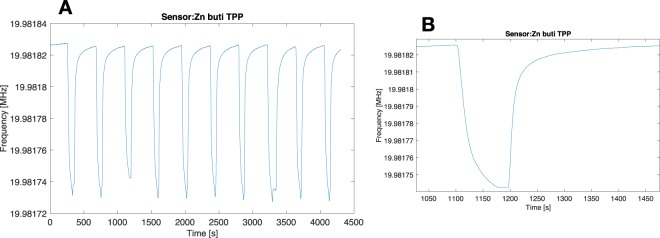
(A) Sequence of signal of one of the sensors, exposed to a series of samples. (B) Details of one of the measurements.
Figure 6
Figure 6
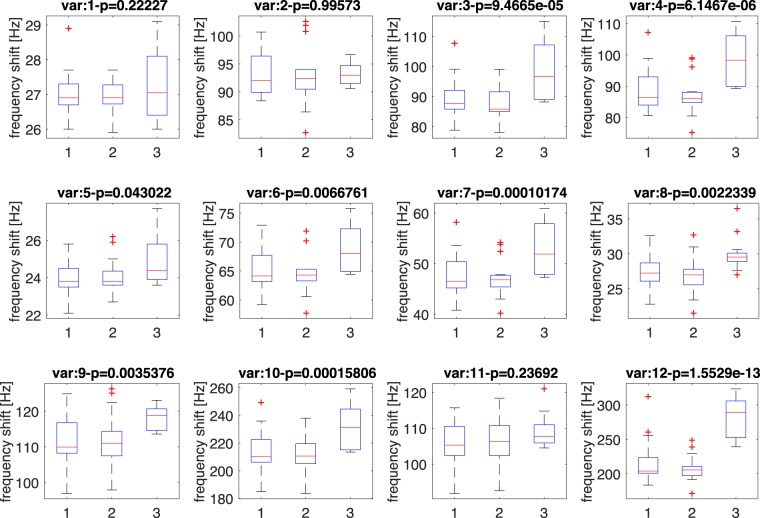
Variance test of sensor data. Each box-plot illustrates the statistical distribution of the corresponding sensor. The header of each box-plot reports the p-value related to at least the separation of one of the three groups respect to the others. Classes are labeled as 1: RBCs, 2: asexual parasites, 3: gametocytes.
Figure 7
Figure 7
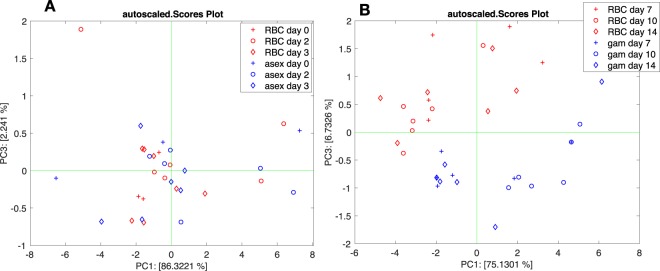
Scores plot of the PCA calculated with asexual stage-infected RBCs (A) and gametocyte-infected RBCs (B).

References

    1. World malaria report 2017. Geneva: World Health Organization (2017).
    1. Delves MJ, Angrisano F, Blagborough AM. Antimalarial Transmission-blocking Interventions: past, present, and future. Trends Parasitol. 2018;34:735. doi: 10.1016/j.pt.2018.07.001. - DOI - PubMed
    1. Watson W, Taylor D, Menard S, Kheng N, White N. Modelling primaquine-induced haemolysis in G6PD deficiency. eLife. 2017;6:e23061. doi: 10.7554/eLife.23061. - DOI - PMC - PubMed
    1. Lacroix R, Mukabana WR, Gouagna LC, Koella JC. Malaria infection increases attractiveness of humans to mosquitoes. PLoS Biol. 2005;3:1590. doi: 10.1371/journal.pbio.0030298. - DOI - PMC - PubMed
    1. Batista E, Costa EFM, Silva AA. Anopheles darlingi (Diptera: Culicidae) displays increased attractiveness to infected individuals with Plasmodium vivax gametocytes. Parasite Vector. 2014;7:251. doi: 10.1186/1756-3305-7-251. - DOI - PMC - PubMed