. 2019 Aug 26;9(1):12335.
doi: 10.1038/s41598-019-48584-5.

Gold(I/III)-Phosphine Complexes as Potent Antiproliferative Agents

Affiliations

Gold(I/III)-Phosphine Complexes as Potent Antiproliferative Agents

Jong Hyun Kim et al. Sci Rep. .

Abstract

The reaction of gold reagents [HAuCl4•3H2O], [AuCl(tht)], or cyclometalated gold(III) precursor, [C^NAuCl2] with chiral ((R,R)-(-)-2,3-bis(t-butylmethylphosphino) quinoxaline) and non-chiral phosphine (1,2-Bis(diphenylphosphino)ethane, dppe) ligands lead to distorted Au(I), (1, 2, 4, 5) and novel cyclometalated Au(III) complexes (3, 6). These gold compounds were characterized by multinuclear NMR, microanalysis, mass spectrometry, and X-ray crystallography. The inherent electrochemical properties of the gold complexes were also studied by cyclic voltammetry and theoretical insight of the complexes was gained by density functional theory and TD-DFT calculations. The complexes effectively kill cancer cells with IC50 in the range of ~0.10-2.53 μΜ across K562, H460, and OVCAR8 cell lines. In addition, the retinal pigment epithelial cell line, RPE-Neo was used as a healthy cell line for comparison. Differential cellular uptake in cancer cells was observed for the compounds by measuring the intracellular accumulation of gold using ICP-OES. Furthermore, the compounds trigger early - late stage apoptosis through potential disruption of redox homeostasis. Complexes 1 and 3 induce predominant G1 cell cycle arrest. Results presented in this report suggest that stable gold-phosphine complexes with variable oxidation states hold promise in anticancer drug discovery and need further development.


Conflict of interest statement

The authors declare no competing interests.

Figures
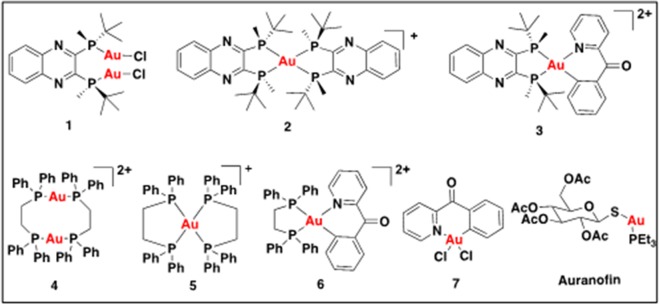
Figure 1
Figure 1
Chemical structures of gold complexes under investigation.
Figure 2
Figure 2
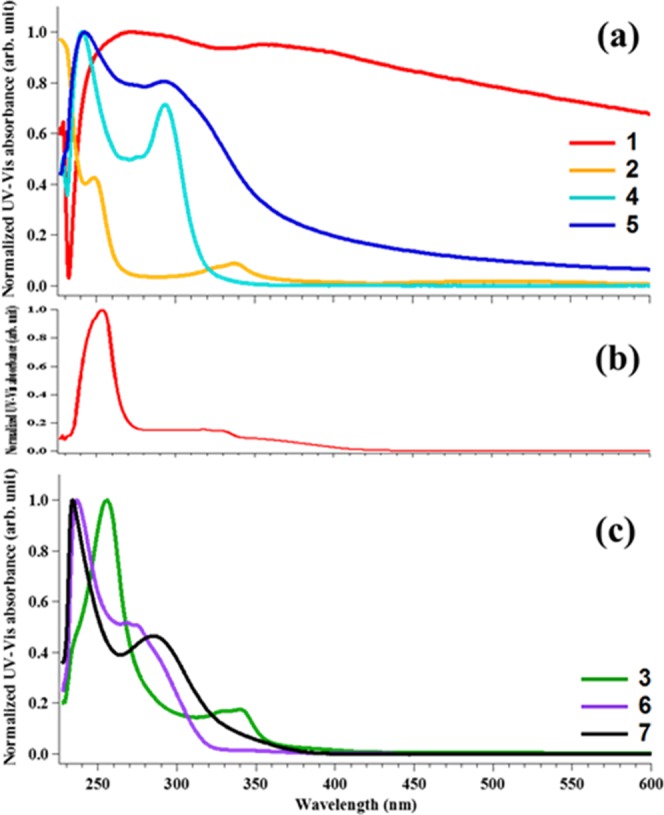
UV-Vis absorption spectrum of Au(I) series, 1, 2, 4, and 5 in PBS (a), 1 in CHCl3 (b), Au(III) series, 3, 6, and 7 in PBS (c). Concentration of complexes = 50 μM. DMSO was used for stock solution. (The final concentration of DMSO was 1% of the total solution).
Figure 3
Figure 3
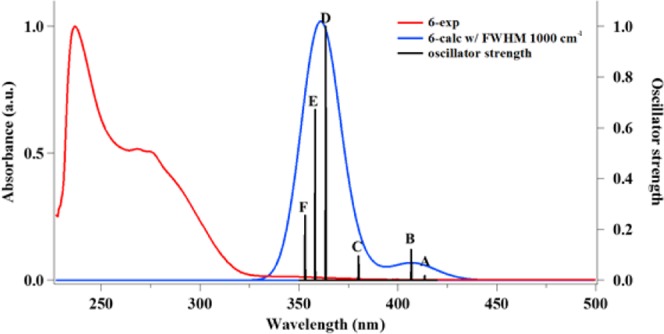
UV-Vis absorption spectrum of Au(III) complex, 6, in PBS at the concentration of 50 μM. DMSO was used for stock solution (red) and theoretical spectrum (blue) and oscillator strengths, f, from Table 1 for 6 (black).
Figure 4
Figure 4
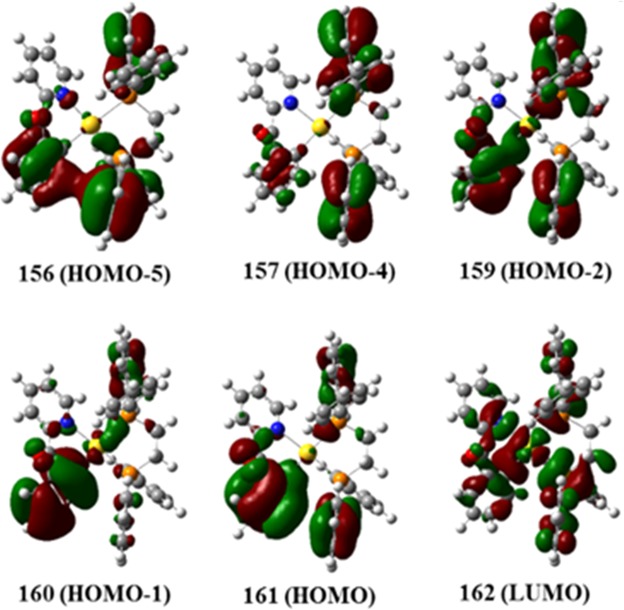
LUMO, HOMO, HOMO-1, HOMO-2, HOMO-4, and HOMO-5 electronic density maps for 6. Calculated on B3LYP, SDD on Au and 6–31 G(d,p) on others.
Figure 5
Figure 5
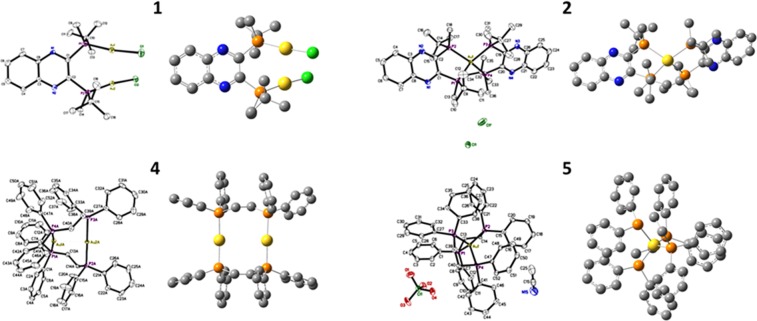
X-ray crystal and calculated structures of 1, 2, 4, and 5. Ellipsoids are drawn at 50% probability level. Hydrogen atoms bound to carbon atoms and solvent are omitted for clarity. The structures were calculated on B3LYP/SDD, 6–31 G(d,p). No imaginary frequencies were found.
Figure 6
Figure 6
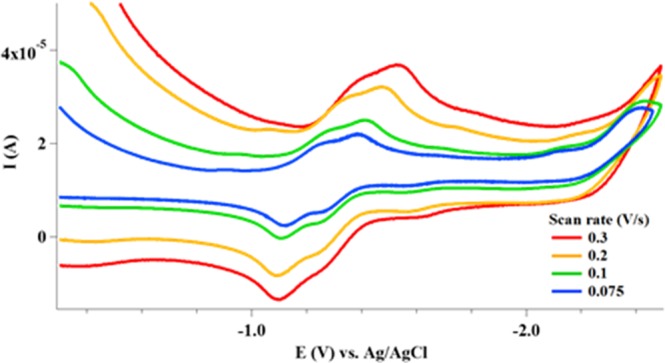
Cyclic voltammograms recorded at a platinum electrode in DMSO solution of 1.0 mM 2, with NaClO4 supporting electrolyte; scan rate 0.3, 0.2, 0.1, and 0.075 V sec−1.
Figure 7
Figure 7
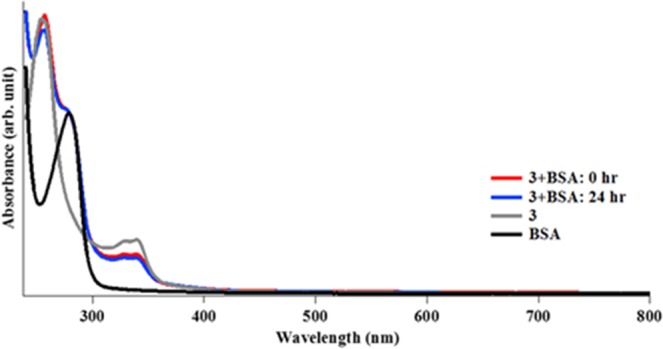
UV-Vis absorption spectra of 3, BSA, and 3 and BSA mixture in PBS. Concentration of complex 3 and BSA = 25 μM. DMSO was used for stock solution of 3.
Figure 8
Figure 8
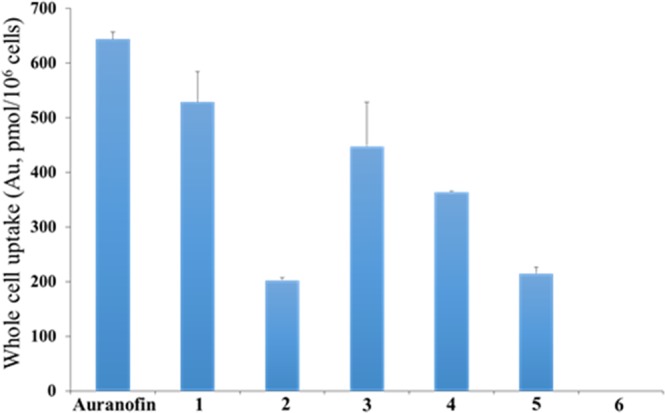
Whole cell (OVCAR8) uptake results from auranofin (5 μM) and complexes 16 (5 μM). Cells were incubated with compounds for 15 h.
Figure 9
Figure 9
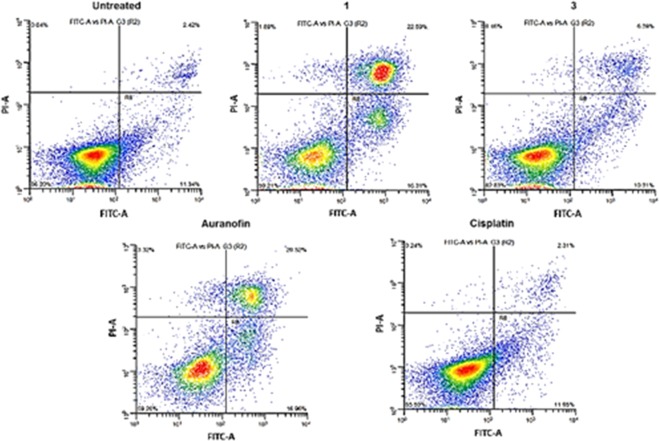
FITC Annexin V/PI apoptosis dead cell assay. OVCAR8 cells were used. Plots of untreated cells (negative control), cells treated with 1 (2 μM for 48 h), 3 (2 μM for 48 h), auranofin (2 μM for 48 h), or cisplatin (2 μM for 48 h).
Figure 10
Figure 10
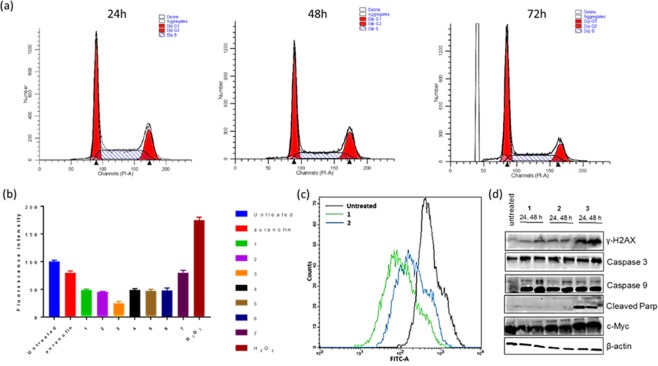
(a) Histogram representing the different phases of the cell cycle of OVCAR8 in the presence or absence 1 (2 µM) over the course of 72 h. 24 h treated with 1: G1: 42.22%, S: 36.39%, G2/M: 21.38%, 48 h treated with 1: G1: 47.27%, S: 34.46%, G2/M: 18.26%, 72 h treated with 1: G1: 54.99%, S: 29.48%, G2/M: 15.53%. (b) Intracellular ROS using OVCAR8 cells and dihydrorhodamine 123 as dye. Plots show untreated cells (negative control), H2O2 treated cells (positive control), and cells treated with 1–7 (5 μM, overnight) or auranofin (5 μM, overnight). (c) Histogram plot of the effects of 1 and 2 (µM) on mitochondrial membrane potential using rhodamine 123 in OVCAR8 cells. (d) immunoblotting for the expression of apoptosis and DNA damage response proteins in OVCAR8 cells following incubation with 1, 2, or 3. (full-length blots/gels are presented in Supplementary Fig. 68).

References

    1. Huang K-B, et al. Organometallic Gold(III) Complexes Similar to Tetrahydroisoquinoline Induce ER-Stress-Mediated Apoptosis and Pro-Death Autophagy in A549 Cancer Cells. J. Med. Chem. 2018;61:3478–3490. doi: 10.1021/acs.jmedchem.7b01694. - DOI - PubMed
    1. Rackham O, Nichols SJ, Leedman PJ, Berners-Price SJ, Filipovska A. A gold(I) phosphine complex selectively induces apoptosis in breast cancer cells: Implications for anticancer therapeutics targeted to mitochondria. Biochem. Pharmacol. 2007;74:992–1002. doi: 10.1016/j.bcp.2007.07.022. - DOI - PubMed
    1. Nobili S, et al. Gold compounds as anticancer agents: chemistry, cellular pharmacology, and preclinical studies. Med. Res. Rev. 2009;30:550–580. doi: 10.1002/med.20168. - DOI - PubMed
    1. Bertrand B, Casini A. A golden future in medicinal inorganic chemistry: the promise of anticancer gold organometallic compounds. Dalton Trans. 2014;43:4209–4219. doi: 10.1039/C3DT52524D. - DOI - PubMed
    1. Berners-Price SJ, et al. In Vivo Antitumor Activity and in Vitro Cytotoxic Properties of Bis[1,2-bis(diphenylphosphino)ethane]gold(I) Chloride. Cancer Res. 1986;46:5486. - PubMed

Publication types

MeSH terms