. 2019 Aug 26;9(1):12341.
doi: 10.1038/s41598-019-48651-x.

Vertical support use and primate origins

Affiliations

Vertical support use and primate origins

Gabriel S Yapuncich et al. Sci Rep. .

Abstract

Adaptive scenarios of crown primate origins remain contentious due to uncertain order of acquisition and functional significance of the clade's diagnostic traits. A feature of the talus bone in the ankle, known as the posterior trochlear shelf (PTS), is well-regarded as a derived crown primate trait, but its adaptive significance has been obscured by poorly understood function. Here we propose a novel biomechanical function for the PTS and model the talus as a cam mechanism. By surveying a large sample of primates and their closest relatives, we demonstrate that the PTS is most strongly developed in extant taxa that habitually grasp vertical supports with strongly dorsiflexed feet. Tali of the earliest fossils likely to represent crown primates exhibit more strongly developed PTS cam mechanisms than extant primates. As a cam, the PTS may increase grasping efficiency in dorsiflexed foot postures by increasing the path length of the flexor fibularis tendon, and thus improve the muscle's ability to maintain flexed digits without increasing energetic demands. Comparisons are made to other passive digital flexion mechanisms suggested to exist in other vertebrates. These results provide robust anatomical evidence that the habitual vertical support use exerted a strong selective pressure during crown primate origins.


Conflict of interest statement

The authors declare no competing interests.

Figures
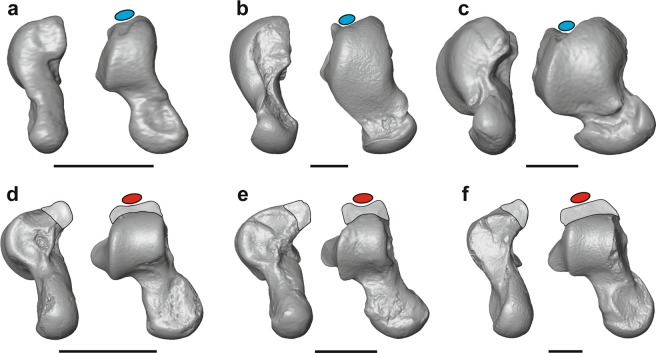
Figure 1
Figure 1
Presence and absence of the posterior trochlear shelf (PTS) in euarchontans. PTS indicated by shading. Ellipses represent flexor fibularis tendon; tendons in red are expected to experience cam effect, while tendons in blue are not. Non-crown primates include (a) Ptilocercus lowii (USNM 488072), (b) Galeopterus variegatus (USNM 317118), and (c) Plesiadapis rex (UM 94816; reversed for consistency). Extant and likely crown primates include (d) Teilhardina belgica (IRSNB M1235), (e) Donrussellia provincialis (MNHN RI 428), and (f) Lepilemur mustelinus (AMNH 170556). Institution abbreviations and expanded comparative plates are provided in Supplementary Material. Scale bars equal 3 mm.
Figure 2
Figure 2
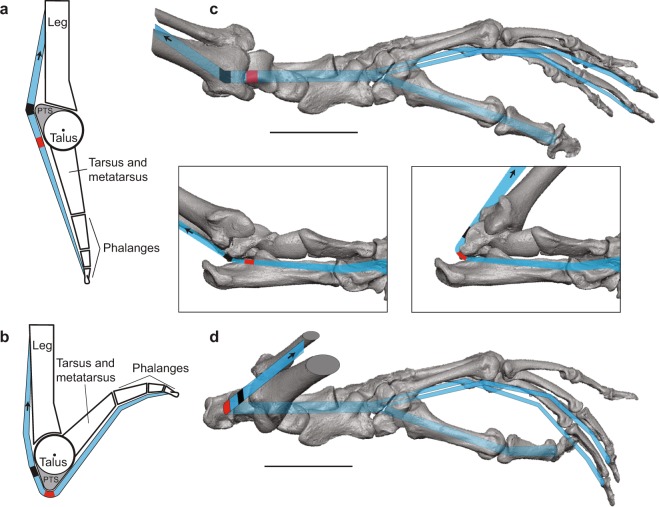
The posterior trochlear shelf (PTS) as a cam mechanism. Line drawings of cam mechanism of the PTS in a plantarflexed (a) and dorsiflexed (b) foot. Cam mechanism modeled in plantarflexed (c) and dorsiflexed (d) foot of Mirza zaza (DLC 315 m), dorsal view. Insets show plantarflexed and dorsiflexed foot in medioplantar view. Blue lines indicate paths of the tendons of flexor fibularis, with black and red marks indicating theoretical contact points between PTS and tendon during plantarflexion and dorsiflexion respectively. Insertion patterns follow Langdon. Arrow indicated by F shows direction of force generated by flexor fibularis.
Figure 3
Figure 3
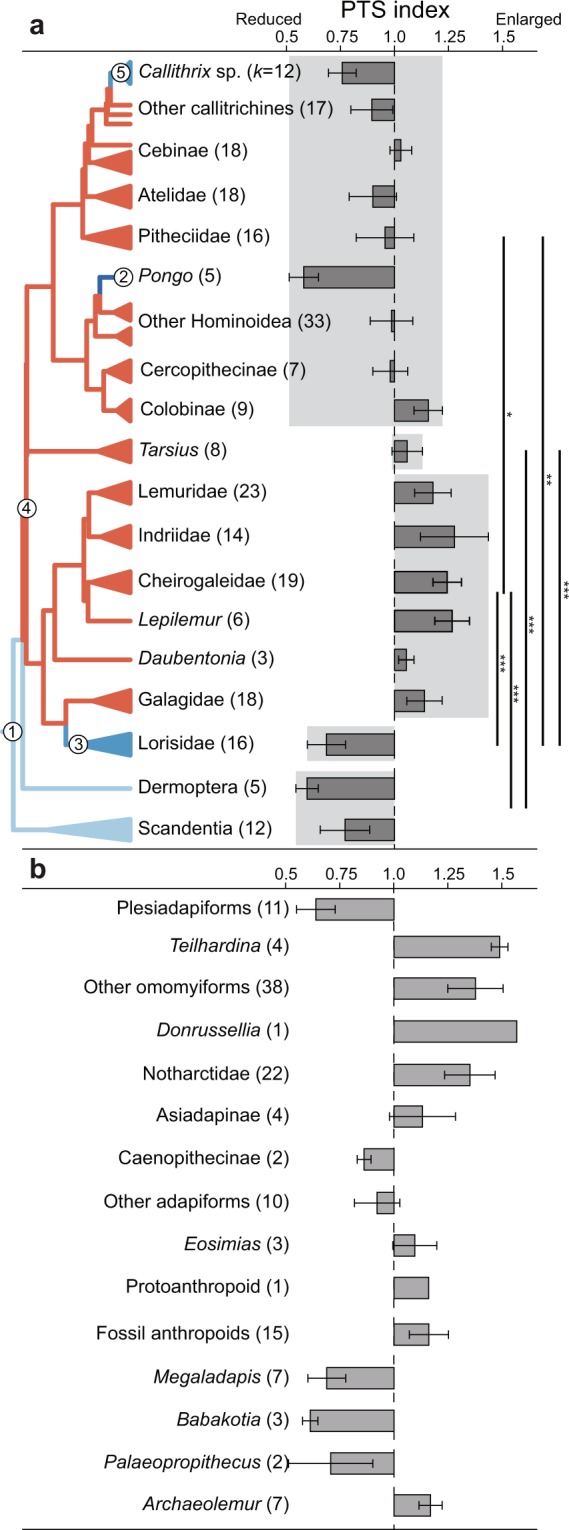
Bar charts of PTS indices, clade-level ANOVA results, and adaptive regime shifts in extant (a) and extinct (b) euarchontans. Whiskers indicate standard deviation. Individual sample sizes indicated in parentheses. Pairwise ANOVAs (F = 27.65, df = 4,68) were computed between groups shaded in light gray using species means and are reported in full in Table S7. Asterisks denote p-values ***p < 0.001, **p < 0.01, *p < 0.05. SURFACE regimes are mapped onto extant phylogeny. Nodes with regime shifts are numbered and detailed in Table S21. Branch colors indicate regime shifts (red: Ɵ > 1.0, blue Ɵ < 1.0); color intensity indicates rank order of Ɵ values (darker colors indicate more extreme optima). Boxplots of PTS indices for all species are shown in Fig. S6.
Figure 4
Figure 4
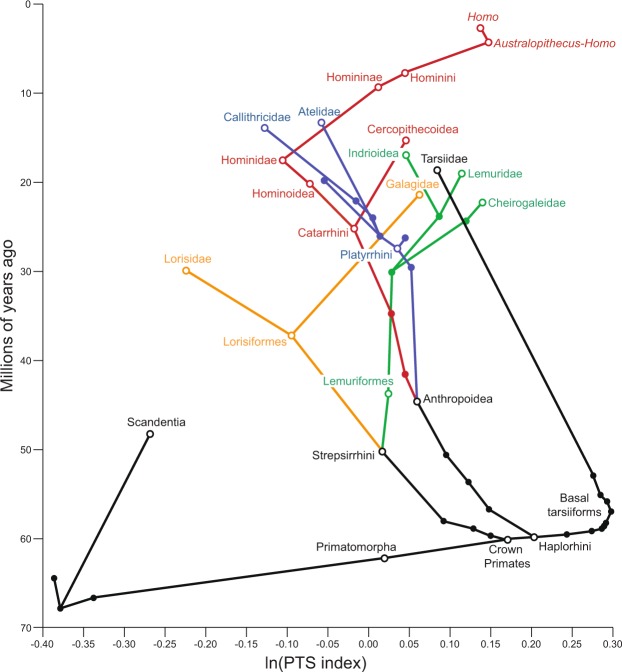
Ancestral state reconstruction (delta model with random walk) of PTS index for select nodes of the euarchontan tree. Branches are colored by clade to improve readability, internal nodes of interest (open circles) are labeled. Mean estimates and confidence intervals for each node are presented in Table S13. Additional discussion of PTS evolution within hominins is presented in Supplementary Material.

References

    1. Decker, R. L. & Szalay, F. S. In Primate Locomotion (ed. Jenkins, F. A.) Origin and function of the pes in the Eocene Adapidae (Lemuriformes, Primates) (Academic Press, New York, 1974).
    1. Dagosto M. Implications of postcranial evidence for the origin of euprimates. J. Hum. Evol. 1988;17:35–56. doi: 10.1016/0047-2484(88)90048-6. - DOI
    1. Gebo DL. Foot morphology and locomotor adaptation in Eocene primates. Folia primatol. 1988;50:3–41. doi: 10.1159/000156332. - DOI - PubMed
    1. Szalay, F. S. & Decker, R. L. In Primate Locomotion (ed. Jenkins, F. A.) Origins, evolution, and function of the tarsus in Late Cretaceous Eutheria and Paleocene Primates (Academic Press, New York, 1974).
    1. Cope ED. The Lemuroidea and the Insectivora of the Eocene period of North America. Am. Nat. 1885;19:457–471. doi: 10.1086/273947. - DOI

Publication types