. 2019 Aug 26;9(1):12350.
doi: 10.1038/s41598-019-48706-z.

Combining ZooMS and zooarchaeology to study Late Pleistocene hominin behaviour at Fumane (Italy)

Affiliations

Combining ZooMS and zooarchaeology to study Late Pleistocene hominin behaviour at Fumane (Italy)

Virginie Sinet-Mathiot et al. Sci Rep. .

Abstract

Collagen type I fingerprinting (ZooMS) has recently been used to provide either palaeoenvironmental data or to identify additional hominin specimens in Pleistocene contexts, where faunal assemblages are normally highly fragmented. However, its potential to elucidate hominin subsistence behaviour has been unexplored. Here, ZooMS and zooarchaeology have been employed in a complementary approach to investigate bone assemblages from Final Mousterian and Uluzzian contexts at Fumane cave (Italy). Both approaches produced analogous species composition, but differ significantly in species abundance, particularly highlighted by a six fold-increase in the quantity of Bos/Bison remains in the molecularly identified component. Traditional zooarchaeological methods would therefore underestimate the proportion of Bos/Bison in these levels to a considerable extent. We suggest that this difference is potentially due to percussion-based carcass fragmentation of large Bos/Bison bone diaphyses. Finally, our data demonstrates high variability in species assignment to body size classes based on bone cortical thickness and fragment size. Thus, combining biomolecular and traditional zooarchaeological methods allows us to refine our understanding of bone assemblage composition associated with hominin occupation at Fumane.


Conflict of interest statement

The authors declare no competing interests.

Figures
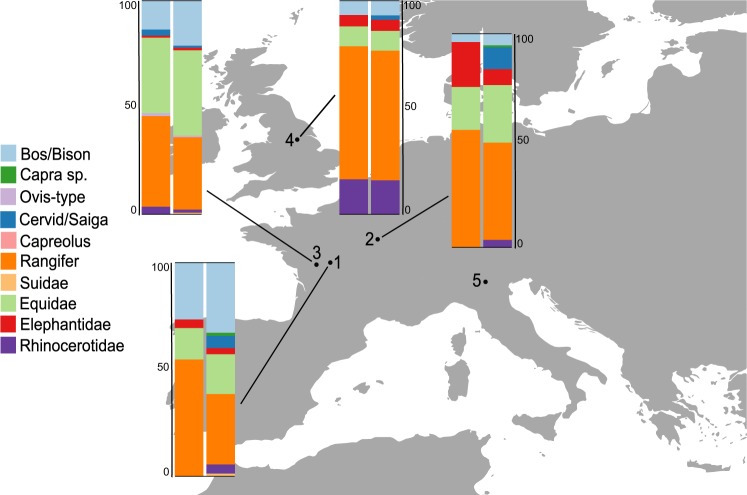
Figure 1
Figure 1
Site location of Fumane and other published, non-targeted ZooMS studies with zooarchaeological data available for the same archaeological layers. For each site the barplot indicates the percentage of number of identified specimens (%NISP) of herbivores for the morphologically identified (left) and the ZooMS-component (right). 1: Les Cottés (France) (ZooMS: N = 70, Morph: N = 75), 2: Grotte du Renne (France) (ZooMS: N = 108, Morph: N = 100), 3: Quinçay (France) (ZooMS: N = 412, Morph: N = 213), 4: Pin Hole Cave (UK) (ZooMS: N = 72, Morph: N = 78), 5: Fumane (Italy; this study see Fig. 3). Further details are provided in Supplementary Table S1.
Figure 2
Figure 2
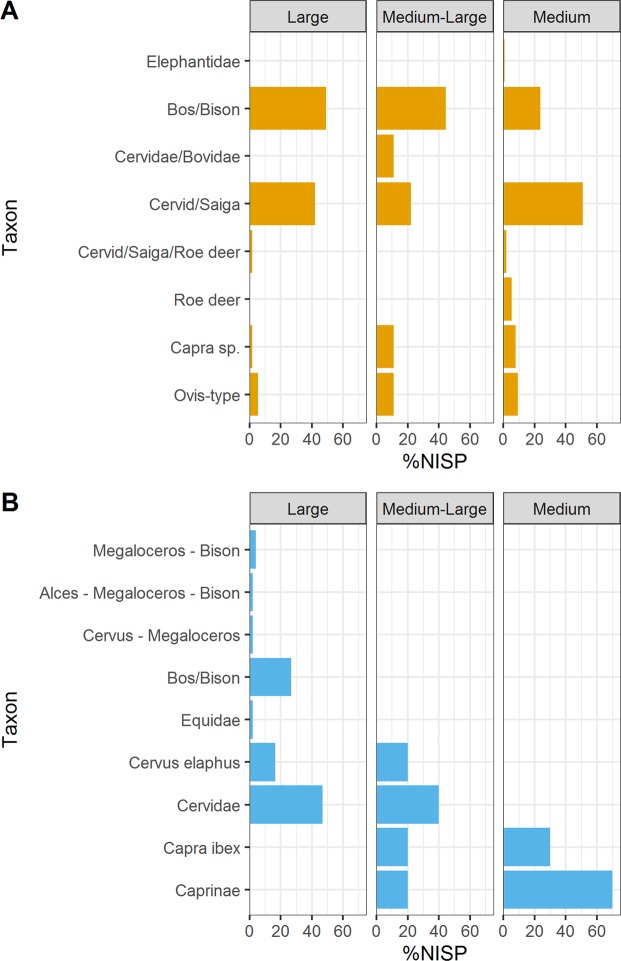
Barplot illustrating relative frequency (%NISP) for taxa identified using ZooMS (A) and morphology (B) in relation to their body size class attribution.
Figure 3
Figure 3
Barplot of %NISP of identified herbivores at Fumane. Morphology: this includes all specimens identified morphologically. Morphology (unburned): this includes specimens identified morphologically but excludes burned fragments (A3: 0.11% of burned specimens out of the morphology-identified assemblage (N = 453); (A4) 0.16% of burned bone fragments out of the morphological faunal assemblage (N = 681)). ZooMS: all specimens identified through ZooMS analysis (does not include burned fragments; see text for details). Colours are similar to Fig. 1. Data for the morphology-component derives from Tagliacozzo et al.. Animal silhouettes are not to scale and derive from phylopic.org.
Figure 4
Figure 4
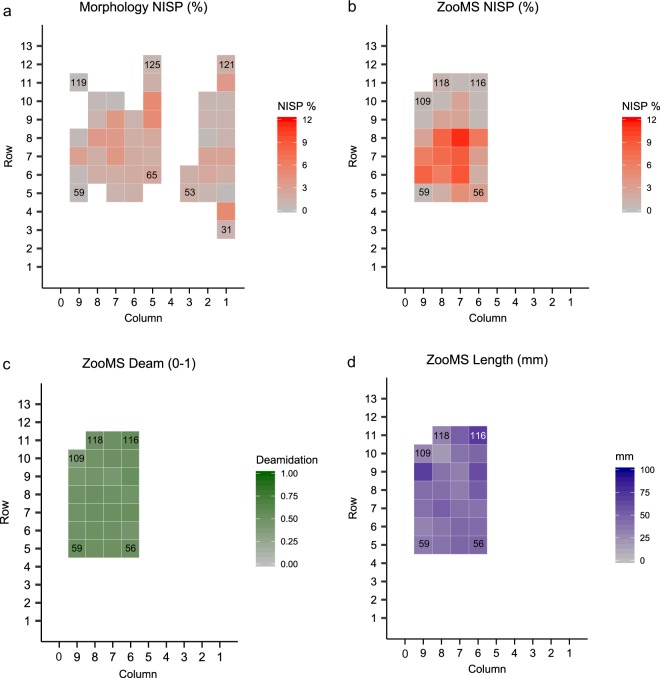
Spatial distribution maps of all bone specimens from the species groups Cervid/Saiga, Capra sp. and Bos/Bison from layers A3 and A4 at Fumane cave. (a) Distribution of %NISP of the three identified species for the morphology-component, over the sampled squares. (b) Distribution of %NISP of the three identified species for the ZooMS-component, over the sampled squares. (c) Average deamidation per square for the ZooMS component. (d) Average length (mm) per square for the ZooMS component. Squares are 1 × 1 meter, and the corresponding excavation numbers for each square can be obtained by joining the y-axis number and the x-axis number (for a detailed excavation plan, see). The numbers within the squares represent the square numbers from the excavation grid. For a and b, a %NISP of 12% would indicate that 12% of the NISP of the combined total of Capra sp., Bos/Bison, and Cervid/Saiga is derived from that square.
Figure 5
Figure 5
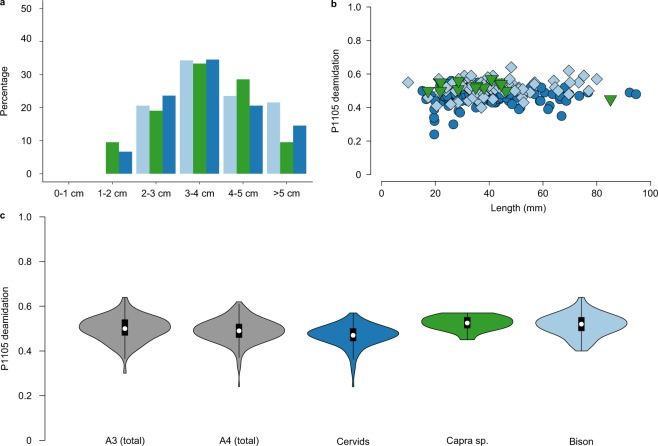
Taphonomic and molecular preservation of Cervid/Saiga, Capra sp., and Bos/Bison specimens. (a) Bone length distribution in mm. (b) Absence of a relationship between bone length (mm) and molecular diagenesis (P1105 deamidation). (c) Violin plots of P1105 deamidation. A3 and A4 include all specimens identified through ZooMS for these levels. Note that Cervid/Saiga is the dominant species group for both A3 and A4, significantly influencing the total violin plots for both levels displayed on the left. Only data for A3 and A4 are included for each panel. Colour legend is identical across panels as well as Figs. 1 and 3 (Cervid/Saiga: dark blue, Capra sp.: green and Bos/Bison: light blue).
Figure 6
Figure 6
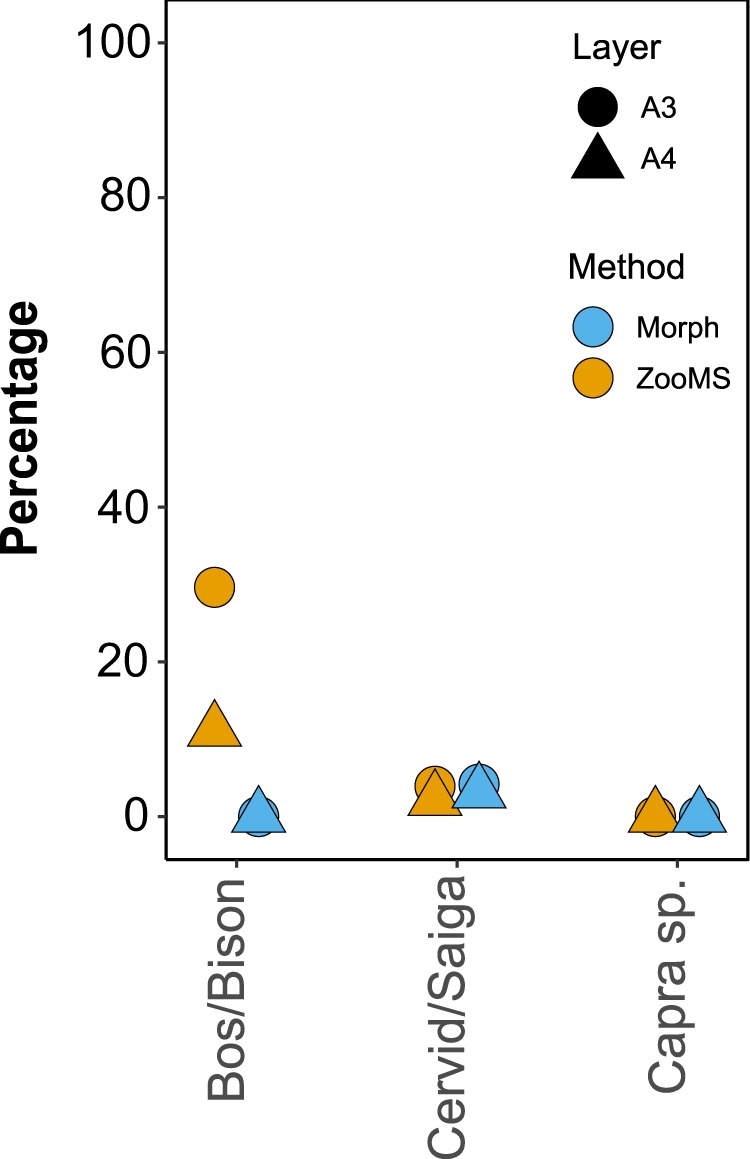
Percussion marks frequencies for the three main species groups within the morphology and the ZooMS-identified component in layers A3 and A4. Y-axis gives the percentage of occurrence (0–100) of percussion marks per specimen for the three major species groups (x-axis). Different point shapes indicate different layers (circle: A3; triangle: A4) whilst colour illustrates different identification method (blue: morphologically identified; gold: ZooMS). See Supplementary Table S4 for associated NISP numbers.

References

    1. Smith GM. Neanderthal megafaunal exploitation in Western Europe and its dietary implications: a contextual reassessment of La Cotte de St Brelade (Jersey) J. Hum. Evol. 2015;78:181–201. doi: 10.1016/j.jhevol.2014.10.007. - DOI - PubMed
    1. Gaudzinski-Windheuser S, Kindler L, Pop E, Roebroeks W, Smith G. The Eemian Interglacial lake-landscape at Neumark-Nord (Germany) and its potential for our knowledge of hominin subsistence strategies. Quat. Int. 2014;331:31–38. doi: 10.1016/j.quaint.2013.07.023. - DOI
    1. Gaudzinski S, Roebroeks W. Adults only. Reindeer hunting at the middle palaeolithic site salzgitter lebenstedt, northern Germany. J. Hum. Evol. 2000;38:497–521. doi: 10.1006/jhev.1999.0359. - DOI - PubMed
    1. Niven L, et al. Neandertal mobility and large-game hunting: the exploitation of reindeer during the Quina Mousterian at Chez-Pinaud Jonzac (Charente-Maritime, France) J. Hum. Evol. 2012;63:624–635. doi: 10.1016/j.jhevol.2012.07.002. - DOI - PubMed
    1. Ruth B, Marco P, Others Human-bird interactions in Prehistory. Session B8, XVII UISPP Congress. Quat. Int. 2016;421:1–5. doi: 10.1016/j.quaint.2016.09.048. - DOI

Publication types