


Extending the Interval of Natalizumab Dosing: Is Efficacy Preserved?
- PMID: 31452081
- PMCID: PMC7007494
- DOI: 10.1007/s13311-019-00776-7
Extending the Interval of Natalizumab Dosing: Is Efficacy Preserved?
Abstract
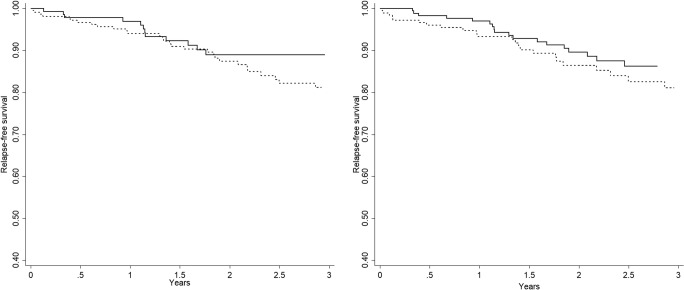
Extending the natalizumab interval after the 24th administration could reduce the risk of progressive multifocal leukoencephalopathy (PML). The objective is to evaluate the noninferiority of the efficacy of an extended interval dosing (EID) compared with the standard interval dosing (SID) of natalizumab. It is an observational, multicenter (14 Italian centers), retrospective cohort study, starting from the 24th natalizumab infusion to the loss of follow-up or 2 years after baseline. Patients were grouped in 2 categories according to the mean number of weeks between doses: < 5 weeks, SID; ≥ 5 weeks, EID. Three hundred and sixty patients were enrolled. Median dose interval (MDI) following 24th infusion was 4.7 weeks, with a bimodal distribution (modes at 4 and 6 weeks). Two hundred and sixteen patients were in the SID group (MDI = 4.3 weeks) and 144 in the EID group (MDI 6.2 weeks). Annualized relapse rate was 0.060 (95% CI = 0.033-0.087) in the SID group and 0.039 (95% CI = 0.017-0.063) in the EID group. The non-inferiority of EID versus SID was satisfied. In conclusion, there is no evidence of a reduced efficacy of natalizumab in an EID setting. This observation confirms previous results and together with the emerging evidence of a reduced risk of PML associated to an EID, supports the need of a randomized study to assess the need to change the standard of the natalizumab dosing schedule.
Keywords: Multiple sclerosis; efficacy; extended dose; natalizumab; progressive multifocal leukoencephalopathy.
Figures

References
-
- Polman CH, O’Connor PW, Havrdova E, Hutchinson M, Kappos L, Miller DH, et al. A randomized, placebo-controlled trial of natalizumab for relapsing multiple sclerosis. N Engl J Med. 2006;354(9):899–910. Available from: http://www.ncbi.nlm.nih.gov/pubmed/16510744. Accessed 27 May 2019 - PubMed
-
- Rudick RA, Stuart WH, Calabresi PA, Confavreux C, Galetta SL, Radue E-W, et al. Natalizumab plus Interferon Beta-1a for Relapsing Multiple Sclerosis. N Engl J Med. 2006;354(9):911–23. - PubMed
-
- Sehr T, Proschmann U, Thomas K, Marggraf M, Straube E, Reichmann H, et al. New insights into the pharmacokinetics and pharmacodynamics of natalizumab treatment for patients with multiple sclerosis, obtained from clinical and in vitro studies. J Neuroinflammation. 2016;13(1):164. 10.1186/s12974-016-0635-2 - PMC - PubMed
Publication types
MeSH terms
Substances
LinkOut - more resources
Full Text Sources
