


Cementing technique for primary knee arthroplasty: a scoping review
- PMID: 31452416
- PMCID: PMC6844414
- DOI: 10.1080/17453674.2019.1657333
Cementing technique for primary knee arthroplasty: a scoping review
Abstract
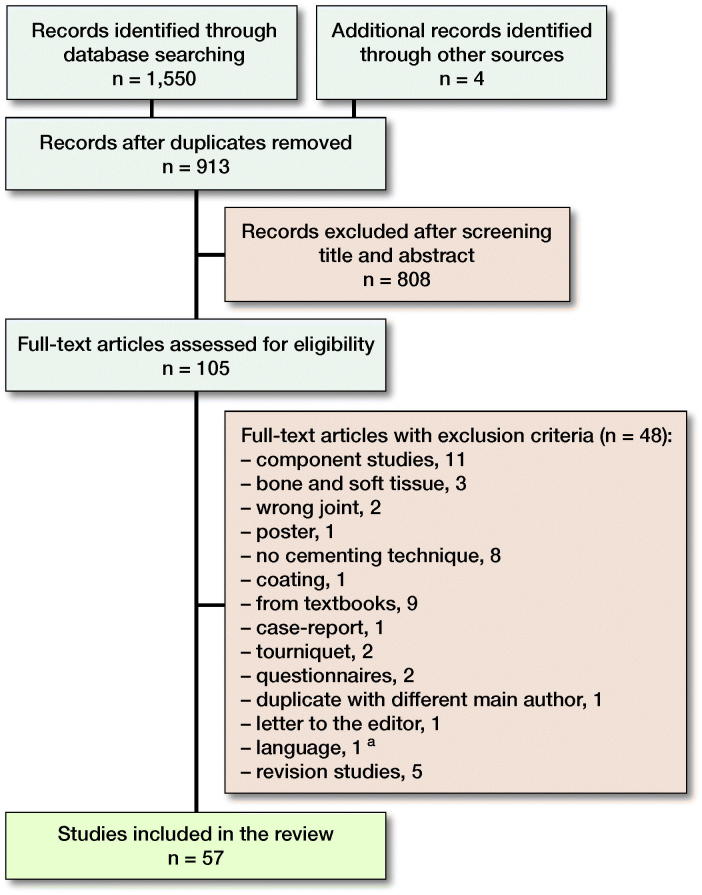
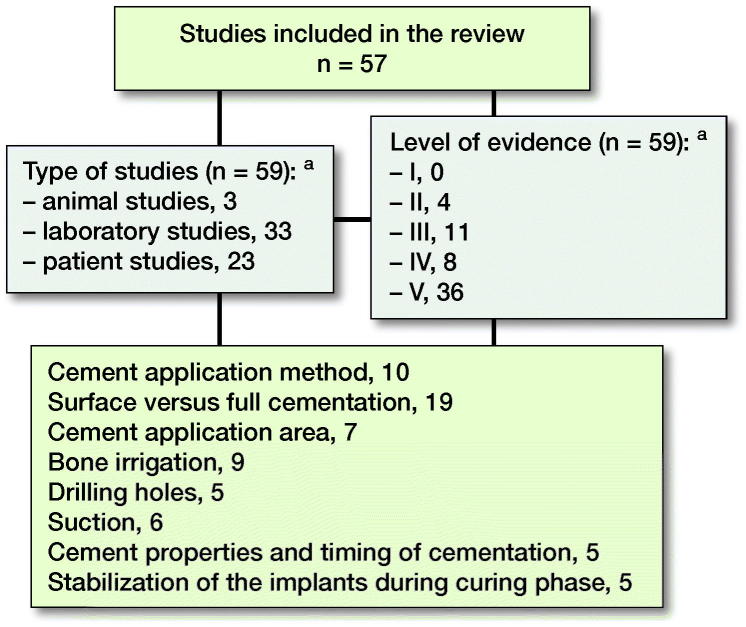
Background and purpose - The optimal cementing technique for primary total knee arthroplasty (TKA) remains unclear. We therefore performed a scoping review based on available studies regarding cementation technique in primary TKA and unicondylar knee arthroplasty (UKA).Patients and methods - A search in 3 databases identified 1,554 studies. The inclusion criteria were literature that studied cementing technique in primary TKA or UKA. This included cement application methods, full or surface cementing, applying cement to the bone and/or prosthesis, stabilization of the implant during curing phase, bone irrigation technique, drilling holes in the bone, use of suction, and the timing of cementation. 57 studies met the inclusion criteria.Results - The evidence was unanimously in favor of pulsatile lavage irrigation, drying the bone, and drilling holes into the tibia during a TKA. All studies concerning suction recommended it during TKA cementation. 7 out of 11 studies favored the use of a cement gun and no studies showed that finger packing was statistically significantly better than using a cement gun. There is evidence that full cementation should be used if metal-backed tibial components are used. Applying the cement to both implant and bone seems to give better cement penetration.Interpretation - There are still many knowledge gaps regarding cementing technique in primary TKA. There seems to be sufficient evidence to recommend pulsatile lavage irrigation of the bone, drilling multiple holes, and drying the bone before cementing and implant insertion, and applying cement to both implant and on the bone.
Figures
References
-
- Arksey H, O’Malley L. Scoping studies: towards a methodological framework. Int J Social Research Methodology 2005; 8(1): 19–32.
-
- Arora J, Ogden A C. Osteolysis in a surface-cemented, primary, modular Freeman-Samuelson total knee replacement. J Bone Joint Surg Br 2005; 87(11): 1502–6. - PubMed
-
- Banwart J C, McQueen D A, Friis E A, Graber C D. Negative pressure intrusion cementing technique for total knee arthroplasty. J Arthroplasty 2000; 15(3): 360–7. - PubMed
Publication types
MeSH terms
Substances
LinkOut - more resources
Full Text Sources
Other Literature Sources
Medical
Miscellaneous