


Soybean iron deficiency chlorosis high throughput phenotyping using an unmanned aircraft system
- PMID: 31452673
- PMCID: PMC6700811
- DOI: 10.1186/s13007-019-0478-9
Soybean iron deficiency chlorosis high throughput phenotyping using an unmanned aircraft system
Erratum in
-
Correction to: Soybean iron deficiency chlorosis high throughput phenotyping using an unmanned aircraft system.Plant Methods. 2019 Oct 10;15:113. doi: 10.1186/s13007-019-0495-8. eCollection 2019. Plant Methods. 2019. PMID: 31624490 Free PMC article.
Abstract
Background: Iron deficiency chlorosis (IDC) is an abiotic stress in soybean [Glycine max (L.) Merr.] that causes significant yield reductions. Symptoms of IDC include interveinal chlorosis and stunting of the plant. While there are management practices that can overcome these drastic yield losses, the preferred way to manage IDC is growing tolerant soybean varieties. To develop varieties tolerant to IDC, breeders may easily phenotype up to thousands of candidate soybean lines every year for severity of symptoms related to IDC, a task traditionally done with a 1-5 visual rating scale. The visual rating scale is subjective and, because it is time consuming and laborious, can typically only be accomplished once or twice during a growing season.
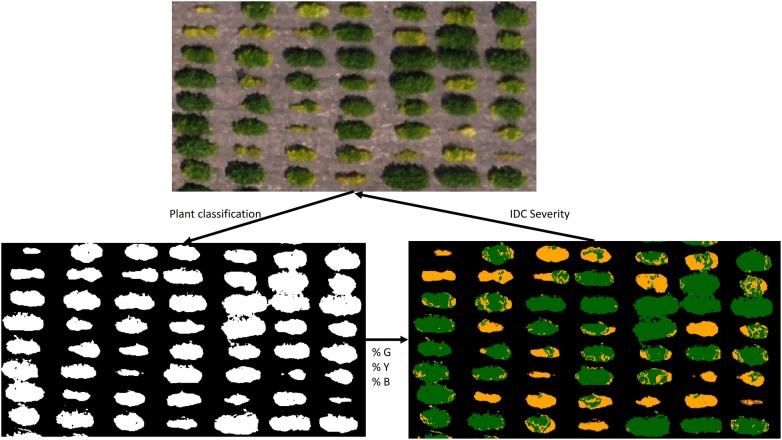
Results: The goal of this study was to use an unmanned aircraft system (UAS) to improve field screening for tolerance to soybean IDC. During the summer of 2017, 3386 plots were visually scored for IDC stress on two different dates. In addition, images were captured with a DJI Inspire 1 platform equipped with a modified dual camera system which simultaneously captures digital red, green, blue images as well as red, green, near infrared (NIR) images. A pipeline was created for image capture, orthomosaic generation, processing, and analysis. Plant and soil classification was achieved using unsupervised classification resulting in 95% overall classification accuracy. Within the plant classified canopy, the green, yellow, and brown plant pixels were classified and used as features for random forest and neural network models. Overall, the random forest and neural network models achieved similar misclassification rates and classification accuracy, which ranged from 68 to 77% across rating dates. All 36 trials in the field were analyzed using a linear model for both visual score and UAS predicted values on both dates. In 32 of the 36 tests on date 1 and 33 of 36 trials on date 2, the LSD associated with UAS image-based IDC scores was lower than the LSD associated with visual scores, indicating the image-based scores provided more precise measurements of IDC severity.
Conclusions: Overall, the UAS was able to capture differences in IDC stress and may be used for evaluations of candidate breeding lines in a soybean breeding program. This system was both more efficient and precise than traditional scoring methods.
Keywords: Image analysis; Iron deficiency chlorosis; Neural network; Random forest; Remote sensing; Soybean; Unmanned aircraft system (UAS).
Conflict of interest statement
Competing interestsThe authors declare that they have no competing interests.
Figures



References
-
- Hansen NC, Schmitt MA, Andersen JE, Strock JS. Iron deficiency of soybean in the upper midwest and associated soil properties. Agron J. 2003;95(6):1595–1601. doi: 10.2134/agronj2003.1595. - DOI
-
- Silva J, Uchida R. Essential nutrients for plant growth: nutrient functions and deficiency symptoms. In: Plant nutrient management in Hawaii’s soils, approaches for tropical and subtropical agriculture. 2000. p. 31–55.
-
- Brown JC, Weber CR, Caldwell BE. Efficient and inefficient use of iron by two soybean genotypes and their isolines. Agron J. 1967;59:459–462. doi: 10.2134/agronj1967.00021962005900050024x. - DOI
LinkOut - more resources
Full Text Sources
Miscellaneous
