


Growing Nano-SiO2 on the Surface of Aramid Fibers Assisted by Supercritical CO2 to Enhance the Thermal Stability, Interfacial Shear Strength, and UV Resistance
- PMID: 31454877
- PMCID: PMC6780530
- DOI: 10.3390/polym11091397
Growing Nano-SiO2 on the Surface of Aramid Fibers Assisted by Supercritical CO2 to Enhance the Thermal Stability, Interfacial Shear Strength, and UV Resistance
Abstract
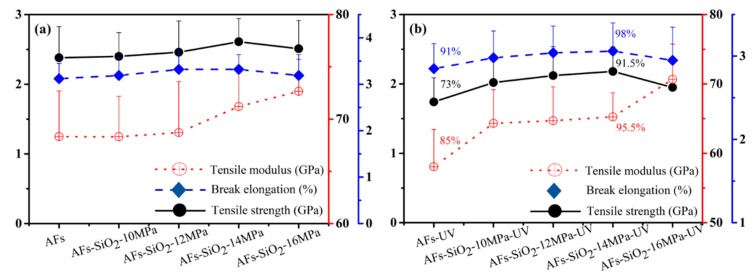
Aramid fibers (AFs) with their high Young's modulus and tenacity are easy to degrade seriously with ultraviolet (UV) radiation that leads to reduction in their performance, causing premature failure and limiting their outdoor end use. Herein, we report a method to synthesize nano-SiO2 on AFs surfaces in supercritical carbon dioxide (Sc-CO2) to simultaneously improve their UV resistance, thermal stability, and interfacial shear strength (IFSS). The effects of different pressures (10, 12, 14, 16 MPa) on the growth of nanoparticles were investigated. The untreated and modified fibers were characterized by Fourier transform infrared spectroscopy (FT-IR), X-ray diffraction (XRD), X-ray photoelectron spectroscopy (XPS) and scanning electron microscopy (SEM). It was found that the nano-SiO2-decorated fibers exhibited improvement of thermal stability and mechanical properties, and the IFSS of the nano-SiO2 modified fibers increases by up to 64% compared with the untreated fibers. After exposure to 216 h of UV radiation, the AFs-UV shows a less decrease in tensile strength, elongation to break and tensile modulus, retaining only 73%, 91%, and 85% of the pristine AFs, respectively, while those of AFs-SiO2-14MPa-UV retain 91.5%, 98%, and 95.5%. In short, this study presents a green method for growing nano-SiO2 on the surface of AFs by Sc-CO2 to enhance the thermal stability, IFSS, and UV resistance.
Keywords: UV resistance; aramid fiber; interfacial shear strength; nano-SiO2; supercritical CO2; thermal stability.
Conflict of interest statement
The authors declare no conflict of interest.
Figures




References
-
- Cao K., Siepermann C.P., Ming Y., Waas A.M., Arruda E.M. Reactive Aramid Nanostructures as High-Performance Polymeric Building Blocks for Advanced Composites. Adv. Funct. Mater. 2013;23:2072–2080. doi: 10.1002/adfm.201202466. - DOI
-
- Mukherjee M., Das C., Kharitonov A., Banik K., Mennig G., Chung T. Properties of syndiotactic polystyrene composites with surface modified short Kevlar fiber. Mater. Sci. Eng. A. 2006;441:206–214. doi: 10.1016/j.msea.2006.08.004. - DOI
-
- Wang F., Wu Y., Huang Y., Liu L. Strong, transparent and flexible aramid nanofiber/POSS hybrid organic/inorganic nanocomposite membranes. Compos. Sci. Technol. 2018;156:269–275. doi: 10.1016/j.compscitech.2018.01.016. - DOI
-
- Taraghi I., Fereidoon A., Taheri-Behrooz F. Low-velocity impact response of woven Kevlar/epoxy laminated composites reinforced with multi-walled carbon nanotubes at ambient and low temperatures. Mater. Des. 2014;53:152–158. doi: 10.1016/j.matdes.2013.06.051. - DOI
-
- Lee J.U., Park B., Kim B.S., Bae D.R., Lee W. Electrophoretic deposition of aramid nanofibers on carbon fibers for highly enhanced interfacial adhesion at low content. Compos. Part A Appl. Sci. Manuf. 2016;84:482–489. doi: 10.1016/j.compositesa.2016.02.029. - DOI
Grants and funding
LinkOut - more resources
Full Text Sources
