


Staphylococcus aureus Infections in Malaysia: A Review of Antimicrobial Resistance and Characteristics of the Clinical Isolates, 1990-2017
- PMID: 31454985
- PMCID: PMC6784215
- DOI: 10.3390/antibiotics8030128
Staphylococcus aureus Infections in Malaysia: A Review of Antimicrobial Resistance and Characteristics of the Clinical Isolates, 1990-2017
Abstract
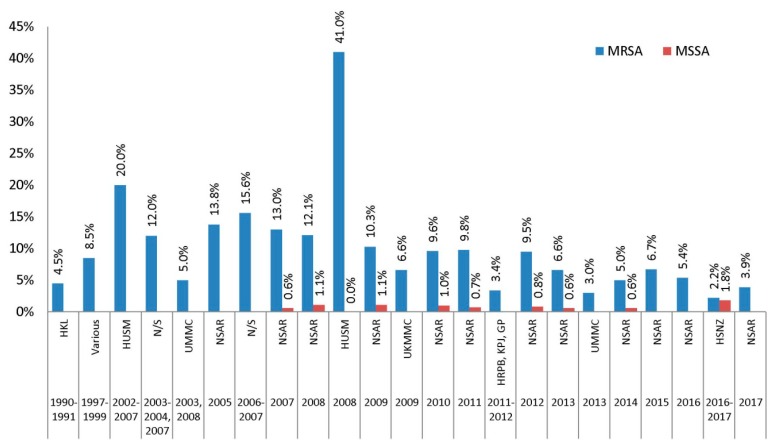
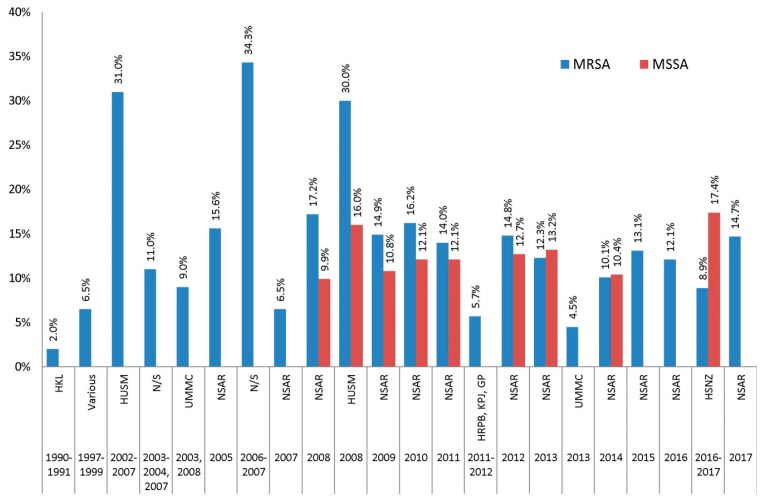
Staphylococcus aureus is an important nosocomial pathogen and its multidrug resistant strains, particularly methicillin-resistant S. aureus (MRSA), poses a serious threat to public health due to its limited therapeutic options. The increasing MRSA resistance towards vancomycin, which is the current drug of last resort, gives a great challenge to the treatment and management of MRSA infections. While vancomycin resistance among Malaysian MRSA isolates has yet to be documented, a case of vancomycin resistant S. aureus has been reported in our neighboring country, Indonesia. In this review, we present the antimicrobial resistance profiles of S. aureus clinical isolates in Malaysia with data obtained from the Malaysian National Surveillance on Antimicrobial Resistance (NSAR) reports as well as various peer-reviewed published records spanning a period of nearly three decades (1990-2017). We also review the clonal types and characteristics of Malaysian S. aureus isolates, where hospital-associated (HA) MRSA isolates tend to carry staphylococcal cassette chromosome mec (SCCmec) type III and were of sequence type (ST)239, whereas community-associated (CA) isolates are mostly SCCmec type IV/V and ST30. More comprehensive surveillance data that include molecular epidemiological data would enable further in-depth understanding of Malaysian S. aureus isolates.
Keywords: Antimicrobial resistance; Malaysian clinical isolates; Staphylococcus aureus; community-associated (CA); hospital-associated (HA); macrolide-lincosamide-streptogramin B (MLSB); methicillin-resistance S. aureus (MRSA); methicillin-susceptible S. aureus (MSSA); sequence types (STs); staphylococcal cassette chromosome mec (SCCmec) type.
Conflict of interest statement
The authors declare no conflict of interest. The founding sponsors had no role in the design of the study; in the collection, analyses, or interpretation of data; in the writing of the manuscript, and in the decision to publish the results.
Figures

References
-
- World Health Organization [(accessed on 20 June 2019)];Antimicrobial Resistance: Global Report on Surveillance. 2014 Available online: https://apps.who.int/iris/bitstream/handle/10665/112642/9789241564748_en....
-
- Ministry of Health Malaysia [(accessed on 20 June 2019)];National Surveillance of Antimicrobial Resistance. 2016 Available online: https://www.imr.gov.my/images/uploads/NSAR/NSAR_2016/NSAR_report_2016.pdf.
-
- Ministry of Health Malaysia [(accessed on 20 June 2019)];National Surveillance of Antimicrobial Resistance. 2017 Available online: https://www.imr.gov.my/images/uploads/NSAR/NSAR_2017/NSAR_report_2017-ed....
Publication types
Grants and funding
LinkOut - more resources
Full Text Sources
