Review
. 2019 Aug 26;8(9):1312.
doi: 10.3390/jcm8091312.

Pulmonary Fibrosis in Children

Affiliations
Review

Pulmonary Fibrosis in Children

Nadia Nathan et al. J Clin Med. .

Abstract

: Pulmonary fibrosis (PF) is a very rare condition in children, which may be observed in specific forms of interstitial lung disease. None of the clinical, radiological, or histological descriptions used for PF diagnosis in adult patients, especially in situations of idiopathic PF, can apply to pediatric situations. This observation supports the view that PF expression may differ with age and, most likely, may cover distinct entities. The present review aims at summarizing the current understanding of PF pathophysiology in children and identifying suitable diagnostic criteria.

Keywords: children; interstitial lung disease; nonspecific interstitial pneumonia; pulmonary fibrosis; usual interstitial pneumonia.


Conflict of interest statement

The authors declare no conflict of interest.

Figures
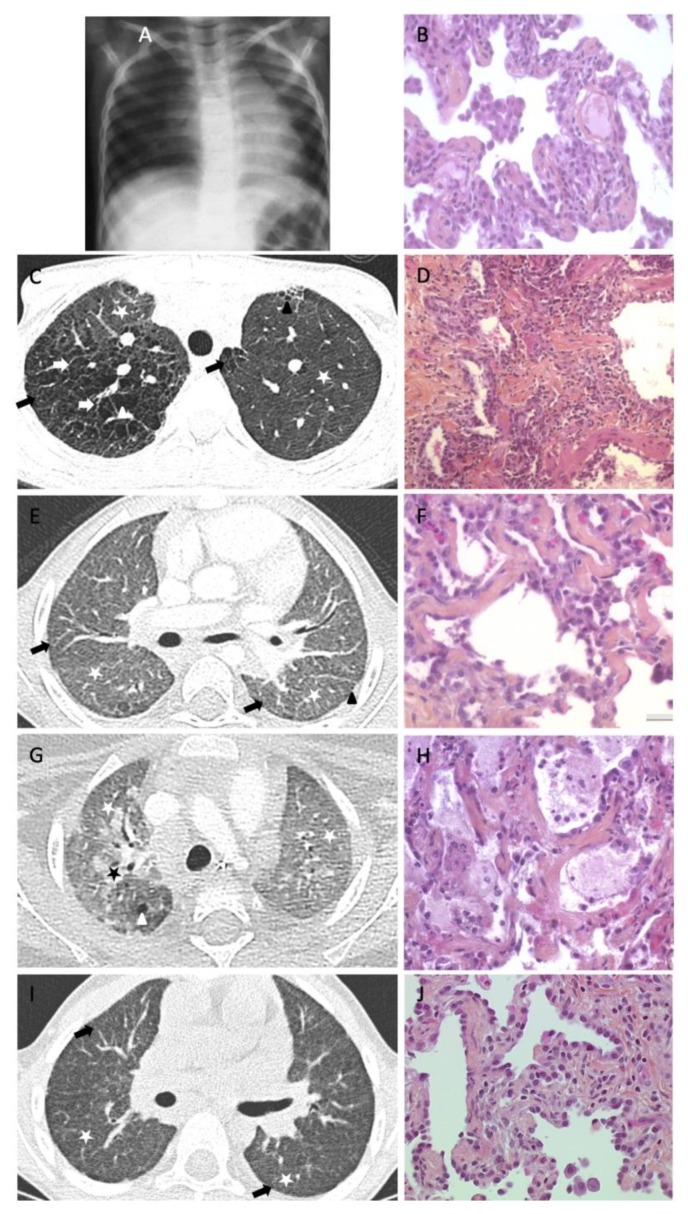
Figure 1
Figure 1
Pulmonary fibrosis examples in children. Panels A and B: Patient 1. (A) Chest X-ray: diffuse repartition of ground-glass opacities (GGOs). (B) Lung biopsy at age 6: no or mild parenchymal distortion, diffuse thickening of the alveolar walls, hyperplasic alveolar epithelial cells (AECs), inflammatory cell recruitment, mild fibroblasts activation, and mild collagen deposition. Panels C and D: Patient 2. (C) Transverse HRCT scan obtained at the level of the upper lobes: diffuse repartition of mild GGOs (white stars), reticulations (with interlobular septal thickening (white arrows) and intralobular lines (black arrows)), and numerous cystic lesions (white arrowheads) with focal left subpleural honeycombing (black arrowhead). Reticulations and cystic lesions are wider on the right. (D) Lung biopsy: parenchymal distortion, inflammatory cell recruitment, lymphoid nodules, and mild collagen and severe elastic fiber deposition. Panels E and F: Patient 3. (E) Transverse HRCT scan obtained under the level of the carina: diffuse repartition of GGOs (white stars), moderate reticulations (with intralobular lines (black arrows)), and few subpleural cystic lesions (black arrowhead). (F) Lung autopsy: no parenchymal distortion, diffuse thickening of the alveolar walls, hyperplasic AECs, mild inflammatory cell recruitment, and elastic fiber deposition. Panels G and H: Patient 4. (G) Transverse HRCT scan obtained at the level of the upper lobes: diffuse repartition of severe GGOs (white stars), consolidations (black star), and few cystic lesions (white arrowhead). (H) Postmortem biopsy: no parenchymal distortion, diffuse thickening of the alveolar walls, hyperplasic AECs, mild inflammatory cell recruitment, elastic fiber deposition, and moderate alveolar proteinosis: intra-alveolar deposit with giant cells and liproproteic material. Panels I and J: Patient 5. (I) HRCT scan obtained at the level of the lung bases: diffuse and homogeneous repartition of GGOs (white stars) with reticulations (with intralobular lines (black arrows)). (J) Lung biopsy: no parenchymal distortion, diffuse thickening of the alveolar walls, hyperplasic AECs, and moderate inflammatory cell recruitment.
Figure 2
Figure 2
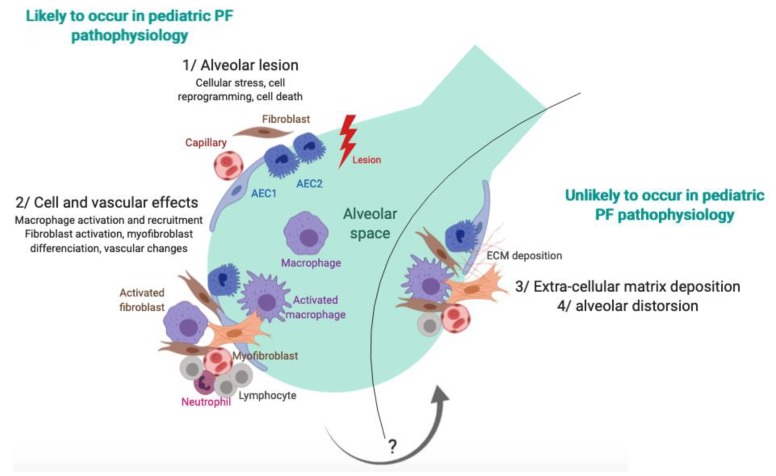
Potential pathophysiology pathway of pulmonary fibrosis in children. Repeated alveolar lesions’ effects on AECs and alveolar macrophages are likely to be observed in children and adult pulmonary fibrosis, leading to a cellular NSIP pattern. The chance of an evolution toward an adult PF pattern with more fibroblastic activation and extracellular matrix deposition remains unknown.

References

    1. Deutsch G.H., Young L.R., Deterding R.R., Fan L.L., Dell S.D., Bean J.A., Brody A.S., Nogee L.M., Trapnell B.C., Langston C., et al. Diffuse lung disease in young children: Application of a novel classification scheme. Am. J. Respir. Crit. Care Med. 2007;176:1120–1128. doi: 10.1164/rccm.200703-393OC. - DOI - PMC - PubMed
    1. Clement A., Nathan N., Epaud R., Fauroux B., Corvol H. Interstitial lung diseases in children. Orphanet J. Rare Dis. 2010;5:22. doi: 10.1186/1750-1172-5-22. - DOI - PMC - PubMed
    1. Kurland G., Deterding R.R., Hagood J.S., Young L.R., Brody A.S., Castile R.G., Dell S., Fan L.L., Hamvas A., Hilman B.C., et al. An official American Thoracic Society clinical practice guideline: Classification, evaluation, and management of childhood interstitial lung disease in infancy. Am. J. Respir. Crit. Care Med. 2013;188:376–394. doi: 10.1164/rccm.201305-0923ST. - DOI - PMC - PubMed
    1. Rice A., Tran-Dang M.-A., Bush A., Nicholson A.G. Diffuse lung disease in infancy and childhood: Expanding the chILD classification. Histopathology. 2013;63:743–755. doi: 10.1111/his.12185. - DOI - PubMed
    1. Griese M., Irnstetter A., Hengst M., Burmester H., Nagel F., Ripper J., Feilcke M., Pawlita I., Gothe F., Kappler M., et al. Categorizing diffuse parenchymal lung disease in children. Orphanet J. Rare Dis. 2015;10:122. doi: 10.1186/s13023-015-0339-1. - DOI - PMC - PubMed

LinkOut - more resources