Review
. 2019 Aug 26;16(17):3101.
doi: 10.3390/ijerph16173101.

Effects of Intermittent Hypoxia on Pulmonary Vascular and Systemic Diseases

Affiliations
Review

Effects of Intermittent Hypoxia on Pulmonary Vascular and Systemic Diseases

Hiroshi Kimura et al. Int J Environ Res Public Health. .

Abstract

Obstructive sleep apnea (OSA) causes many systemic disorders via mechanisms related to sympathetic nerve activation, systemic inflammation, and oxidative stress. OSA typically shows repeated sleep apnea followed by hyperventilation, which results in intermittent hypoxia (IH). IH is associated with an increase in sympathetic activity, which is a well-known pathophysiological mechanism in hypertension and insulin resistance. In this review, we show the basic and clinical significance of IH from the viewpoint of not only systemic regulatory mechanisms focusing on pulmonary circulation, but also cellular mechanisms causing lifestyle-related diseases. First, we demonstrate how IH influences pulmonary circulation to cause pulmonary hypertension during sleep in association with sleep state-specific change in OSA. We also clarify how nocturnal IH activates circulating monocytes to accelerate the infiltration ability to vascular wall in OSA. Finally, the effects of IH on insulin secretion and insulin resistance are elucidated by using an in vitro chamber system that can mimic and manipulate IH. The obtained data implies that glucose-induced insulin secretion (GIS) in pancreatic β cells is significantly attenuated by IH, and that IH increases selenoprotein P, which is one of the hepatokines, as well as TNF-α, CCL-2, and resistin, members of adipokines, to induce insulin resistance via direct cellular mechanisms. Clinical and experimental findings concerning IH give us productive new knowledge of how lifestyle-related diseases and pulmonary hypertension develop during sleep.

Keywords: REM sleep; insulin resistance; insulin secretion; intermittent hypoxia; lifestyle-related diseases; pulmonary hypertension; sleep apnea; sympathetic nerve.


Conflict of interest statement

H.K. works in a department supported by Actelion Pharmaceuticals Japan. This research received no external funding.

Figures
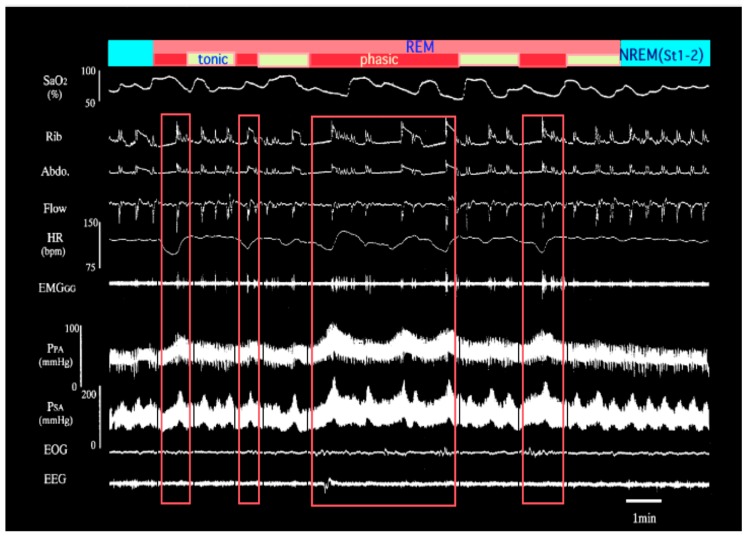
Figure 1
Figure 1
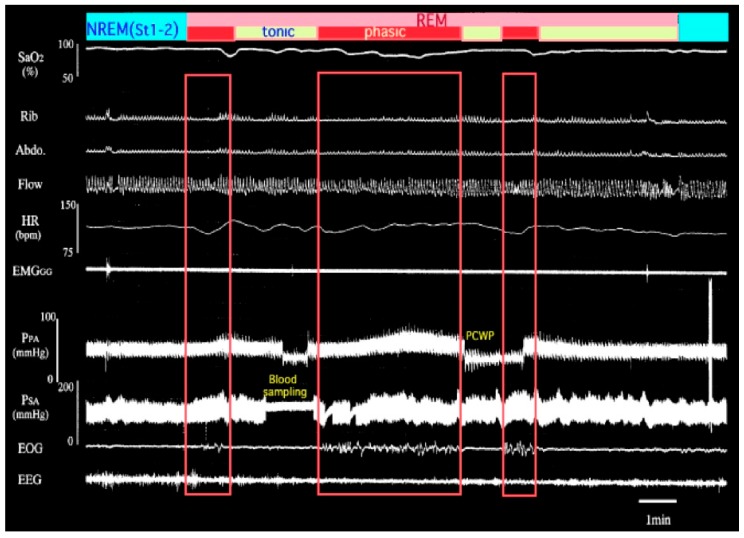
Representative polysomnographic recording during transition from non-REM (NREM) to REM to NREM sleep in an obstructive sleep apnea (OSA) patient with daytime pulmonary hypertension (PH) (adapted from [14]). Increase in pulmonary artery pressure is more exaggerated during REM sleep than NREM sleep. Moreover, the rapid rise of pulmonary arterial pressure (PAP) associated with the appearance of phasic REM and its recovery to the initial level immediately after the disappearance of REM are evident. The record of the area surrounded by the red square lines represents REM sleep. SpO2; arterial oxygen saturation by pulse oximeter, Rib; rib cage movement, Abdo; abdominal movement, Flow; nasal airflow, HR; heart rate, EMGGG; genioglossal electromyogram, PPA; pulmonary artery pressure, PSA; systemic artery pressure, EOG; electrooculogram, EEG; electroencephalogram. Phasic; phasic REM, tonic; tonic REM.
Figure 2
Figure 2
Polysomnographic recording in the same patient who was treated with nasal continuous positive airway pressure (CPAP). Tremendous desaturation before CPAP treatment was restored. However, the increase in pulmonary artery pressure can be observed in association with the appearance of phasic REM, suggesting the participation of neural control. REM-specific elevation in PAP occurred independently of the degree of hypoxia. PCWP; pulmonary capillary wedge pressure. SpO2; arterial oxygen saturation by pulse oximeter, Rib; rib cage movement, Abdo; abdominal movement, Flow; nasal airflow, HR; heart rate, EMGGG; genioglossal electromyogram, PSA; systemic artery pressure, EOG; electrooculogram, EEG; electroencephalogram. Phasic; phasic REM, tonic; tonic REM.
Figure 3
Figure 3
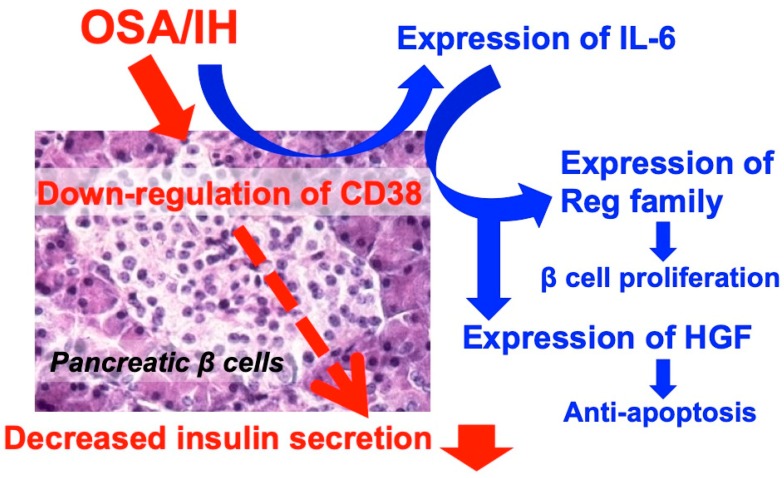
Possible effects of intermittent hypoxia (IH) on glucose-induced insulin secretion and β cell proliferation. IH causes the downregulation of CD38 to decrease glucose-induced insulin secretion, as well as the upregulation of IL-6. IL-6 increases the expression of Reg family genes and HGF gene Reg family members function as growth factors for pancreatic β cells and HGF works as an antiapoptotic factor. As a result, pancreatic β cells with decreased glucose-induced insulin secretion are increased.
Figure 4
Figure 4
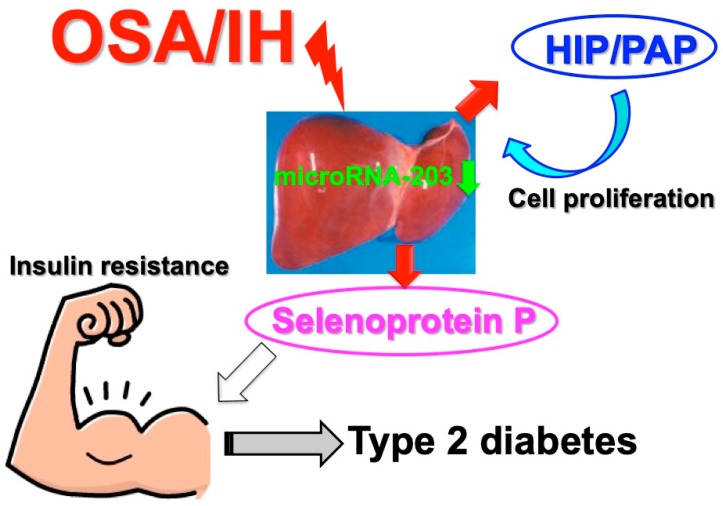
A possible mechanism of IH-induced insulin resistance by selenoprotein P. IH stress downregulates microRNA-203 in hepatocytes. The mRNAs for selenoprotein P and HIP/PAP target microRNA-203. As a result, IH exposure upregulates hepatokine(s) such as selenoprotein P to increase insulin resistance, as well as HIP/PAP to increase hepatocyte proliferation [50].
Figure 5
Figure 5
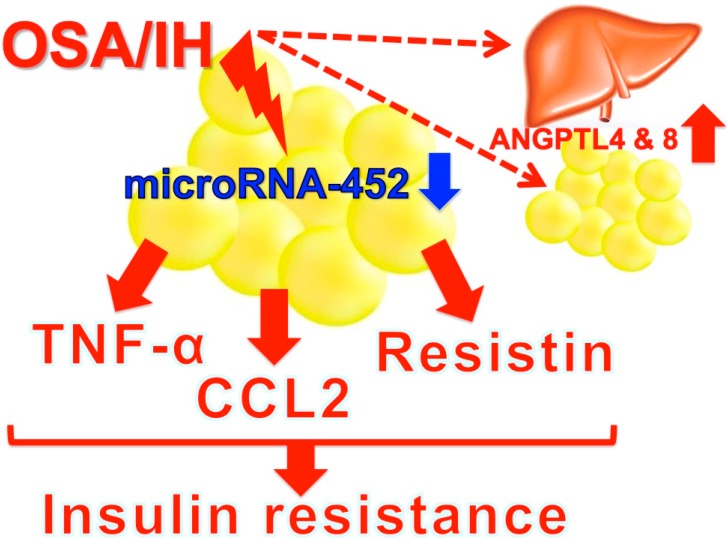
A possible mechanism of IH-induced insulin resistance. IH stress upregulates serum levels of ANGPTL4 and 8 [54] as well as the expression of adipokine(s) such as TNF-α, CCL2, and resistin via the downregulation of microRNA-452 to increase insulin resistance [55]. Secreted ANGPTL4, ANGPTL8, TNF-α, CCL2, and resistin all work together to lead to insulin resistance and/or type 2 diabetes in OSA patients.

References

    1. Senaratna C.V., Perret J.L., Lodge C.J., Lowe A.J., Campbell B.E., Matheson M.C., Hamilton G.S., Dharmage S.C. Prevalence of obstructive sleep apnea in the general population: A systematic review. Sleep Med. Rev. 2017;34:70–81. doi: 10.1016/j.smrv.2016.07.002. - DOI - PubMed
    1. Yamauchi M., Nakano H., Maekawa J., Okamoto Y., Ohnishi Y., Suzuki T., Kimura H. Oxidative stress in obstructive sleep apnea. Chest. 2005;127:1674–1679. doi: 10.1378/chest.127.5.1674. - DOI - PubMed
    1. Yamauchi M., Tamaki S., Tomoda K., Yoshikawa M., Fukuoka A., Makinodan K., Koyama N., Suzuki T., Kimura H. Evidence for activation of nuclear factor kappaB in obstructive sleep apnea. Sleep Breath. 2006;10:189–193. doi: 10.1007/s11325-006-0074-x. - DOI - PubMed
    1. Kimura H., Niijima M., Edo H., Honda Y., Kuriyama T. Differences in the response of genioglossal muscle activity to sustained hypoxia between healthy subjects and patients with obstructive sleep apnea. Respiration. 1994;61:155–160. doi: 10.1159/000196328. - DOI - PubMed
    1. Kunitomo F., Kimura H., Tatsumi K., Okita S., Tojima H., Kuriyama T., Honda Y. Abnormal breathing during sleep and chemical control of breathing during wakefulness in patients with sleep apnea syndrome. Am. Rev. Respir. Dis. 1989;139:164–169. doi: 10.1164/ajrccm/139.1.164. - DOI - PubMed