


Patient preferences of chemotherapy treatment options and tolerance of chemotherapy side effects in advanced stage lung cancer
- PMID: 31455252
- PMCID: PMC6712837
- DOI: 10.1186/s12885-019-6054-x
Patient preferences of chemotherapy treatment options and tolerance of chemotherapy side effects in advanced stage lung cancer
Abstract
Background: In the U.S., lung cancer accounts for 14% of cancer diagnoses and 28% of cancer deaths annually. Since no cure exists for advanced lung cancer, the main treatment goal is to prolong survival. Chemotherapy regimens produce side effects with different profiles. Coupling this with individual patient's preferred side effects could result in patient-centered choices leading to better treatment outcomes. There are apparently no previous studies of or tools for assessing and utilizing patient chemotherapy preferences in clinical settings. The long-term goal of the study was to facilitate patients' treatment choices for advanced-stage lung cancer. A primary aim was to determine how preferences for chemotherapy side effects relate to chemotherapy choices.
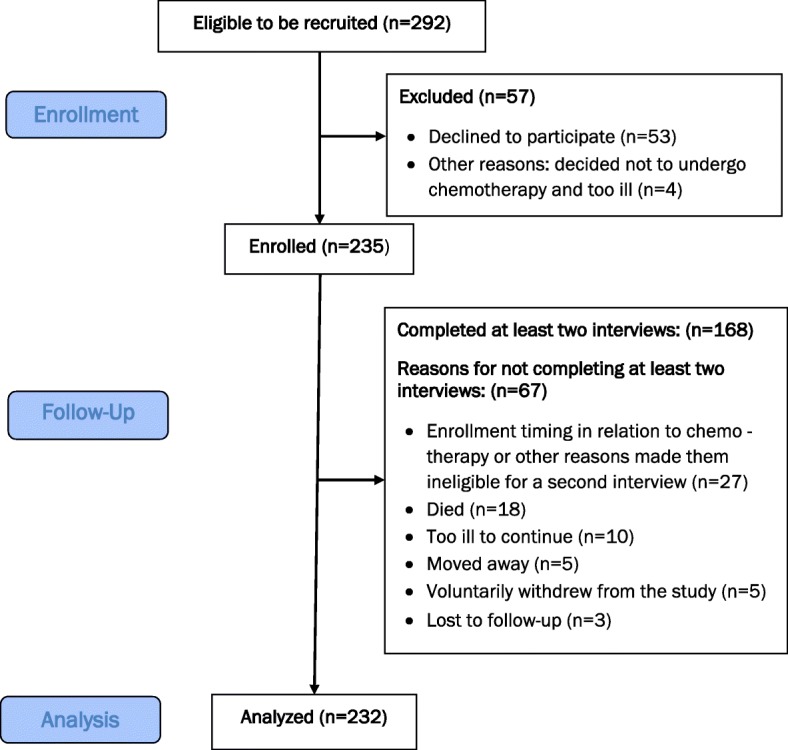
Methods: An observational, longitudinal, open cohort study of patients with advanced-stage non-small cell lung cancer (NSCLC) was conducted. Data sources included patient medical records and from one to three interviews per subject. Data were analyzed using Chi-square, Fisher's Exact and McNamara's test, and logistic regression.
Results: Patients identified the top three chemotherapy side effects that they would most like to avoid: shortness of breath, bleeding, and fatigue. These side effects were similar between first and last interviews, although the rank order changed after patients experienced chemotherapy.
Conclusions: Patients ranked drug side effects that they would most like to avoid. Patient-centered clinical care and patient-centered outcomes research are feasible and may be enhanced by stakeholder commitment. The study results are limited to patients with advanced NSCLC. Most of the subjects were White, since patients were drawn from the U.S. Midwest, a predominantly White population.
Conflict of interest statement
The authors declare that they have no competing interests.
References
-
- Howlader N, Noone AM, Krapcho M, Miller D, Bishop K, Altekruse SF, Kosary CL, Yu M, Ruhl J, Tatalovich Z, Mariotto A, Lewis DR, Chen HS, Feuer EJ, Cronin KA (eds). SEER cancer statistics review, 1975–2013, National Cancer Institute. Bethesda, https://seer.cancer.gov/csr/1975_2013/, based on November 2015 SEER data submission, posted to the SEER web site, April 2016.
-
- American Cancer Society . Cancer facts & figures 2016. Atlanta: American Cancer Society; 2016.
-
- American Cancer Society. Treatment choices for non-small cell lung cancer, by stage, 2017. Atlanta: American Cancer Society. https://www.cancer.org/cancer/non-small-cell-lung-cancer/treating/by-sta.... Accessed 7 Nov 2017
MeSH terms
LinkOut - more resources
Full Text Sources
Medical
